
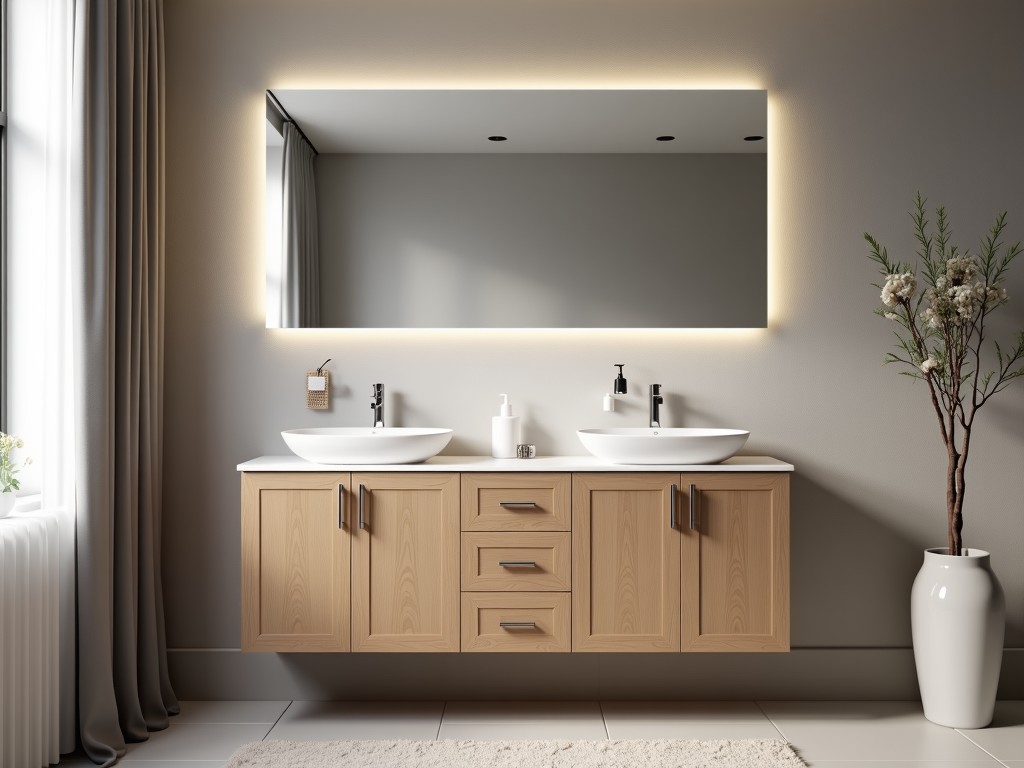
Bathroom Vanity Cabinet With Sink
Inquire Now
Bathroom Vanity Cabinet with Sink
This section outlines the core design intent behind a bathroom vanity cabinet that integrates a sink basin, focusing on structural durability, water resistance, and ease of maintenance for commercial and institutional restrooms.
Materials and Construction
The cabinet carcass is fabricated from 18‑mm thick marine‑grade plywood with a phenolic resin overlay, providing a minimum bending strength of 45 MPa and resistance to delamination under cyclic humidity exposure.
All exposed edges receive a 2‑mm PVC edge band sealed with hot‑melt adhesive, achieving a water ingress rating of IPX4 when tested per IEC 60529.
- Interior shelves: 12‑mm moisture‑resistant MDF with melamine finish, load capacity 30 kg per shelf.
- Drawer boxes: 0.8‑mm cold‑rolled steel with powder‑coat coating, full‑extension ball‑bearing slides rated for 45 kg dynamic load.
- Sink basin: vitreous china, 5‑mm thickness, compliant with ASME A112.19.2/CSA B45.1 standards.
Dimensional Specifications
| Parameter | Typical Value | Tolerance |
|---|---|---|
| Overall Width | 600 mm | ±2 mm |
| Overall Depth | 460 mm | ±2 mm |
| Overall Height (incl. sink) | 850 mm | ±3 mm |
| Sink Basin Interior Width | 540 mm | ±2 mm |
| Sink Basin Depth | 190 mm | ±2 mm |
Installation and Integration
The vanity is designed for wall‑mounted installation using four M8 stainless‑steel anchor bolts, each with a shear capacity of 5 kN, allowing a maximum load of 150 kg when properly secured to concrete or masonry substrates.
Plumbing connections feature a ½‑inch NPT male thread for hot and cold supplies, and a 1.5‑inch PVC waste outlet with a built‑in trap, facilitating quick‑connect couplings that reduce on‑site labor time by approximately 20 % compared with traditional soldered joints.
Performance Characteristics
Water resistance testing shows less than 0.5 % weight gain after 24 hours immersion at 23 °C, confirming the effectiveness of the phenolic overlay and edge sealing.
Load‑deflection measurements on the countertop surface indicate a maximum deflection of 0.8 mm under a uniformly distributed load of 200 kg, well within the serviceability limit of L/200 for bathroom fixtures.
Applications
In healthcare facilities, the seamless joint between sink and cabinet minimizes crevices where pathogens can accumulate, supporting infection‑control protocols that require cleanable surfaces with ≤0.2 µm roughness.
Educational institutions benefit from the vandal‑resistant steel drawer slides and impact‑rated sink, which withstand repeated loading cycles exceeding 50,000 operations without loss of functionality.
Customization Options
- Alternative widths: 500 mm, 700 mm, 800 mm (customizable in 50 mm increments).
- Sink material choices: vitreous china, stainless steel grade 304, or solid surface acrylic.
- Finish options: high‑pressure laminate (HPL) in 12 standard colors, or veneer with UV‑cured coating.
- Hardware upgrades: soft‑close dampers, touch‑less faucet provision, integrated LED lighting strips.
Quality Assurance
Each unit undergoes a three‑stage inspection: dimensional verification using a CMM with ±0.02 mm accuracy, water‑tightness test at 0.5 bar pressure for 5 minutes, and load‑cycle test of 10,000 open‑close operations on drawer slides.
Documentation includes material test certificates, ISO 9001:2015 quality management compliance, and a limited warranty covering structural defects for five years under normal use.
Frequently Asked Questions
Q: Can the vanity dimensions be adjusted to match specific rough‑in measurements?
A: Yes, width and depth can be modified in 10 mm increments; height adjustments require changes to the sink basin and support brackets.
Q: What information is needed to obtain a quotation?
A: Required data include desired overall dimensions, sink material, finish selection, hardware preferences, and quantity for pricing.
Q: How are units protected during export shipment?
A: Cabinets are packed in double‑wall corrugated cartons with corner protectors, wrapped in polyethylene film, and secured on pallets with straps; each pallet receives a shock‑indicator label.
Related Products
Related News

custom closet spatial organization and material performance analysis

Bathroom Taps Technical Analysis
