
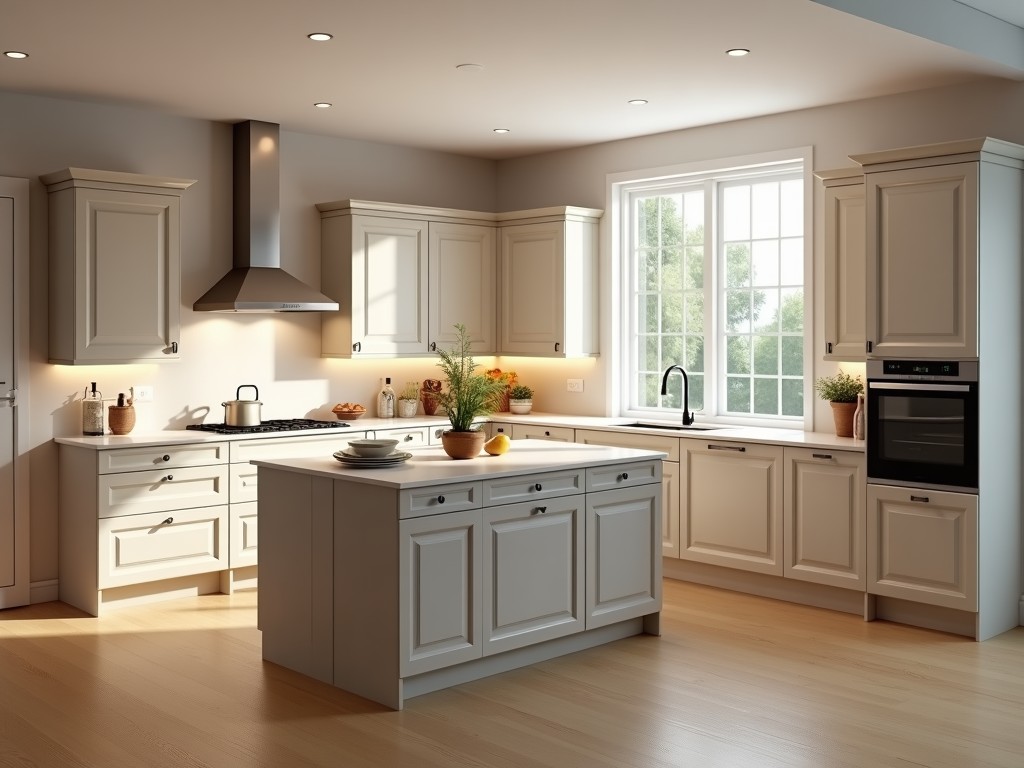
Buy Custom Kitchen And Bathroom Cabinets
Inquire Now
Custom Kitchen and Bathroom Cabinets
Industrial buyers often require cabinetry that meets strict dimensional tolerances, surface durability, and ease of maintenance for environments such as commercial kitchens, laboratories, healthcare facilities, and retail spaces. Custom fabrication allows precise adaptation to spatial constraints, equipment layouts, and regulatory standards while maintaining consistent performance across large installations.
Material Selection and Performance
Common substrate options include multilayer plywood (typically 15‑18 mm thick, density 500‑650 kg/m³), medium-density fiberboard (MDF, 16‑19 mm, density 700‑800 kg/m³), particleboard (18‑22 mm, density 600‑750 kg/m³), and solid hardwood strips (various species, density 600‑900 kg/m³). Each material offers distinct moisture resistance, mechanical strength, and emission characteristics.
Surface finishes such as melamine-impregnated paper, PVC foil, polyurethane lacquer, or powder‑coated metal provide varying levels of abrasion resistance (measured by Taber wear index), chemical exposure tolerance, and cleanability. For wet environments, substrates with a minimum swelling thickness of < 2 % after 24 h water immersion are preferred.
| Material | Typical Thickness (mm) | Density (kg/m³) | Moisture Resistance (Swelling % after 24h) | Typical Use |
|---|---|---|---|---|
| Multilayer Plywood | 15‑18 | 500‑650 | < 2 | Structural boxes, shelving |
| MDF | 16‑19 | 700‑800 | 2‑4 | Door panels, decorative elements |
| Particleboard | 18‑22 | 600‑750 | 3‑5 | Economy carcasses, back panels |
| Solid Hardwood | Variable | 600‑900 | < 1.5 | High‑impact doors, exposed frames |
Construction Methods
Two primary carcass architectures are employed: frameless (full‑access) and face‑frame. Frameless units rely on panel thickness and edge‑banding for rigidity, achieving typical shelf sag limits of < 1 mm under a 50 kg uniformly distributed load. Face‑frame designs add a 19‑mm hardwood stile and rail assembly, increasing resistance to racking by approximately 30 %.
Joinery options include cam‑lock fasteners (shear strength ≈ 1.2 kN), dowel‑reinforced butt joints (tensile capacity ≈ 0.8 kN), and dovetail drawer boxes (tensile > 2 kN). Edge protection is applied via 0.4‑mm PVC or ABS banding, adhered with hot‑melt EVA providing peel strength > 1.5 N/mm.
Hardware specifications are critical for cycle life. Soft‑close hinges are rated for 50,000 opening‑closing cycles at a torque of 0.25 Nm, while full‑extension drawer slides sustain dynamic loads of 40 kg per pair with a rated life of 75,000 cycles. Adjustable shelf pins accommodate 3‑mm increments, allowing load redistribution without tool‑free movement.
Customization Options
Dimensional flexibility is achieved through CNC panel cutting with positional accuracy of ±0.2 mm. Width, height, and depth can be specified in 1‑mm steps, enabling tight fitting around service conduits, appliances, or structural columns. Standard cabinet heights range from 300 mm to 2100 mm, with toe‑kick recesses adjustable from 50 mm to 150 mm.
Door styles include slab (flat panel), shaker (5‑piece recessed center), raised panel, and louvered configurations. Panel thicknesses typically range from 16 mm to 22 mm, with optional edge profiling radii of 2 mm to 6 mm. Surface finishes are selectable from a catalog of over 120 colors and textures, each accompanied by published abrasion and chemical resistance data.
Interior accessories are engineered for specific load cases: pull‑out shelves rated for 30 kg dynamic load, lazy‑susan turntables with 150 mm diameter and 20 kg capacity, and waste‑bin modules featuring soft‑close mechanisms and 12‑liter volume. All accessories are supplied with mounting brackets that accommodate 5‑mm adjustment for alignment.
Applications in Industrial Settings
In commercial kitchens, cabinets must resist frequent washing, steam exposure, and impact from heavy pots. Substrates with low swelling (< 2 %) and finishes certified to NSF/ANSI 2 for food‑zone contact are specified. Seamless edge banding eliminates crevices that could harbor bacteria, simplifying sanitation procedures.
Laboratory environments demand chemical resistance to solvents, acids, and bases. Polyurethane or powder‑coated surfaces provide immersion resistance ratings of > 24 h for common reagents, while stainless‑steel frames or aluminum extrusions offer non‑corrosive structural support. Antimicrobial additives can be incorporated into melamine layers upon request.
Healthcare facilities prioritize smooth, non‑porous surfaces that withstand disinfectants containing alcohol or bleach. Finishes with a minimum 200‑cycle abrasion resistance (Taber) and low VOC emissions (< 0.5 mg/m³) are selected. Rounded corners and radius‑reduced profiles minimize injury risk in high‑traffic corridors.
Retail and hospitality installations benefit from branding integration through custom foil wraps or digital prints on medium‑density overlay (MDO) panels. Durability is ensured by specifying impact resistance of > 5 J (Charpy) for door panels and a minimum 10‑year warranty on finish adhesion under standard indoor conditions.
Quality Control and Testing
Each production lot undergoes dimensional verification using coordinate‑measuring machines (CMM) with a tolerance of ±0.5 mm on overall cabinet squareness and diagonal difference. Surface adhesion is evaluated via cross‑hatch tape test (ASTM D3359) requiring a rating of 4B or better for lacquer and polyurethane finishes.
Load testing of shelves applies a static weight of 60 kg for 24 hours, measuring deflection with dial gauges; acceptable deformation is ≤ 1.5 mm. Cycle endurance for hinges and slides is performed on motorized test rigs, logging torque and wear; units must maintain functional movement without binding after the stipulated cycle count.
Material certificates of conformity are supplied for substrate formaldehyde emission class (E1 or E2) and for finish heavy‑metal content (RoHS compliance). All inspections are documented in a traceable batch record accessible to the customer upon request.
Lead Time and Packaging
Standard-size cabinets with predefined material and finish selections typically enter production within 3‑4 working days after receipt of approved drawings. Fully customized projects, including non‑standard dimensions, special hardware, or proprietary finishes, generally require 5‑6 weeks from design freeze to shipment readiness.
Packaging strategy employs flat‑pack configuration to minimize volume. Panels are separated by corrugated interleavers, corner protectors of 20 mm × 20 mm × 150 mm are applied, and the assembly is wrapped in 80‑µm stretch film. Palletized loads conform to ISPM 15 heat‑treated wood standards, facilitating international freight without additional fumigation.
Frequently Asked Questions
Can dimensions be customized to match existing infrastructure?
Yes. CNC cutting enables 1‑mm increment adjustments for width, height, and depth, allowing precise alignment with utility conduits, structural columns, or pre‑installed equipment.
What information is required before quotation?
A set of layout drawings (plan and elevation) indicating required openings, appliance cut‑outs, and finish preferences, along with material specifications if known, enables an accurate cost estimate.
What materials are available for wet environments?
Multilayer plywood with marine‑grade glue, HDPE‑laminated particleboard, or stainless‑steel frames with PVC‑coated panels are commonly specified for areas exposed to frequent water contact.
How is quality inspected before shipment?
Each unit undergoes dimensional CMM testing, surface adhesion assessment, and load‑deflection verification as outlined in the quality control section. Results are recorded in a batch report available to the buyer.
What packaging methods are available for export?
Standard export packaging includes flat‑pack on ISPM 15‑compliant pallets, corner protection, stretch‑film wrapping, and optional moisture‑barrier bags for high‑humidity destinations.
How are samples arranged?
Physical samples of selected door finishes, edge banding, and hardware can be shipped via courier upon request, with lead times of 3‑5 working days for standard options.
Request a Quote
To obtain a detailed quotation tailored to your project specifications, please provide the required documentation through the contact form.
Request QuoteRelated Products
Related News

custom closet spatial organization and material performance analysis

Bathroom Taps Technical Analysis
