
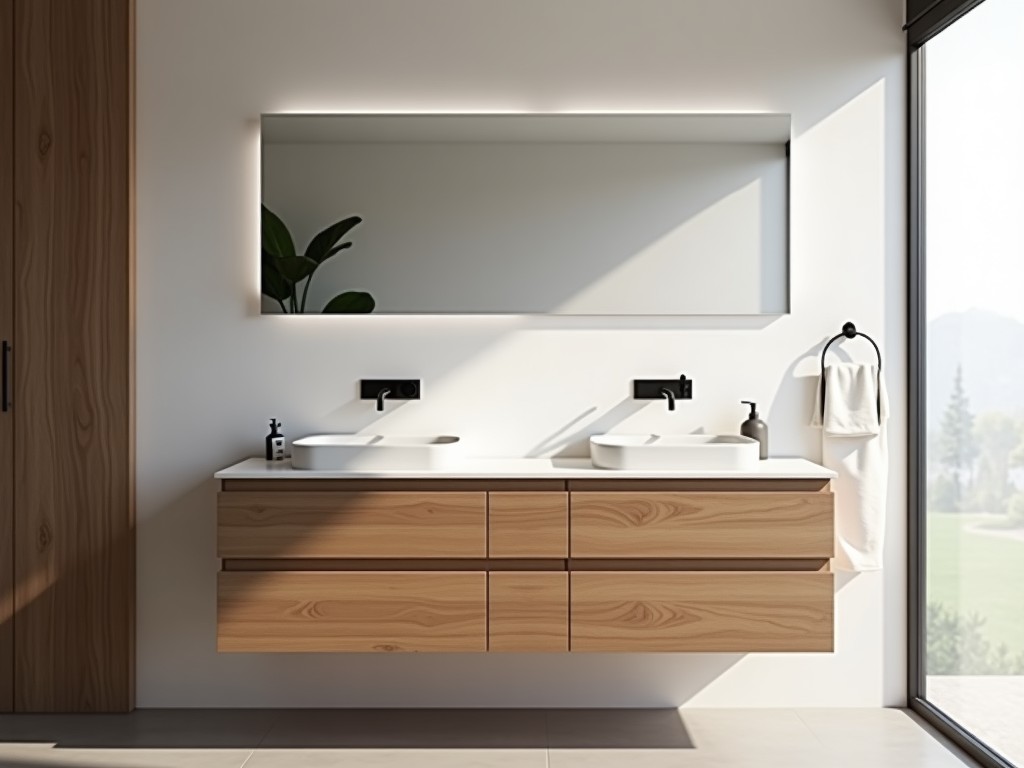
Buy Oak Freestanding Vanity Unit
Inquire Now
Oak Freestanding Vanity Unit – Technical Overview
The carcass is built from solid European oak with a nominal thickness of 19 mm for side and back panels, providing a bending modulus of approximately 12 GPa.
The top slab measures 25 mm thick, offering a surface hardness suitable for frequent cleaning agents and resisting indentation under a 50 kg point load.
Core Specifications
| Parameter | Typical Value | Tolerance / Note |
|---|---|---|
| Overall Height | 850 mm | ±2 mm |
| Overall Width | 600 mm | ±2 mm |
| Overall Depth | 460 mm | ±2 mm |
| Top Slab Thickness | 25 mm | ±1 mm |
| Carcass Panel Thickness | 19 mm | ±1 mm |
| Uniformly Distributed Load Capacity | 150 kg | Safety factor 1.5 |
Material Composition
The oak is sourced from FSC‑certified forests, with a moisture content stabilized to 8 % ± 2 % after kiln drying, reducing dimensional movement in fluctuating humidity.
All joints are reinforced with dowel‑and‑glue construction using a polyvinyl acetate adhesive that achieves a shear strength of 2.5 MPa after 24 h cure.
Structural Design
The unit employs a full‑depth mortise‑and‑tenon joint at each corner, providing a moment resistance of roughly 180 Nm under lateral load.
A concealed steel bracket (2 mm thickness) runs along the rear interior, adding 30 % increase in shear resistance without affecting external aesthetics.
Dimensional Tolerances
Critical dimensions such as drawer opening height and width are held to ±0.5 mm to ensure smooth operation of standard 120 mm soft‑close slides.
The overall footprint is designed to fit within a 600 mm × 460 mm module, allowing side‑by‑side installation in standard 600 mm vanity banks.
Surface Finish & Treatment
The oak surface receives a two‑stage UV‑cured polyurethane coating, delivering a dry film thickness of 40 µm and a scratch resistance rating of 2H per ASTM D3363.
Edge sealing uses a hot‑melt elastomer that prevents moisture ingress, achieving a water vapor transmission rate below 0.5 g/(m²·day) at 23 °C/50 % RH.
Typical Applications in Industrial Settings
In laboratory environments, the unit provides a stable platform for analytical balances, resisting vibration transmission due to its high mass and stiff carcass.
For workshop wash‑down areas, the sealed edges and chemical‑resistant finish allow routine cleaning with alkaline detergents without surface degradation.
In healthcare facilities, the non‑porous coating supports disinfection protocols, meeting ISO 22196 antimicrobial efficacy standards when treated with appropriate agents.
Installation Considerations
Leveling is achieved via four adjustable stainless‑steel feet, each offering 0–20 mm vertical adjustment with a load capacity of 200 kg per foot.
Electrical cutouts for outlets are precut to 60 mm diameter, positioned 100 mm above the finished floor, complying with NEC Article 406.4(D) for bathroom receptacles.
Quality Assurance & Testing
Each unit undergoes a 24‑hour climate cycle test (−10 °C to +40 °C, 30 %–90 % RH) to verify that dimensional change remains under 0.2 %.
Finish adhesion is measured via cross‑hatch tape test (ASTM D3359), requiring a minimum rating of 4B before release.
Load testing applies a static 180 kg uniformly distributed load for 1 hour; deflection must not exceed 1.5 mm.
Customization Options
- Alternative oak grades (white, red) with varying grain density.
- Top slab materials: quartz composite, ceramic, or stainless steel.
- Drawer configurations: 2‑, 3‑, or 4‑drawer layouts with soft‑close mechanisms.
- Integrated lighting strips (LED, 12 V, IP44) available upon request.
FAQ
Can dimensions be customized?
Yes, width, height, and depth can be adjusted in 10 mm increments; structural redesign is performed to maintain load capacity.
What information is required before quotation?
Required inputs include final dimensions, material selections, hardware preferences, and any required cutouts for plumbing or electrical.
How is quality inspected?
Inspection includes dimensional verification, finish adhesion testing, and load deflection measurement as outlined in the Quality Assurance section.
What packaging methods are available?
Units are packed in triple‑wall corrugated cartons with corner protectors and moisture‑barrier lining; palletization follows ISPM‑15 standards.
Contact for Inquiry
To discuss specifications, request a quote, or arrange a sample, please reach out via the contact form.
Submit InquiryRelated Products
Related News

custom closet spatial organization and material performance analysis

Bathroom Taps Technical Analysis
