
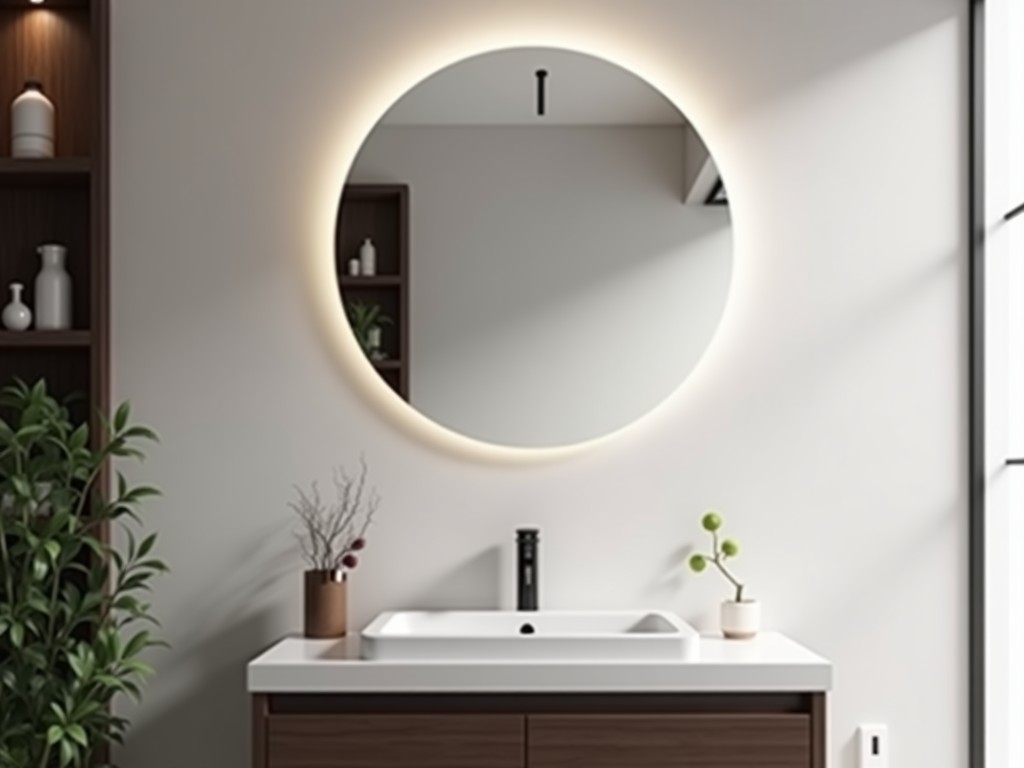
Custom Factory Circular Bathroom Mirror Cabinet
Inquire Now
Custom Factory Circular Bathroom Mirror Cabinet
Circular mirror cabinets are selected for bathroom environments where continuous sightlines and reduced protrusion are critical. The geometry eliminates sharp corners that can trap moisture and minimizes the risk of impact damage in tight spaces.
Design begins with a defined radius (R) and uniform wall thickness (t) to maintain structural integrity under typical loads. The cabinet depth is kept under 120 mm to comply with most national clearance codes while providing sufficient internal volume for toiletries.
Material Options
- Frame: 304 stainless steel (1.2 mm thickness) or 6063‑T5 aluminum alloy (1.5 mm) for corrosion‑resistant support.
- Mirror substrate: tempered low‑iron glass, 4 mm nominal thickness, surface flatness ≤0.1 mm over 300 mm.
- Reflective coating: copper‑free silver with a protective overcoat, delivering ≥92 % reflectance at 550 nm.
- Optional anti‑fog layer: hydrophilic nanocoating, contact angle <10 ° after curing.
Dimensional Customization
| Parameter | Standard Range | Customizable Range | Typical Tolerance |
|---|---|---|---|
| Diameter (mm) | 400 – 800 | 300 – 1200 | ±0.5 |
| Depth (mm) | 80 – 120 | 60 – 150 | ±0.3 |
| Mounting hole pattern | 4‑hole, 100 mm pitch | Customer‑specified | ±0.2 |
| Door swing angle | 90° | 70° – 110° | ±2° |
Manufacturing Process
Cabinet bodies are formed by CNC spinning of seamless tubing, ensuring uniform wall thickness and eliminating weld seams that could harbor bacteria. Mirror edges are subjected to diamond‑wheel polishing to achieve a radius of curvature ≤0.2 mm, reducing stress concentration.
Surface Treatment and Corrosion Resistance
After fabrication, frames receive a pretreat‑seal phosphate layer followed by electrostatic powder coating (epoxy‑polyester, 80 µm dry film thickness). Salt‑spray testing per ASTM B117 shows no red rust after 500 hours. The mirror coating is sealed with a SiO₂‑based topcoat to resist alkaline cleaning agents (pH up to 10).
Quality Assurance Checks
- Dimensional verification using CMM; all critical features within stated tolerances.
- Reflectivity measured with spectrophotometer; minimum 92 % across 400‑700 nm.
- Adhesion test (cross‑hatch, ASTM D3359) rating 5B for coating integrity.
- Functional cycle test: 20,000 door open‑close operations without hinge wear >0.05 mm.
Typical Applications
In wet areas, a circular profile reduces the surface area where water can bead and evaporate, lowering the chance of mineral deposits. The absence of corners also improves ergonomic flow in narrow vanities, allowing users to access the cabinet interior without striking protruding edges.
Comparison: Circular vs. Rectangular Mirror Cabinets
| Attribute | Circular | Rectangular |
|---|---|---|
| Installation clearance (mm) | Diameter + 20 | Width + 20, Height + 20 |
| Cleaning frequency (times/week) | 3 (due to reduced pooling) | 5 (corner buildup) |
| Risk of edge impact (qualitative) | Low (no sharp corners) | Moderate (four exposed corners) |
| Weight (kg) for 600 mm diameter/600×400 mm rect. | 7.8 | 8.2 |
Frequently Asked Questions
Yes. Diameter, depth, and mounting patterns are adjustable according to project requirements; tooling adjustments may affect lead time.
Target diameter, desired depth, frame material, finish color, and any special coating (anti‑fog, antimicrobial). A sketch or DXF helps expedite the estimate.
Reflectivity is measured spectrophotometrically on three points per piece; adhesion is verified via cross‑hatch tape test per ASTM D3359.
Each unit is wrapped in low‑density polyethylene foam, placed in a single‑wall corrugated carton with corner protectors, and sealed with poly‑strap. Palletized shipments include moisture‑barrier film and shock‑indicating labels.
Related Products
Related News

custom closet spatial organization and material performance analysis

Bathroom Taps Technical Analysis
