
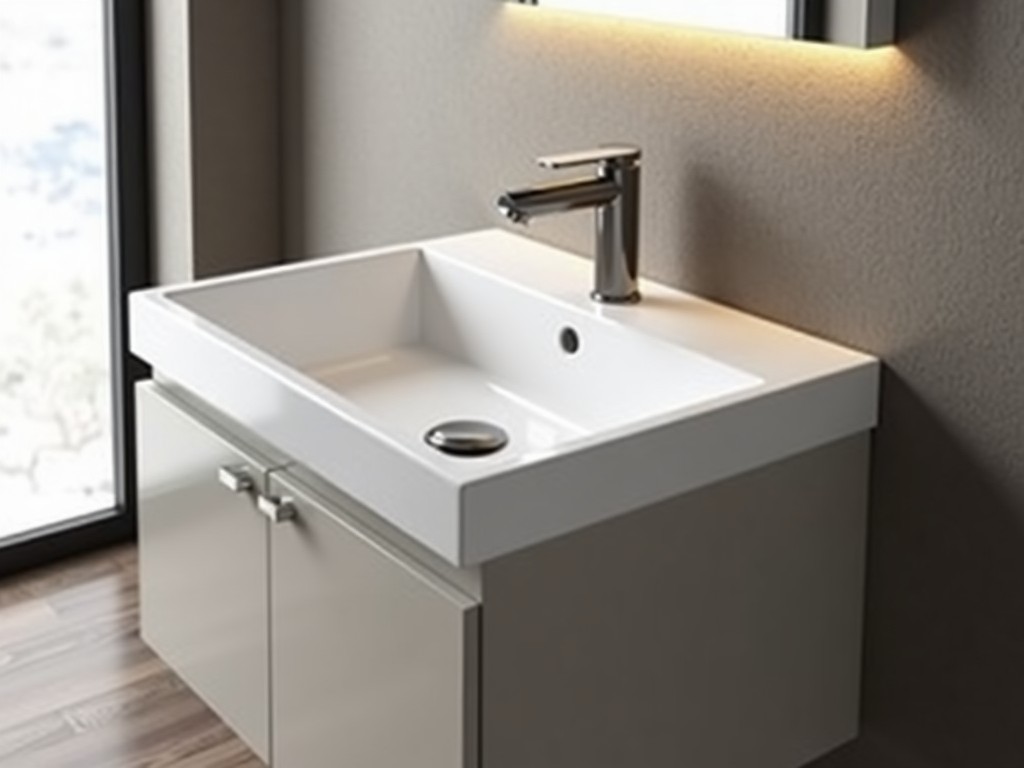
Deep Basin Bathroom Sink Unit Price
Inquire Now
Deep Basin Bathroom Sink Unit – Technical Overview
A deep basin bathroom sink unit combines a basin with nominal depth ranging from 180 mm to 250 mm measured from the overflow rim to the basin bottom, providing increased liquid capacity while keeping the front rim height within standard ergonomic limits (approximately 800 mm–850 mm above finished floor).
Design Dimensions and Capacity
Typical overall width varies between 500 mm and 650 mm to accommodate single‑ or double‑faucet configurations. The basin depth directly influences usable volume: a 200 mm deep basin holds roughly 12 L of water at normal operating level, whereas a 250 mm deep basin reaches 15 L.
Overflow provisions are sized to discharge at least 30 % of the basin’s volumetric flow rate per minute, preventing spillover during peak usage. The rear wall thickness is commonly 12 mm to 18 mm to resist cracking under thermal shock from hot water inflow.
Material Options and Performance Characteristics
- Vitreous china: water absorption < 0.5 %, compressive strength > 70 MPa, resistant to staining and chemical cleaners.
- Grade 304 stainless steel: thickness 1.2 mm–1.5 mm, yield strength ≈ 215 MPa, excellent impact resistance, suitable for high‑traffic public restrooms.
- Solid surface (acrylic‑based): density 1.6 g/cm³, flexural modulus ≈ 3.5 GPa, seamless joints, repairable surface scratches.
Each material exhibits a distinct coefficient of thermal expansion: vitreous china ≈ 5 × 10⁻⁶ /°C, stainless steel ≈ 16 × 10⁻⁶ /°C, solid surface ≈ 5 × 10⁻⁶ /°C, influencing the required expansion gaps during installation.
Installation and Plumbing Considerations
Mounting types include wall‑hung with concealed brackets, floor‑mounted pedestal, or countertop‑set units. Wall‑hung models typically require a load‑bearing stud capable of supporting a static load of at least 150 kg per anchor point.
Rough‑in dimensions for the waste outlet are standardized at 40 mm diameter with a centerline distance of 200 mm from the finished floor for wall‑hung units; floor‑mounted variants may adjust to 180 mm–220 mm depending on pedestal height.
Flexible supply connectors (½‑inch NPT) are recommended to accommodate minor misalignments, and a minimum clearance of 50 mm behind the basin is advised for maintenance access.
Load Capacity and Durability Metrics
Static load testing (ASTM F1292) shows that vitreous china basins sustain a uniformly distributed load of 250 kg without visible deformation; stainless steel units exhibit elastic deflection < 0.5 mm under the same load.
Impact resistance is evaluated via a 2 kg steel ball drop from 1 m height; vitreous china shows no cracking at impact energies up to 2 J, while solid surface absorbs impact with negligible surface damage.
Chemical resistance is quantified by immersion in 5 % sodium hypochlorite for 24 h; weight change remains below 0.1 % for all three material classes, confirming suitability for frequent disinfection cycles.
Factors Influencing Unit Price
Material selection constitutes the primary cost driver: vitreous china typically ranges from $45–$70 per unit, stainless steel from $80–$120, and solid surface from $100–$150, based on raw material market indices and forming complexity.
Basin depth and width affect material usage; each additional 10 mm of depth increases raw material volume by roughly 8 %, translating to a proportional price increase of $3–$6 per unit depending on material.
Finish options such as anti‑microbial glaze, brushed stainless texture, or matte solid surface coating add $5–$15 per unit due to secondary processing steps.
Volume discounts apply: orders of 100 units or more generally receive a 5 %–10 % reduction, while lot sizes below 20 units incur a surcharge of approximately 3 % for setup and handling.
| Parameter | Typical Value / Range | Impact on Price |
|---|---|---|
| Material | Vitreous china / SS 304 / Solid surface | Base cost driver (± $30–$100) |
| Basin Depth | 180 mm – 250 mm | +$3–$6 per 10 mm increment |
| Finish | Standard glaze / Brushed / Matte coating | +$5–$15 |
| Order Quantity | <20 units / 20‑99 units / ≥100 units | Surcharge 0 % / –2 % / –5 % to –10 % |
Typical Applications in Commercial Environments
Deep basin sink units are specified in healthcare facilities where higher fluid volume is required for patient washing and instrument rinsing, reducing the frequency of refill cycles.
In high‑traffic public restrooms such as airports and convention centers, the increased depth accommodates simultaneous use by multiple users, minimizing queue times during peak periods.
Educational laboratories benefit from the enhanced capacity for chemical spill containment, allowing safer temporary storage before transfer to waste receptacles.
Frequently Asked Questions
Can dimensions be customized?
Yes, basin depth, width, and overflow height can be adjusted per project requirements; custom tooling may affect lead time and unit cost.
What information is required before quotation?
Required details include material preference, target dimensions, finish type, quantity, and any special certifications (e.g., ADA compliance, NSF).
How is quality inspected?
Each unit undergoes dimensional verification (± 1 mm tolerance), surface defect inspection under 500 lux illumination, and hydrostatic leak testing at 1.5× working pressure.
What packaging methods are available?
Standard packaging consists of double‑wall corrugated cartons with interior foam corners; optional palletizing and crate options are available for overseas shipments.
For a detailed quotation tailored to your project specifications, please contact our technical sales team.
Request QuotationRelated Products
Related News

custom closet spatial organization and material performance analysis

Bathroom Taps Technical Analysis
