
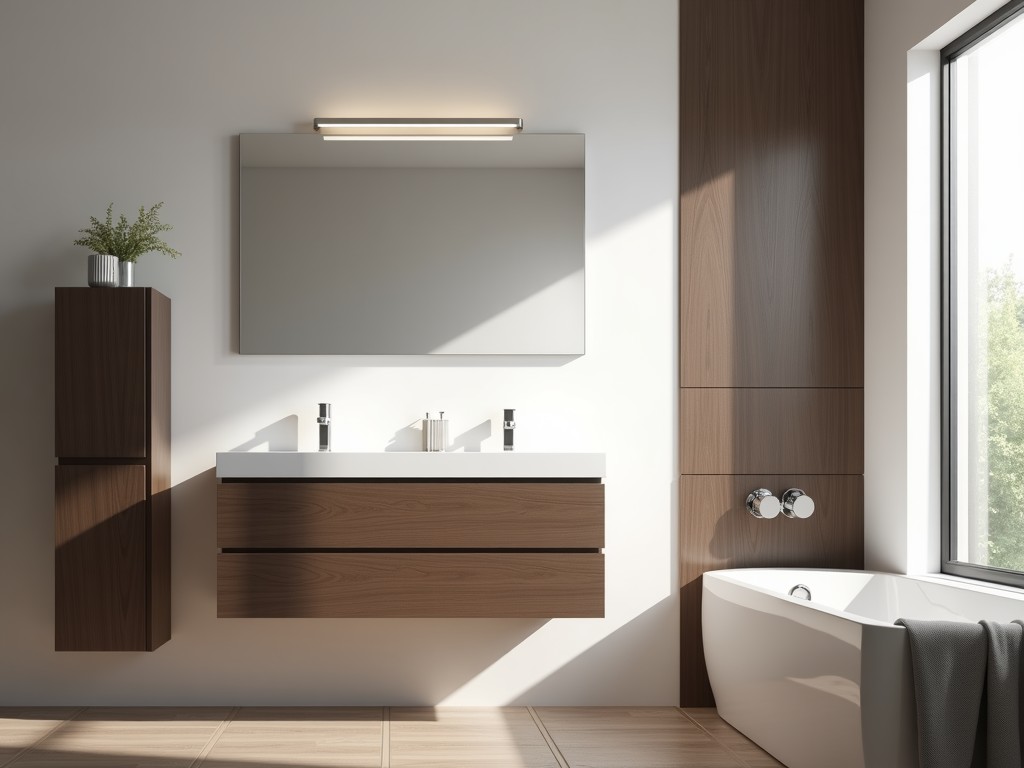
Oem Free Standing Bathroom Cabinet Wholesale
Inquire Now
OEM Free Standing Bathroom Cabinet – Wholesale Overview
Free standing bathroom cabinets are designed to be installed without wall anchoring, relying on a stable base and balanced weight distribution. Wholesale OEM supply allows manufacturers to specify dimensions, material finishes, and hardware while maintaining consistent production tolerances. This page outlines the technical considerations that influence selection for commercial projects, hospitality fit‑outs, and residential developments.
Core Construction Characteristics
The carcass typically uses 18 mm moisture‑resistant MDF or particleboard, providing a bending stiffness of approximately 2.1 GPa, which limits deflection under typical sink loads. Edge sealing is applied with PVC or melamine tape to achieve a water‑vapor transmission rate below 0.5 g/(m²·24 h). Interior shelves are often 12 mm thick, spaced to accommodate 300 mm high storage modules.
A steel or aluminum reinforcement bar, usually 20 × 30 mm rectangular tube, runs horizontally at the base to increase torsional rigidity. This addition raises the cabinet’s resistance to lateral sway by an estimated 35 % compared with unreinforced designs, an important factor for freestanding units in high‑traffic environments.
Material Options and Surface Finishes
- Core board: MR‑MDF (density 650‑750 kg/m³) or MR‑particleboard (density 600‑680 kg/m³)
- Surface finish: melamine foil (thickness 0.15 mm), PVC laminate (0.2 mm), or water‑based UV lacquer (dry film 30 µm)
- Edge treatment: PVC banding (0.4 mm), ABS banding (0.5 mm), or polyurethane hot‑melt (0.3 mm)
- Hardware: concealed soft‑close hinges (torque 0.25 Nm), drawer slides (load rating 30 kg per pair), and adjustable levelling feet (adjustment range 0‑20 mm)
Finish selection influences both appearance and long‑term maintenance. Melamine offers a cost‑effective surface with a Taber abrasion rating of ~150 cycles, while UV lacquer provides a harder coating (>2 H pencil hardness) suitable for premium hotel bathrooms.
Typical Dimensional Configurations
| Parameter | Common Range | Notes |
|---|---|---|
| Overall Height | 800 – 900 mm | Includes toe‑kick clearance of 100 mm |
| Width (single unit) | 400 – 600 mm | Modules can be ganged for wider vanities |
| Depth | 460 – 520 mm | Accommodates standard 450 mm sink bowls |
| Base Clearance | 100 – 150 mm | Allows for floor cleaning and service access |
| Weight (approx.) | 18 – 25 kg | Dependent on material and hardware |
Values represent typical production capabilities; exact dimensions are adjustable according to project specifications.
Manufacturing Considerations for Wholesale OEM
Batch production relies on CNC panel saws with positional accuracy ±0.1 mm, ensuring repeatable cut‑outs for plumbing and electrical service holes. Edge banding is performed using hot‑melt applicators set at 180 °C, delivering a bond strength exceeding 1.2 MPa.
Quality checks include a 90‑degree square test on carcass assembly (tolerance ±0.5 mm) and a 48‑hour humidity cycle at 70 % RH to validate dimensional stability. Finished units undergo a 5 kg drop test on each corner to verify impact resistance of the finish.
Applications in Commercial and Residential Settings
In hospitality projects, free standing cabinets enable rapid room refurbishment without altering wall structures, reducing installation time by an estimated 20 % compared with wall‑mounted units. Their modular nature allows replacement of individual cabinets during soft‑goods upgrades.
For multi‑family residential buildings, the cabinets provide a standardized solution that meets accessibility guidelines when paired with appropriate toe‑kick heights and lever‑style handles. The ability to specify anti‑microbial surface treatments supports compliance with health‑care facility requirements.
Customization Logic
Customers typically provide a schematic showing desired width, height, and depth, along with the location of cut‑outs for faucet and drain lines. Engineers then adjust the internal shelf layout to maintain a minimum 150 mm clearance between the sink basin and the lowest shelf.
Finish customization is driven by the project’s design palette; for example, a matte white UV lacquer may be selected to match wall tiles, while a wood‑grain melamine offers a warm aesthetic at lower cost. Hardware choices are aligned with load expectations; heavy‑duty drawer slides are specified when the cabinet is intended to store linens or cleaning supplies.
Packaging and Shipping Protection
Standard packaging consists of a five‑layer corrugated cardboard sleeve with internal corner protectors made of expanded polystyrene (density 20 kg/m³). Each unit is wrapped in a polyethylene film (50 µm) to guard against moisture during transit.
Palletized shipments use ISO‑standard pallets (1200 × 1000 mm) with a maximum stack height of 1.8 m, secured by PET strapping (0.8 mm thickness). This configuration limits vibration‑induced damage to less than 2 % of units based on historical shipment data.
Frequently Asked Questions
- Can dimensions be customized? Yes, width, height, and depth are adjustable within the ranges shown in the specification table; custom cut‑outs for plumbing are accommodated upon receipt of detailed drawings.
- What information is required before quotation? A basic layout sketch, desired material finish, hardware preferences, and target order quantity.
- What materials are available? MR‑MDF, MR‑particleboard, with surface options of melamine foil, PVC laminate, or UV lacquer; edge banding in PVC, ABS, or polyurethane.
- How is quality inspected? Dimensional checks, edge bond strength tests, humidity cycling, and finish impact resistance are performed on a sampling basis per ISO‑9001‑aligned procedures.
- What packaging methods are available? Standard corrugated sleeves with corner protectors; optional wooden crates for high‑value or long‑distance shipments.
Ready to Discuss Your OEM Requirements?
Submit your project specifications through the contact form to receive a detailed quotation, lead‑time estimate, and sample availability. Our engineering team will review your design for manufacturability and suggest any adjustments that improve cost efficiency or performance.
Request a QuoteRelated Products
Related News

custom closet spatial organization and material performance analysis

Bathroom Taps Technical Analysis
