
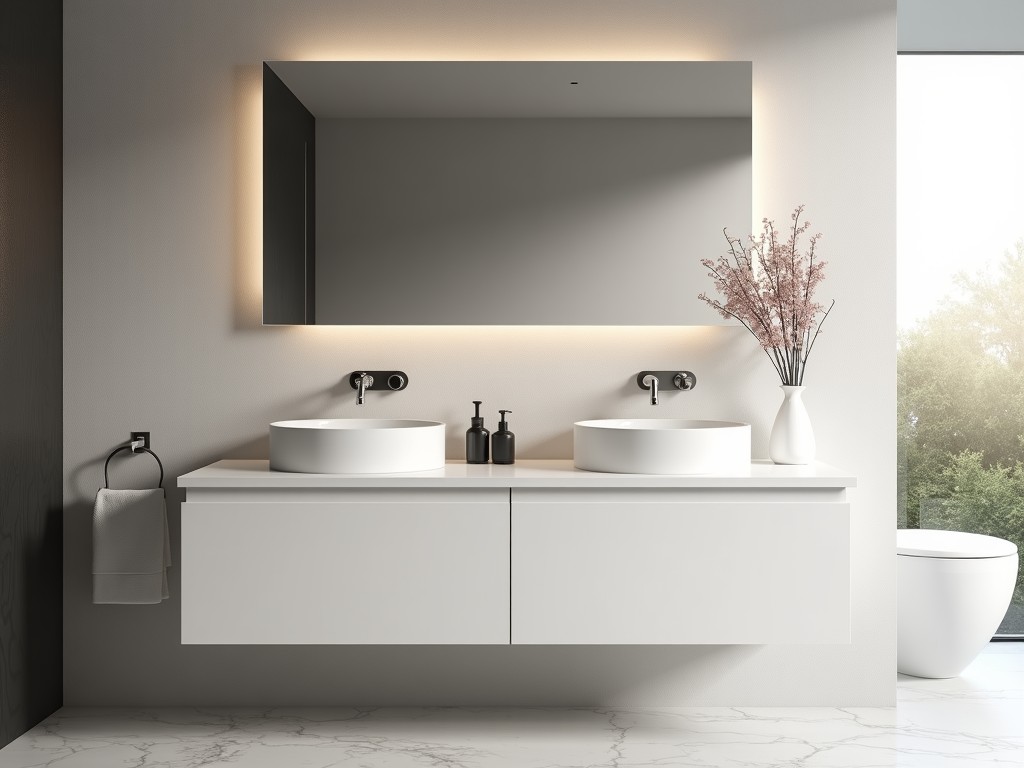
Oem White Quartz Bathroom Countertops
Inquire Now
OEM White Quartz Bathroom Countertops
White quartz countertops are engineered stone slabs composed of approximately 90‑95% ground quartz aggregate bound with polymer resins and pigments. The high quartz content provides a non‑porous surface that resists staining, bacterial growth, and chemical attack typical in bathroom environments.
Material Composition and Performance
The resin binder, usually a unsaturated polyester or acrylic system, contributes flexural strength and impact resistance while allowing precise color control. Typical flexural modulus ranges from 10–12 GPa, and compressive strength exceeds 150 MPa, ensuring durability under daily loads.
Surface finish options include polished, honed, or leathered textures. Polished finishes achieve a gloss rating of 70‑80 GU, honed finishes 20‑30 GU, and leathered finishes provide a matte appearance with improved slip resistance (wet pendulum test value > 45).
Manufacturing Considerations
Slabs are produced via vacuum vibration casting, which minimizes air entrapment and ensures uniform density. Curing occurs at 60‑80 °C for 2‑4 hours, followed by calibration to thickness tolerances of ±0.5 mm. Edge profiling is performed with CNC routers to achieve tolerances of ±0.2 mm on radii.
Quality control includes slab thickness measurement, surface defect inspection under 500 lux lighting, and chemical resistance testing using ASTM C650. Only slabs passing a 95 % visual acceptance rate proceed to packaging.
Technical Specifications
| Property | Typical Value | Test Standard |
|---|---|---|
| Density | 2.3‑2.4 g/cm³ | ASTM C97 |
| Water Absorption | <0.05 % | ASTM C97 |
| Flexural Strength | 45‑55 MPa | ASTM C880 |
| Mohs Hardness | 6‑7 | EN 101 |
| Heat Resistance (short term) | Up to 150 °C | Manufacturer internal |
Applications in Bathroom Environments
The non‑porous nature of white quartz prevents water penetration, reducing the risk of mold and mildew growth behind vanities and shower surrounds. Its chemical resistance to common bathroom cleaners (e.g., ammonia‑based, bleach) ensures surface integrity over years of use.
White quartz provides a neutral backdrop that enhances lighting reflectance, improving perceived space in compact bathrooms. The consistent coloration allows seamless integration with ceramic fixtures, glass enclosures, and metal hardware without visual variation.
Quality Control Philosophy
Each production lot undergoes random sampling for thickness, flatness, and surface gloss. Defects such as pits, resin spots, or color streaks are documented and traced to specific mixing or curing parameters, enabling corrective actions before shipment.
Final inspection includes a 10 × 10 cm abrasion test per ASTM C1243 to verify wear resistance, ensuring the surface maintains appearance after simulated cleaning cycles.
Customization Options
- Thickness: 12 mm, 18 mm, 20 mm, 30 mm (custom upon request)
- Edge profiles: eased, beveled, bullnose, ogee, waterfall
- Finish: polished, honed, leathered, brushed
- Size: standard slabs 3200 × 1600 mm; custom cuts via CNC
- Integrated features: pre‑drilled faucet holes, backsplash, undermount sink cutouts
Packaging and Shipping
Slabs are interleaved with polyethylene foam sheets and secured within wooden crates or steel‑frame pallets. Corner protectors and edge guards minimize impact damage during transit. Each package includes a packing slip with slab ID, dimensions, and inspection certificate.
For export, crates are fumigated per ISPM‑15 standards and sealed with moisture‑barrier film to prevent condensation. Typical lead time is 3‑4 weeks after receipt of approved shop drawings, subject to raw‑material availability.
Frequently Asked Questions
Yes. CNC cutting allows precise length, width, and cut‑out specifications based on provided DXF or DWG files.
Q: What information is required before quotation?Project dimensions, edge profile selection, finish type, quantity, and any required cut‑outs (faucet, sink, backsplash).
Q: How is quality inspected?Visual inspection under controlled lighting, thickness verification with calipers, gloss measurement, and chemical resistance spot testing.
Q: What packaging methods are available?Standard wooden crates, steel‑frame pallets, or custom foam‑lined containers for high‑value projects.
Q: What is the typical production lead time?Three to four weeks after drawing approval, with expedited options available for urgent schedules.
Related Products
Related News

custom closet spatial organization and material performance analysis

Bathroom Taps Technical Analysis
