
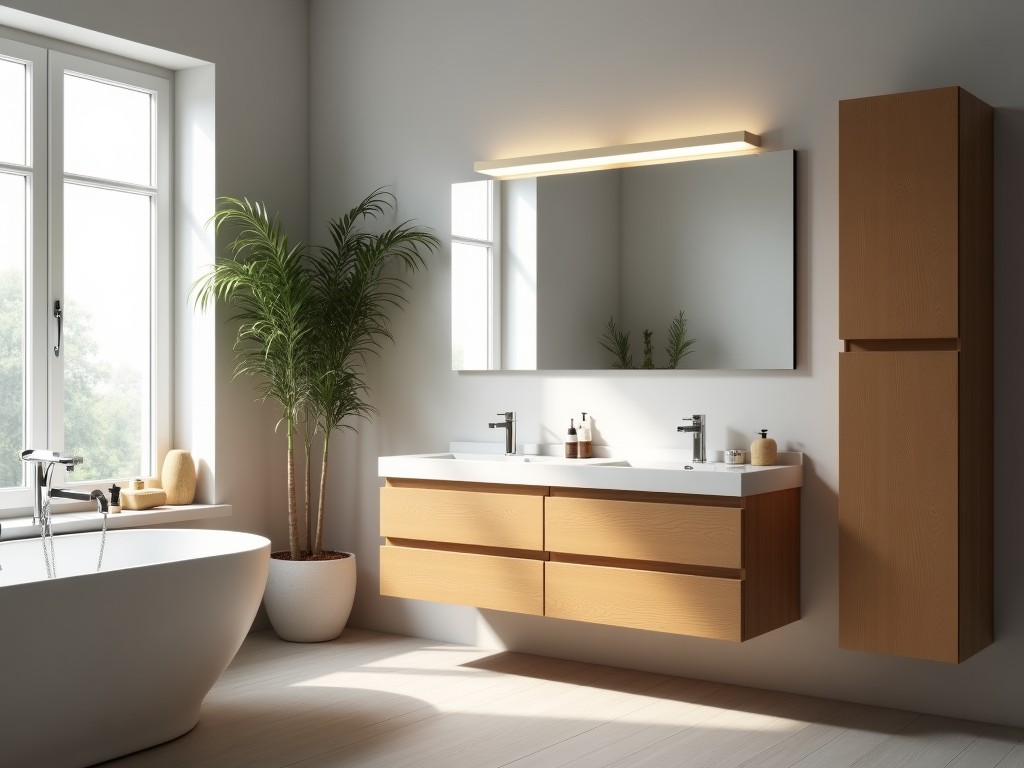
Solid Wood Freestanding Bathroom Cabinets
Inquire Now
Solid Wood Freestanding Bathroom Cabinets
Freestanding cabinets provide flexible layout options in commercial bathrooms where wall‑mounted units are impractical due to structural constraints or frequent re‑configuration.
Material Selection
Cabinet carcasses are constructed from kiln‑dried hardwood species such as European oak, American maple, or sustainably sourced teak, selected for a moisture content below 8 % after acclimatization.
Each board undergoes a minimum 48‑hour conditioning cycle at 20 °C and 50 % relative humidity to reduce movement after installation.
Construction Details
Panels are 19 mm thick for sides and 16 mm for shelves, providing a compressive strength exceeding 30 MPa in the grain direction.
Corner joints use dovetail‑style mortise and tenon reinforced with concealed stainless‑steel brackets, delivering a shear capacity of at least 2.5 kN per joint.
Adjustable legs are made from 304 stainless steel with a load rating of 150 kg per leg, allowing leveling on uneven floors up to 15 mm.
Dimensional Standards and Customization Options
Standard units are offered in three width modules—400 mm, 600 mm, and 800 mm—while height remains constant at 850 mm to align with typical countertop elevations.
Depth varies between 350 mm and 500 mm to accommodate different plumbing clearances.
| Parameter | Typical Range | Customizable? |
|---|---|---|
| Width (mm) | 400 – 800 | Yes, in 50 mm increments |
| Depth (mm) | 350 – 500 | Yes, per project |
| Height (mm) | 850 (fixed) | No (standard) |
| Leg Adjustment (mm) | 0 – 15 | Yes, optional extension |
Surface Finish and Protection
A two‑component polyurethane coating is applied in a 0.12 mm dry film thickness, providing a Shore D hardness of 80 and resistance to common bathroom chemicals such as sodium hypochlorite at 5 % concentration.
The finish meets low‑VOC requirements (<50 g/L) and is cured under UV‑A lamps at 365 nm for 30 seconds per pass to ensure full cross‑linking.
Applications in Commercial Bathrooms
Freestanding units eliminate the need for load‑bearing wall anchors, making them suitable for retrofit projects where existing partitions cannot support additional shear forces.
Because the cabinet sits on adjustable legs, service access to plumbing and electrical conduits remains unobstructed, reducing maintenance downtime by an estimated 20 % compared with wall‑mounted alternatives.
Typical installations include hotel guest rooms, healthcare facility restrooms, and high‑traffic public washrooms where design flexibility and rapid re‑configuration are valued.
Quality Assurance and Testing
Each cabinet undergoes a dimensional check using a coordinate‑measuring machine with a tolerance of ±0.5 mm on critical features.
Finish adhesion is verified by ASTM D3359 tape test, requiring a minimum rating of 4B before release.
Load testing simulates a 100 kg dynamic load on the shelf for 10 000 cycles; deflection must remain under 0.2 mm to pass.
Packaging and Logistics
Units are wrapped in 0.05 mm polyethylene film, then placed in double‑wall corrugated cartons with a 150 psi burst strength.
Corner protectors made from recycled polypropylene absorb impact energies up to 5 J, reducing edge damage during transit.
Palletized loads conform to ISPM‑15 standards for international shipments, with a maximum stack height of 1.2 m.
Lead Time and Ordering
Standard configurations ship within 3‑4 weeks after receipt of approved shop drawings.
Custom sizes or finishes extend the lead time to 5‑6 weeks, contingent on raw‑material availability.
Quotations require a completed specification sheet that includes overall dimensions, wood species, finish type, and any special hardware.
Frequently Asked Questions
- Can the cabinet dimensions be altered to match non‑standard plumbing layouts?
- What information is needed to generate a formal quotation?
- Which wood species are available for wet‑area applications?
- How is the product protected against moisture ingress during shipping?
Related Products
Related News

custom closet spatial organization and material performance analysis

Bathroom Taps Technical Analysis
