
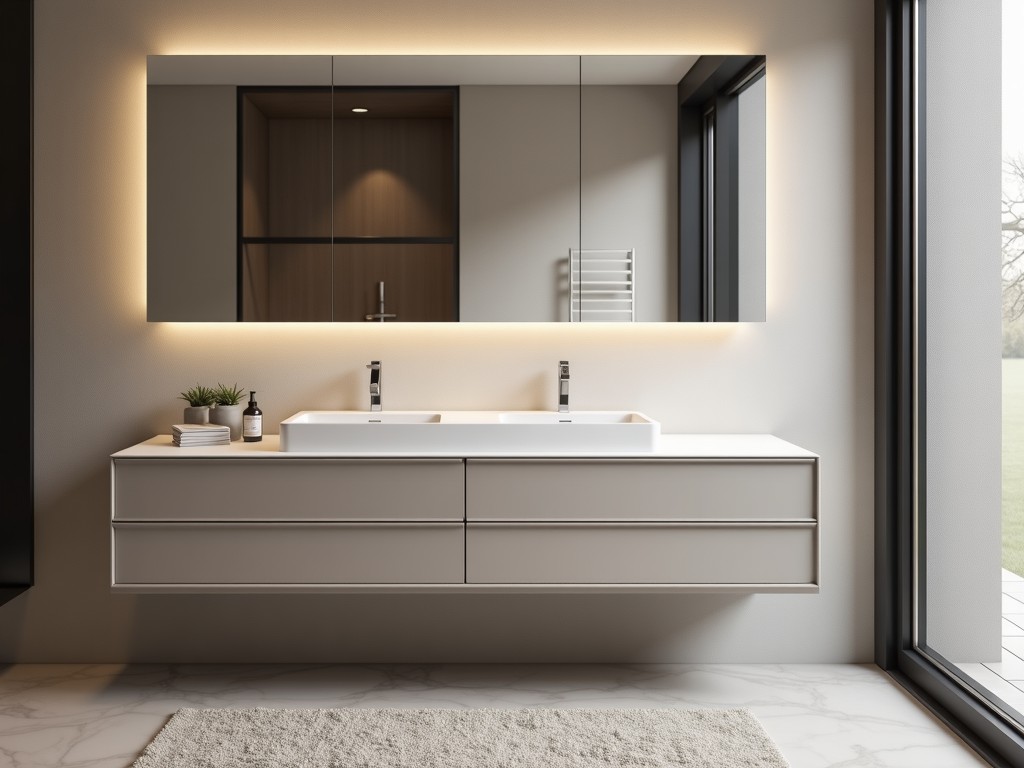
Under Sink Bathroom Cabinet Top Factory
Inquire Now
Under Sink Bathroom Cabinet Top – Factory Production Overview
The factory produces cabinet tops designed to fit beneath bathroom sinks, providing a stable substrate for countertop materials while resisting moisture exposure. Each panel is fabricated to tight dimensional tolerances to ensure seamless integration with standard vanity cabinets.
Material Selection and Properties
Common substrates include medium-density fiberboard (MDF), particleboard, and moisture-resistant plywood. MDF typically offers a density of 0.65 g/cm³ with a thickness tolerance of ±0.5 mm at 18 mm nominal. Particleboard provides a lower density around 0.55 g/cm³ but higher compressive strength. Plywood grades used for wet areas feature cross‑banded veneers and a phenolic resin core, delivering water absorption below 3 % after 24 h immersion.
Surface treatments such as melamine laminate, PVC foil, or water‑based polyurethane coating are applied to improve scratch resistance and seal the substrate edges. Laminate thickness generally ranges from 0.2 mm to 0.4 mm, contributing to overall panel rigidity.
Dimensional Tolerances and Standard Sizes
Factory‑cut tops are produced to match common vanity widths of 600 mm, 750 mm, 900 mm, and 1200 mm, with depths typically 460 mm to accommodate sink bowls and plumbing. Length tolerances are held to ±1 mm, while width and depth tolerances are ±0.5 mm to ensure proper fit within cabinet carcasses.
Custom lengths are achievable through CNC sawing, allowing non‑standard dimensions for retrofit projects or bespoke vanity layouts. Edge squareness is maintained within 0.2 mm deviation across the panel perimeter.
Surface Finishes and Edge Treatments
Finish options include matte, semi‑gloss, and high‑gloss melamine, each measured by gloss units at 60° (matte < 10 GU, semi‑gloss ≈ 30 GU, high‑gloss > 70 GU). Edge banding is applied using hot‑melt adhesive with a thickness of 0.4 mm, providing a seamless appearance and preventing moisture ingress at the cut edges.
For environments requiring higher chemical resistance, a two‑component polyurethane topcoat can be sprayed, delivering a Shore D hardness of approximately 75 and a taber abrasion loss under 50 mg after 1000 cycles.
Manufacturing Process Overview
Raw panels are first inspected for thickness and flatness using laser gauges. CNC routers then cut the panels to programmed dimensions, followed by edge banding stations where pre‑glued tape is applied and cured under heated rollers. Surface laminates are bonded via vacuum press at 0.8 MPa for 20 seconds to ensure uniform adhesion.
After lamination, panels pass through a curing oven (if applicable) at 80 °C for 10 minutes to cross‑link coatings. Final sanding removes any excess adhesive, and a vision system checks for surface defects such as bubbles, scratches, or delamination.
Quality Control and Testing
Each batch undergoes dimensional verification using coordinate measuring machines, with acceptance criteria of ±0.5 mm for length and width. Moisture resistance is evaluated by submersion tests; panels must show less than 5 % weight gain after 24 h immersion at 20 °C.
Mechanical performance includes a uniform load test where a 150 kg weight is applied across the panel surface for 24 hours; deflection must remain below 0.3 mm. Adhesion of laminate is measured by peel strength, targeting a minimum of 1.5 N/mm.
Visual inspection is conducted under 500 lux lighting, classifying any surface blemish greater than 0.5 mm² as non‑conforming. All test results are logged and traceable to the production order.
Applications in Bathroom Cabinetry
The fabricated tops serve as the structural base for sink installations, supporting the weight of the basin, faucet, and user loads. By providing a flat, moisture‑resistant surface, they reduce the risk of swelling or warping that could compromise sealant lines around the sink cutout.
In retrofit scenarios, the tops allow quick replacement of damaged substrates without modifying the existing cabinet frame, thereby lowering labor costs and minimizing downtime for hospitality or residential projects.
Customization Options
Clients may specify alternative thicknesses ranging from 12 mm to 25 mm, depending on load requirements and design preferences. Edge profiles can be altered from square to eased or bullnose radii, with radii typically set between 2 mm and 5 mm.
Surface finishes are available in a wide palette of solid colors, wood grains, and patterned laminates, all compatible with the chosen substrate. Custom CNC cutouts for faucet holes, soap dispensers, or overflow drains are programmed directly from client‑provided DXF files.
Typical Material Properties
| Property | MDF (Typical) | Particleboard (Typical) | Moisture‑Resistant Plywood (Typical) |
|---|---|---|---|
| Density (g/cm³) | 0.65 | 0.55 | 0.50‑0.55 |
| Nominal Thickness (mm) | 18 ±0.5 | 18 ±0.5 | 18 ±0.5 |
| Water Absorption (% , 24h) | <5 | <8 | <3 |
| Internal Bond Strength (MPa) | 0.6‑0.8 | 0.4‑0.6 | 0.8‑1.0 |
| Modulus of Elasticity (MPa) | 2500‑3000 | 2000‑2500 | 3000‑3500 |
Frequently Asked Questions
Can dimensions be customized? Yes, CNC cutting allows non‑standard lengths, widths, and cutouts per supplied drawings.
What information is required before quotation? Panel dimensions, substrate preference, finish type, edge treatment, and any required cutouts or holes.
What materials are available? MDF, particleboard, and moisture‑resistant plywood, each with optional laminate or coating.
How is quality inspected? Dimensional checks, moisture resistance tests, load deflection, adhesion peel strength, and visual inspection under standardized lighting.
What packaging methods are available? Panels are stacked on pallets with corner protectors, wrapped in stretch film, and sealed with moisture‑barrier bags for overseas shipment.
What is the typical production lead time? Lead time ranges from 10 to 18 working days depending on order complexity and current factory load.
Contact for Technical Inquiry
For detailed specifications, sample requests, or project‑specific consultation, please reach out to our engineering team.
Request a QuoteRelated Products
Related News

custom closet spatial organization and material performance analysis

Bathroom Taps Technical Analysis
