
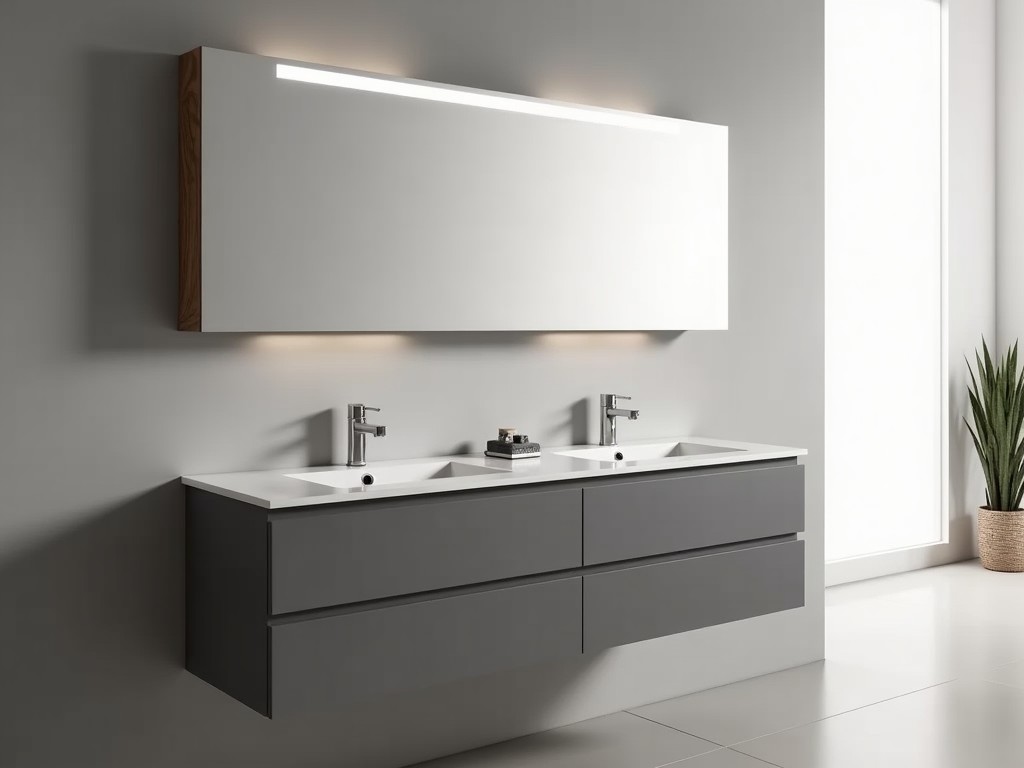
Wall Hung Corner Bathroom Cabinet Top Suppliers
Inquire Now
Wall Hung Corner Bathroom Cabinet
A wall hung corner cabinet occupies the triangular void created by two perpendicular walls, utilizing space that is often inaccessible to floor‑standing units.
Design and Geometry
The cabinet body is typically fabricated as a right‑angle prism with a depth ranging from 300 mm to 450 mm, allowing clearance for plumbing fixtures while maintaining structural rigidity.
Mounting brackets are positioned along the vertical edges to distribute load directly onto wall studs, minimizing cantilever moments that could stress the fixing points.
- Internal shelving is adjustable in 25 mm increments to accommodate varying toiletries.
- Door swing is limited to 90° to prevent interference with adjacent fixtures in tight layouts.
- Ventilation gaps of 5 mm are incorporated at the rear to reduce moisture buildup behind the panel.
Materials and Construction
Material choice determines resistance to humidity, chemical exposure, and mechanical wear in commercial bathroom environments.
- Stainless steel grade 304 offers a tensile strength of approximately 520 MPa and a corrosion rate below 0.02 mm/year in pH 5–9 solutions.
- Marine‑grade polypropylene (PP‑GF30) provides a flexural modulus of 3.5 GPa and absorbs less than 0.1 % water after 24 h immersion.
- Cold‑rolled steel with a zinc‑nickel coating achieves a salt‑spray endurance of 500 hours before red rust appears.
Load Capacity and Mounting
The hanging design transfers the cabinet’s weight and contents to the building structure through anchor points rated for specific shear loads.
| Stud Spacing (mm) | Maximum Uniform Load (kg) | Recommended Anchor Type |
|---|---|---|
| 400 | 80 | M6 expansion bolt with 30 mm embed |
| 600 | 55 | M6 expansion bolt with 30 mm embed |
| 800 | 35 | M6 expansion bolt with 30 mm embed |
Surface Finishes
Finish selection affects both aesthetics and long‑term surface integrity under frequent cleaning cycles.
- Powder‑coated epoxy provides a film thickness of 80 µm with a pencil hardness of 2H.
- Physical vapor deposition (PVD) titanium nitride yields a wear resistance of 0.02 mm³/N·m in Taber abrasion testing.
- High‑pressure laminate (HPL) sheets meet EN 438‑2 standards for impact resistance (≥20 J) and stain resistance (rating 5).
Applications in Commercial Bathrooms
In high‑traffic facilities such as hotels, hospitals, and airports, corner wall hung cabinets reduce floor obstructions, improving wheelchair maneuverability and simplifying cleaning protocols.
The vertical orientation places frequently used items at eye level, decreasing the need for bending and thereby lowering the risk of strain injuries among staff.
Quality Control and Testing
Each unit undergoes a sequence of inspections before leaving the factory to verify dimensional accuracy, mechanical strength, and finish uniformity.
- Coordinate measuring machine (CMM) checks confirm that diagonal tolerances stay within ±0.5 mm.
- Static load testing applies 1.5× the rated uniform load for 10 minutes; deflection must remain under 2 mm.
- Salt‑spray exposure (ASTM B117) for 200 hours verifies that coating adhesion exceeds 4 MPa per cross‑hatch test.
Customization Options
Manufacturers adjust geometry, hardware, and accessories to match project‑specific constraints such as odd wall angles or integrated lighting requirements.
- Cabinet depth can be altered from 250 mm to 500 mm in 10 mm increments.
- Door hinges are available in concealed, soft‑close, or 180° pivot configurations.
- Integrated LED strips with IP65 rating can be routed along the interior shelf edges.
- Locking mechanisms range from cam locks to electronic keypad systems.
Frequently Asked Questions
Yes, the cabinet panel can be cut to any angle between 75° and 105° with corresponding adjustments to the mounting bracket geometry.
Project planners should provide wall stud spacing, desired interior depth, load expectations, and finish preference.
Stainless steel 316L, marine‑grade polypropylene, and coated steel with zinc‑nickel alloy are offered for high‑chloride or chemical exposure zones.
Each unit receives dimensional CMM verification, load deflection testing, and a visual finish audit under 500 lux illumination.
Cabinets are wrapped in polyethylene foam, placed in double‑wall corrugated cartons, and secured with corner protectors and strapping.
Lead times range from 3 to 5 weeks for standard configurations; custom projects add 1‑2 weeks depending on complexity.
Contact Us
To discuss your specific requirements or request a detailed quotation, please reach out to our engineering team.
Related Products
Related News

custom closet spatial organization and material performance analysis

Bathroom Taps Technical Analysis
