
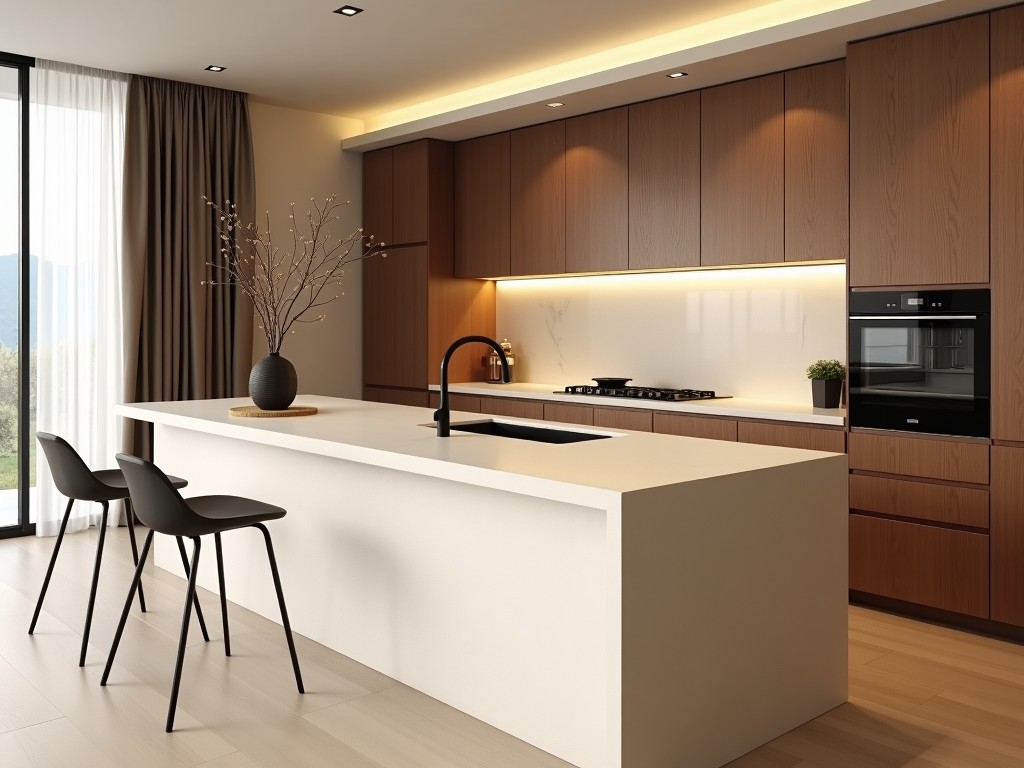
B2B Best Beige Quartz Countertops
Inquire Now
B2B Best Beige Quartz Countertops
Beige quartz countertops are engineered surfaces composed primarily of natural quartz crystals bound with polymer resins and mineral pigments. This combination yields a non‑porous slab with consistent coloration and predictable mechanical performance. Industrial buyers select these countertops for applications where chemical resistance, ease of cleaning, and dimensional stability are critical.
Material Composition and Properties
Typical slabs contain 90‑95% ground quartz by weight, with the remaining 5‑10% consisting of unsaturated polyester resin, pigments, and minor additives. The quartz provides hardness and abrasion resistance, while the resin matrix imparts flexibility and seals the surface against liquid ingress.
- Bulk density: approximately 2.3‑2.5 g/cm³.
- Water absorption: ≤0.05% (ASTM C97).
- Compressive strength: ≥150 MPa (ASTM C170).
- Flexural strength: ≥50 MPa (ASTM C880).
- Mohs hardness: 6‑7.
- Coefficient of thermal expansion: 20‑25 × 10⁻⁶/°C.
Manufacturing Process
Raw quartz granules are blended with resin and pigments under vacuum to eliminate air bubbles. The mixture is then vibrated and pressed into slabs at pressures exceeding 100 bar, followed by curing in a controlled temperature oven for polymerization. After curing, slabs undergo calibration, polishing to a specified gloss level, and final inspection.
The vacuum vibration step reduces porosity to below 0.02%, which directly contributes to the material’s stain resistance and inhibits microbial growth. Consistent curing cycles ensure uniform cross‑link density, which affects long‑term mechanical stability.
Applications in Industrial Settings
In laboratories and food‑processing facilities, the non‑porous nature of quartz prevents absorption of solvents, acids, and organic contaminants, simplifying sanitation protocols. The material’s resistance to thermal shock allows placement near equipment that generates moderate heat, such as analytical instruments or warming cabinets.
- Pharmaceutical cleanrooms – resistance to alcohol‑based disinfectants.
- Chemical pilot plants – tolerance to splashes of dilute acids and bases.
- Electronics assembly – low outgassing and static dissipative options.
- Hospitality service bars – durability against frequent glassware impact.
Customization Options
Countertops can be produced in various thicknesses to match structural requirements and load‑bearing expectations. Edge profiles range from eased to bullnose, and slab dimensions are adaptable to facility layouts.
| Thickness (mm) | Approx. Weight (kg/m²) | Typical Max Size (mm) |
|---|---|---|
| 12 | 27.6 | 3200 × 1600 |
| 20 | 46.0 | 3200 × 1600 |
| 30 | 69.0 | 3200 × 1600 |
Quality Control and Testing
Each slab undergoes dimensional verification using laser gauges to ensure thickness tolerance within ±0.3 mm and length/width tolerance within ±2 mm. Surface finish is measured with a gloss meter to confirm compliance with the specified gloss unit range (typically 40‑80 GU). Visual inspection under standardized lighting detects any inclusions, color variation, or surface defects.
Additional testing includes resistance to surface staining (ASTM D1308) and impact resistance (ASTM D256) for project‑specific requirements. Results are documented and made available to purchasers upon request.
Packaging and Logistics
Finished slabs are separated by interleaving foam sheets and placed inside wooden crates reinforced with metal corner brackets. Crates are strapped and labeled with handling instructions, including recommended lift points and maximum stack height. For overseas shipments, crates are heat‑treated to meet ISPM‑15 standards and sealed with moisture‑resistant barriers.
Lead times depend on slab thickness, color batch, and order volume, generally ranging from 3 to 6 weeks after final drawing approval. Expedited options are available for critical projects, subject to production capacity.
Frequently Asked Questions
- Can dimensions be customized?
Yes, slabs can be cut to specific lengths, widths, and thicknesses based on project drawings. Edge profiles and cut‑outs for sinks or equipment are also available. - What information is required before quotation?
Project layout, required thickness, edge profile, total surface area, and any special cut‑outs or openings. Additionally, delivery address and any certification needs (e.g., NSF, ISO) help refine the quote. - What materials are available?
The base is natural quartz with polymer resin; pigment options allow a range of beige tones from light sand to deeper taupe. Custom color matching can be arranged upon request. - How is quality inspected?
Dimensional checks, gloss measurement, visual inspection, and optional performance tests such as chemical resistance and impact strength are performed per lot. - What packaging methods are available?
Standard wooden crate with foam interleaving, reinforced metal corners, and moisture barrier. Specialized packaging for cleanroom or hazardous environments can be quoted. - How are export shipments protected?
Crates are heat‑treated, sealed, and secured with strapping. Shock‑absorbing pallets and corner protectors minimize transit damage. - What is the typical production lead time?
Generally 3‑6 weeks after final approval, varying with thickness and order size. Expedited schedules are possible for urgent requirements. - How are samples arranged?
Small sample tiles (typically 100 mm × 100 mm) can be shipped via courier upon request, with associated freight costs.
Related Products
Related News

custom closet spatial organization and material performance analysis

Bathroom Taps Technical Analysis
