
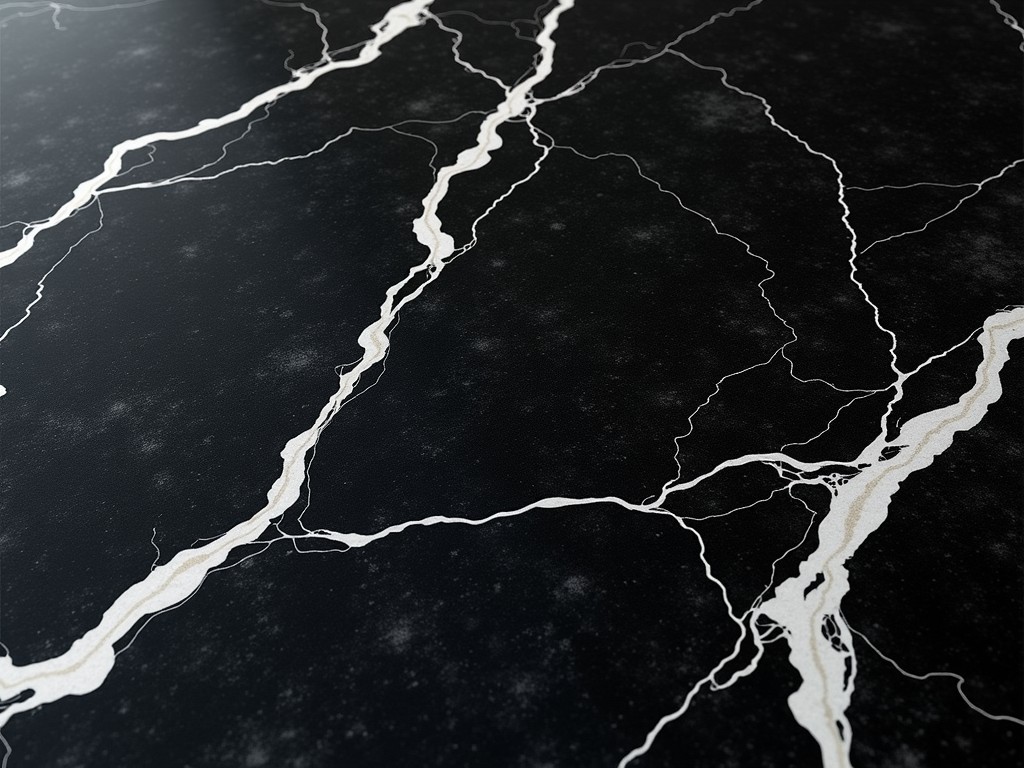
Black Marble Quartz Countertops With White Veining
Inquire Now
Black Marble Quartz Countertops with White Veining
The product combines natural quartz aggregates with a polymer resin matrix and mineral pigments to replicate the appearance of black marble while providing the performance benefits of engineered stone.
Material Composition and Manufacturing Process
Approximately 90% by weight is ground quartz, the remaining 10% consists of unsaturated polyester resin, pigments, and additives. The mixture undergoes vacuum vibration compaction to eliminate air pockets, then is cured in a heated press at up to 100 °C for a controlled period to achieve full polymerization.
Technical Specifications
| Property | Typical Value | Test Method |
|---|---|---|
| Density | 2.30 g/cm³ | ASTM C97 |
| Compressive Strength | ≥ 200 MPa | ASTM C170 |
| Flexural Strength | ≥ 50 MPa | ASTM C880 |
| Water Absorption | ≤ 0.05 % | ASTM C97 |
| Mohs Hardness | 7 | ASTM C1353 |
| Coefficient of Thermal Expansion | 2.5 × 10⁻⁵ /°C | ASTM E831 |
| Stain Resistance (Rating) | Excellent (no visible stain after 24 h exposure to coffee, oil, wine) | ANSI Z124.6 |
Primary Applications
- Kitchen countertops – low porosity prevents absorption of food liquids, reducing bacterial growth and simplifying cleaning.
- Bathroom vanities – resistance to cosmetics, cleaning agents, and moisture ensures long‑term surface integrity.
- Laboratory workbenches – chemical resistance to common reagents and ease of decontamination meet lab safety standards.
- Hospitality reception desks – consistent veining pattern across large slabs provides a seamless, upscale appearance.
- Retail display surfaces – high abrasion tolerance maintains aesthetic appeal under heavy foot traffic.
Quality Control and Testing
Each slab is inspected for thickness tolerance (± 0.5 mm), surface flatness (≤ 0.3 mm deviation over 1 m), and color uniformity. Veining alignment is verified against a master pattern using high‑resolution imaging. Representative samples undergo the mechanical tests listed in the specification table; any batch failing to meet the minimum compressive or flexural strength is rejected.
Customization Options
- Slab thickness: 20 mm (standard for vertical applications) or 30 mm (preferred for horizontal countertops).
- Maximum slab size: 3200 mm × 1600 mm; custom lengths available upon request.
- Edge profiles: eased, beveled, bullnose, ogee, waterfall, and custom CNC‑machined designs.
- Finish: polished (gloss > 80 GU), honed (matte 5‑10 GU), leather‑textured, or brushed.
- Veining intensity: adjustable pigment dispersion to achieve subtle, moderate, or pronounced white veining against the black base.
Frequently Asked Questions
Related Products
Related News

custom closet spatial organization and material performance analysis

Bathroom Taps Technical Analysis
