
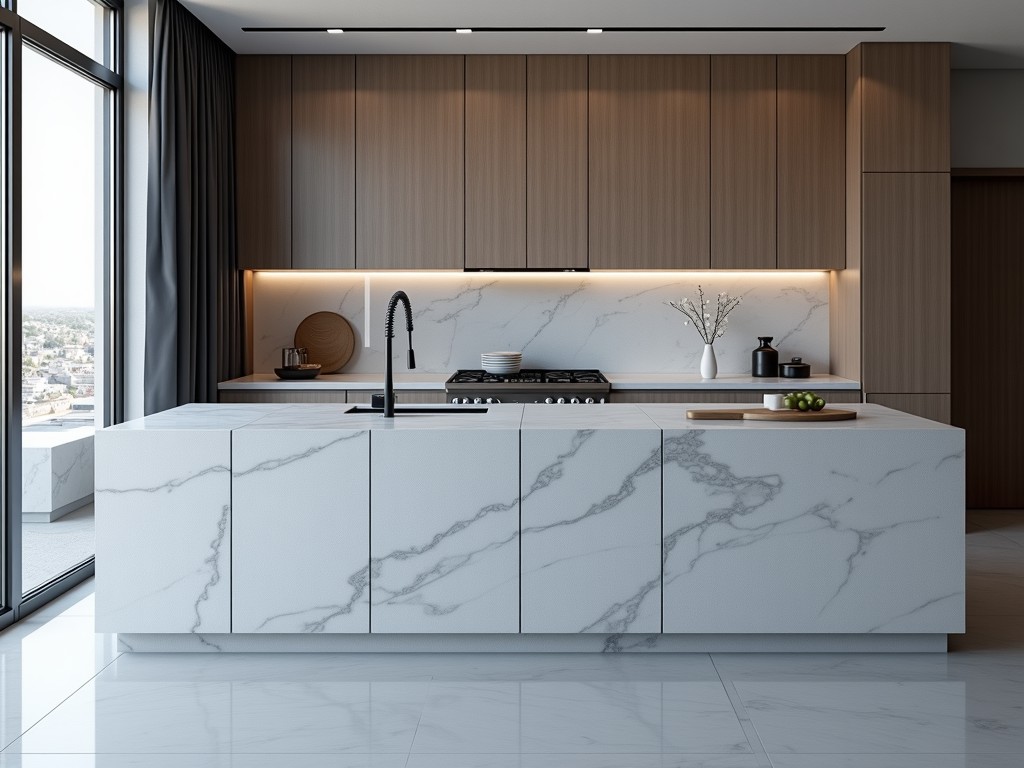
Blue Gray Quartz Countertops Top Suppliers
Inquire Now
Blue Gray Quartz Countertops: Technical Overview for Industrial Procurement
Blue gray quartz countertops are engineered stone slabs composed primarily of natural quartz aggregate bound with polymer resins and mineral pigments. The typical quartz content ranges from 90% to 94% by weight, providing a hard, non‑porous surface that mimics the appearance of natural stone while offering engineered consistency.
Material Composition and Properties
The resin matrix is usually a unsaturated polyester or acrylic system that cures to form a solid, impermeable layer. Pigments are inorganic oxides selected for UV stability, ensuring the blue‑gray hue does not fade under indoor lighting. Resulting material characteristics include a density of approximately 2.35 g/cm³, a Mohs hardness of 6.5‑7, and a compressive strength exceeding 150 MPa.
| Property | Typical Value | Unit |
|---|---|---|
| Density | 2.35 | g/cm³ |
| Compressive Strength | 150‑200 | MPa |
| Flexural Strength | 40‑50 | MPa |
| Water Absorption | <0.05 | % |
| Abrasion Resistance (Taber) | <80 mg loss per 1000 cycles | mg |
The low water absorption and high abrasion resistance make the surface resistant to staining, bacterial growth, and wear from frequent cleaning cycles. These properties are particularly relevant in environments where chemical exposure and strict hygiene standards are required.
Manufacturing Considerations for Countertops
Slabs are typically produced in dimensions of 3200 mm × 1600 mm with thickness options of 20 mm, 30 mm, or custom sizes upon request. Tolerances on thickness are generally ±0.5 mm, and length/width tolerances are ±2 mm. Edge profiling is performed after slab cutting using CNC routers to achieve profiles such as eased, bullnose, or ogee with radius tolerances of ±0.2 mm.
- Standard thicknesses: 20 mm (¾ in) and 30 mm (1 ¼ in)
- Maximum slab size: 3200 mm × 1600 mm (126 in × 63 in)
- Edge profile options: eased, bevel, bullnose, ogee, waterfall
- Surface finishes: polished (gloss > 80 GU), honed (gloss 10‑30 GU), leathered (textured)
Applications in Industrial and Commercial Settings
Because the material is non‑porous and resistant to common acids, alkalis, and solvents, it is frequently selected for laboratory workstations, healthcare facility surfaces, and food preparation areas where hygiene and chemical resistance are critical. The consistent coloration also supports aesthetic continuity in large‑scale installations such as hotel lobbies, retail corridors, and office reception desks.
- Laboratory countertops – resistance to reagents and ease of decontamination
- Healthcare – seamless surfaces that inhibit microbial harborage
- Hospitality – uniform appearance across multiple units in hotels and restaurants
- Retail – durable surfaces for high‑traffic service desks and display fixtures
Supplier Evaluation Criteria
When assessing suppliers of blue gray quartz slabs, procurement teams should verify color batch consistency, resin formulation transparency, and compliance with relevant industry standards. Lead time, logistics capability, and after‑sales support (such as damage claim handling) also influence total cost of ownership.
- Color consistency: ΔE < 2 between slabs from the same production lot
- Certifications: ISO 9001, ISO 14001, NSF/ANSI 51 for food contact
- Typical lead time: 2‑4 weeks for stock colors, 6‑8 weeks for custom runs
- Packaging: wooden crates with corner protectors and protective film
- After‑sales: clear policy for chip, crack, or color deviation claims
Quality Control and Testing
Quality control begins with raw material inspection (quartz purity, resin viscosity) and continues through slab curing, dimensional verification, and surface finish assessment. Non‑destructive testing such as glossometry and colorimetry ensures that each slab meets the specified aesthetic and functional thresholds before release.
| Inspection Item | Acceptance Criteria | Method |
|---|---|---|
| Slab Thickness | Nominal ± 0.5 mm | Caliper measurement at 5 points |
| Length & Width | Nominal ± 2 mm | Steel rule or laser scanner |
| Surface Gloss | Polished > 80 GU; Honed 10‑30 GU | Glossmeter (60°) |
| Color Difference (ΔE) | <2.0 within lot | Spectrophotometer (CIELAB) |
| Edge Profile Radius | Specified radius ± 0.2 mm | Coordinate measuring machine (CMM) |
Customization Options
Beyond standard slabs, suppliers can provide cut‑to‑size panels, prefabricated backsplashes, and integrated edge treatments to meet specific project geometries. Custom pigment matching is possible for large volume orders, allowing designers to achieve precise hue consistency across multiple installations.
- Cut‑to‑size panels with CNC kerf tolerance ± 0.1 mm
- Integrated backsplashes up to 100 mm height
- Special edge profiles: waterfall, mitered, laminated
- Finish variations: matte, satin, brushed, or custom texture
- Logo or pattern inlay using epoxy‑filled recesses
Packaging, Lead Times, and Logistics
Finished slabs are typically packed in wooden crates with internal corner protectors, edge guards, and a polyethylene film to prevent surface abrasion during transit. Standard pallet dimensions accommodate 20 mm or 30 mm thickness slabs, with a maximum net weight of approximately 2800 kg per crate. Lead times depend on stock availability and order volume; stock colors usually ship within two weeks, while custom pigment runs may require six to eight weeks for production and curing.
- Packaging: kiln‑dried pine crate, 12 mm thickness, with metal straps
- Protection: corner foam, edge guards, and anti‑static film
- Typical freight: FCL container, LTL palletized, or air freight for urgent samples
- Documentation: material safety data sheet (MSDS), certificate of conformity, packing list
Related Products
Related News

custom closet spatial organization and material performance analysis

Bathroom Taps Technical Analysis
