
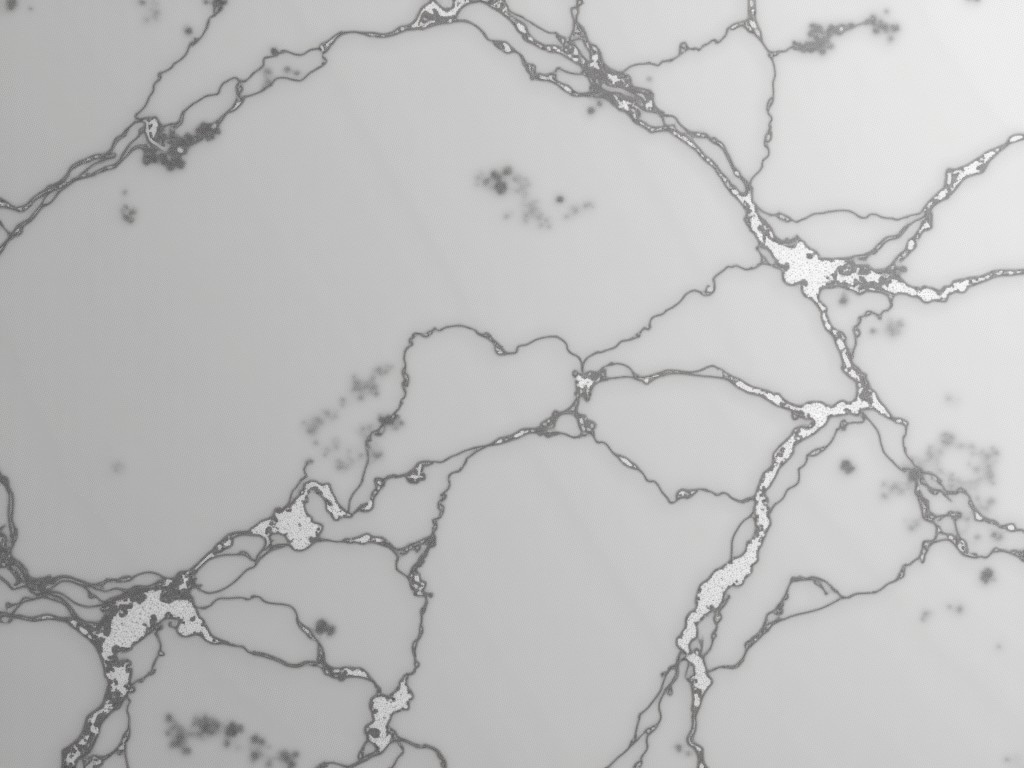
Buy Gray Quartz Countertops With White Veins
Inquire Now
Buy Gray Quartz Countertops with White Veins
Product Overview
Gray quartz countertops with white veining are engineered stone slabs made from roughly 93% ground natural quartz, polymer resins, and mineral pigments. The quartz crystals give the slab its inherent hardness, while the resin binds the particles and carries the pigment that creates a uniform gray matrix interrupted by crisp white veining.
Technical Specifications
| Property | Typical Value |
|---|---|
| Slab Thickness | 2 cm (3/4 in) or 3 cm (1 1/4 in) |
| Standard Slab Size | 3200 mm × 1600 mm (126 in × 63 in) |
| Density | 2.3–2.5 g/cm³ |
| Compressive Strength | ≥200 MPa |
| Flexural Strength | ≥50 MPa |
| Water Absorption | ≤0.02% |
| Mohs Hardness | 6–7 |
| Stain Resistance (ISO 10545‑14) | Class 5 (no visible stain after 24 h exposure) |
| Heat Resistance (short term) | Withstands up to 180 °C without discoloration |
Performance Characteristics
Because the resin fills the interstitial spaces, the resulting surface is non‑porous, which prevents liquid absorption and inhibits bacterial growth. This makes the material suitable for environments where hygiene is critical, such as food preparation areas and laboratories. The uniform pigment distribution ensures that the gray tone remains consistent across large installations, while the white veins are produced through a controlled veining process that mimics natural stone patterns.
Applications
Gray quartz with white veining is selected for projects that demand both aesthetic continuity and mechanical resilience. In commercial kitchens, the surface resists knife impacts and thermal shock from hot pans, while the non‑porous nature simplifies cleaning protocols. In healthcare facilities, the lack of pores reduces the risk of pathogen harborage, supporting infection‑control standards. Laboratories benefit from chemical resistance to common reagents, and office reception desks gain a sophisticated look that maintains appearance under constant use.
- Hotel lobby counters and bar tops
- Retail display fixtures
- Educational laboratory benchtops
- Elevator interior panels
Customization Options
Beyond the standard gray base with white veins, the product can be adapted to meet specific design and functional requirements.
- Edge profiles: eased, beveled, ogee, bullnose, waterfall
- Surface finishes: polished (high gloss), honed (matte), leathered (textured)
- Vein matching: book‑matching or slab‑to‑slab alignment for seamless patterns
- Dimensional cuts: custom lengths, widths, and cut‑outs for sinks or appliances
Quality Control
Each slab undergoes a series of checks before leaving the factory to ensure it meets the agreed specifications.
| Inspection Item | Acceptance Criteria |
|---|---|
| Thickness Variation | ±0.3 mm across the slab |
| Color Consistency | ΔE < 2.0 (CIELAB) relative to approved sample |
| Veining Alignment | Maximum offset 2 mm for book‑matched pairs |
| Surface Flatness | ≤0.5 mm deviation over 1 m straightedge |
| Edge Integrity | No chips >2 mm; edges free of cracks |
Packaging & Shipping
Finished slabs are packed on A‑frame steel pallets with corner protectors and edge foam. Each slab is separated by recycled cardboard interleaves and secured with polyester straps. The pallet is then shrink‑wrapped to guard against moisture and surface abrasion during transit. For export shipments, pallets are placed inside ISO containers with additional bracing to prevent movement, and a phytosanitary‑treated wooden base is used when required by destination regulations.
Frequently Asked Questions
Q: Can the slab dimensions be customized to fit a specific layout?
A: Yes. Slabs can be cut to length, width, and include cut‑outs for sinks, cooktops, or fixtures based on shop‑drawing tolerances.
Q: What information is required before a quotation is issued?
A: Project dimensions, desired thickness, edge profile, finish type, and any special veining matching instructions.
Q: How are veins matched across multiple slabs?
A: Vein matching is performed by selecting sequential blocks from the same quarry run and aligning the natural patterns; a digital layout is provided for approval.
Q: What adhesives are recommended for seam installation?
A: Two‑part epoxy or polyester adhesives formulated for quartz stone, with a tensile strength ≥15 MPa, are typically used.
Q: What is the typical production lead time?
A: Lead time ranges from 2 to 4 weeks after final drawing approval, depending on order size and customization complexity.
Get a Quote
To discuss your project requirements, request a detailed quotation, or arrange a sample slab, please contact our technical sales team.
Related Products
Related News

custom closet spatial organization and material performance analysis

Bathroom Taps Technical Analysis
