
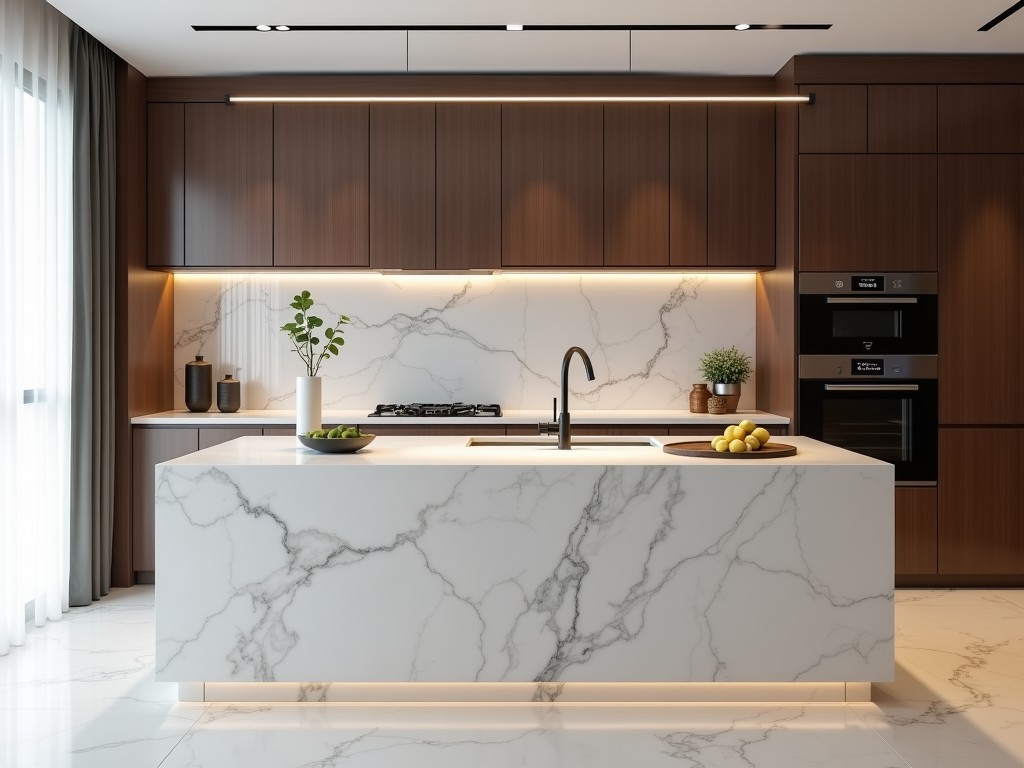
China Average Cost Of Quartz Countertops
Inquire Now
China Average Cost of Quartz Countertops
Overview
Quartz countertops are engineered stone surfaces composed of approximately 90‑95% ground natural quartz crystals blended with polymer resins and pigments. The resulting slab exhibits a non‑porous structure, consistent color distribution, and mechanical properties that depend on resin content and curing conditions.
Cost Influencing Factors
The average cost quoted by Chinese manufacturers varies primarily with three technical parameters: quartz purity level, slab thickness, and resin system type. Higher purity quartz (>98% SiO2) reduces filler content and increases material cost, while thicker slabs (20 mm vs 12 mm) raise raw material usage linearly. Resin systems with enhanced UV stability or fire retardancy add formulation expenses.
Secondary cost drivers include surface finish (polished, honed, textured), edge profile complexity, and any required CNC cut‑outs for sinks or cooktops. Logistics factors such as FOB port handling, container utilization, and destination tariffs also affect the final quoted price.
Typical Price Ranges
| Quartz Purity | Thickness | Resin Type | Average FOB Price (USD/ft²) |
|---|---|---|---|
| Standard (90‑95%) | 12 mm | General purpose | 45‑55 |
| High (96‑98%) | 20 mm | UV‑stable | 70‑85 |
| Premium (>98%) | 20 mm | Fire‑retardant | 95‑115 |
Values represent typical FOB quotations for standard polished finishes; actual quotes may deviate based on order volume, custom edge work, and packaging requirements.
Material Composition and Properties
The quartz aggregate provides a Mohs hardness of approximately 7, conferring resistance to scratching from common kitchen utensils. The polymer resin matrix, usually unsaturated polyester or acrylic, contributes flexural strength in the range of 30‑50 MPa and a tensile modulus of 8‑12 GPa, depending on cure temperature and catalyst loading.
Water absorption measured per ASTM C97 is typically below 0.02% due to the non‑porous nature of the cured resin, which also yields a chemical resistance rating suitable for exposure to mild acids and alkalis (pH 4‑10). Thermal expansion coefficient lies between 20‑25 × 10⁻⁶/°C, necessitating expansion joints in large installations.
Manufacturing Considerations
Slab production involves vacuum mixing of quartz powder, resin, pigments, and additives, followed by compaction under pressures of 80‑100 bar in a slab press. The mixture is then cured in a temperature‑controlled oven at 80‑120 °C for 30‑60 minutes to achieve full polymerization. Post‑curing, slabs undergo calibration gauging to ensure thickness tolerance within ±0.1 mm and surface flatness within 0.5 mm over a 1‑meter span.
Quality control includes spectrophotometric color matching (ΔE < 2), density verification (target 2.3‑2.4 g/cm³), and flexural testing per ASTM C1240. Any slab failing to meet the specified modulus or showing surface defects is re‑processed or rejected.
Applications in Industrial Settings
Quartz countertops are selected for environments requiring hygienic surfaces, such as pharmaceutical laboratories, food processing cleanrooms, and chemical testing facilities. The non‑porous surface inhibits microbial colonization, and the chemical resistance permits routine cleaning with isopropyl alcohol or diluted bleach without degradation.
In industrial workshops, quartz provides a durable work surface resistant to impact from dropped tools and abrasion from particulate matter. Its low thermal conductivity reduces heat transfer from hot equipment, contributing to operator comfort.
Customization and Tolerances
Customers may specify custom pigment blends to match corporate color standards, with tolerance measured in CIELAB units (ΔE ≤ 1.5). Edge profiles can be fabricated via CNC routing to radii as small as 3 mm or complex ogee shapes, with positional accuracy of ±0.2 mm.
For applications requiring integrated features, manufacturers can incorporate pre‑formed cut‑outs for undermount sinks, drain boards, or sensor housings, maintaining slab integrity through reinforcement ribs where necessary.
Lead Time, Packaging, and Logistics
Standard production lead time ranges from 10‑18 business days after receipt of approved shop drawings and material confirmation. Expedited schedules are achievable for orders under 50 m², subject to press availability.
Slabs are packaged in A‑frame wooden crates with corner protectors and interleaving foam sheets to prevent edge chipping. Each crate is labeled with slab ID, thickness, and orientation marks. Export shipments comply with ISPM‑15 wood packaging regulations and are secured with steel strapping to withstand container vibration.
Frequently Asked Questions
Yes. Slabs can be cut to any length and width within press limits (maximum 3200 mm × 1600 mm) with thickness options of 12 mm, 18 mm, or 20 mm. Custom tolerances are discussed during quotation.
What information is required before quotation?Required data includes slab dimensions, thickness, desired quartz purity or brand equivalence, resin system (standard, UV‑stable, fire‑retardant), surface finish, edge profile, and quantity. A layout drawing or CAD file improves accuracy.
How is quality inspected?Inspection comprises visual appearance checks, thickness measurement with micrometers, density verification via water displacement, and flexural strength testing on sample coupons. Results are documented in a material test report available upon request.
What packaging methods are available?Standard packaging uses A‑frame crates with foam interleaving. Alternative options include steel‑frame pallets for high‑volume shipments or custom crates with additional corner reinforcement for delicate edge profiles.
What is the typical production lead time?For standard specifications, lead time is 10‑18 business days. Lead times extend to 25 days for large format slabs (>2.4 m²) or when special resin systems require extended curing cycles.
Get a Technical Quote
To obtain a detailed cost estimate tailored to your project’s dimensional, material, and finish requirements, please provide your specifications via the inquiry form.
Request QuoteRelated Products
Related News

custom closet spatial organization and material performance analysis

Bathroom Taps Technical Analysis
