
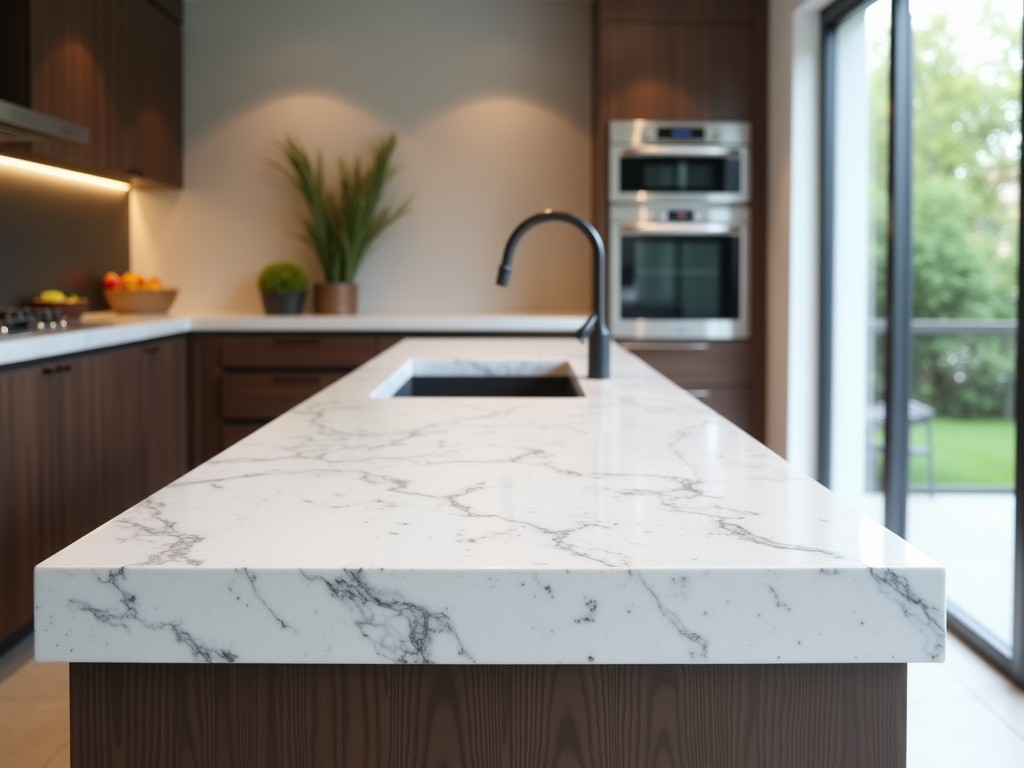
Cost Of Quartz Countertops Per Square Foot
Inquire Now
Cost of Quartz Countertops per Square Foot
Overview of Quartz Countertop Pricing
Quartz countertops are engineered stone surfaces composed of approximately 90‑95% ground natural quartz crystals blended with polymer resins and pigments. The cost per square foot reflects material composition, slab thickness, edge treatment, and fabrication complexity.
Industrial buyers evaluate price alongside performance metrics such as flexural strength (≥ 50 MPa), water absorption (<0.05% by weight), and Mohs hardness (≈7). Understanding these parameters helps predict long‑term value and maintenance requirements.
Key Cost Drivers
- Quartz content percentage – higher purity increases material cost.
- Slab thickness – typical 2 cm (¾″) vs 3 cm (1¼″) affects price per ft² by roughly 15‑25%.
- Color and pattern – solid colors are least expensive; veined or exotic designs add 10‑30% premium.
- Edge profile – eased, beveled, ogee, or waterfall edges increase fabrication time.
- Project size – economies of scale reduce per‑unit cost for large installations.
Typical Price Ranges (USD/ft²)
| Quartz Type | Thickness | Price Range per ft² |
|---|---|---|
| Standard solid color | 2 cm | $55 – $70 |
| Standard solid color | 3 cm | $65 – $85 |
| Veined / patterned | 2 cm | $70 – $90 |
| Veined / patterned | 3 cm | $80 – $105 |
| Premium exotic (e.g., marble look) | 3 cm | $95 – $130 |
Values are indicative for North American market, inclusive of material only. Fabrication, delivery, and installation add typically $20‑$40 per ft² depending on region and project complexity.
Performance Characteristics Influencing Cost
Higher quartz content correlates with increased flexural strength and lower thermal expansion. Typical values: flexural strength 55‑75 MPa, compressive strength >200 MPa, coefficient of thermal expansion 20‑25 × 10⁻⁶/°C.
Water absorption below 0.02% ensures stain resistance, reducing long‑term maintenance cost. These technical specs are often reflected in the price tier; premium slabs undergo additional vacuum vibration and curing cycles to achieve tighter tolerances.
Installation and Fabrication Considerations
Edge treatments add labor: eased edge ≈ $2/ft², beveled ≈ $4/ft², ogee ≈ $6/ft², waterfall (full‑height) can exceed $12/ft². Cut‑outs for sinks or cooktops increase scrap and machining time, typically adding $10‑$15 per cut‑out.
Seam placement influences aesthetic and cost; minimizing seams requires larger slabs, which may increase material price but reduce fabrication labor. For large commercial projects, manufacturers often provide slab layout optimization services.
Comparison with Alternative Surfaces
| Material | Typical Cost (ft²) | Flexural Strength (MPa) | Water Absorption (%) |
|---|---|---|---|
| Quartz (standard) | $55‑$85 | 55‑70 | <0.05 |
| Granite | $45‑$75 | 10‑20 | 0.1‑0.4 |
| Solid Surface (Acrylic) | $40‑$65 | 20‑30 | 0.02‑0.05 |
| Laminate | $12‑$28 | 5‑10 | Not applicable (non‑porous) |
While granite offers lower upfront cost, its higher porosity and variability in strength can increase long‑term maintenance. Quartz provides consistent engineering properties, which justifies the higher price for many industrial and commercial applications.
Quality Control and Certification
Reputable manufacturers adhere to ISO 9001 for production consistency and ASTM C1728 for slab dimensional tolerance (±0.5 mm). Incoming quartz is tested for silica content (>90 %) and resin cure degree via FTIR spectroscopy.
Finished slabs undergo automated thickness scanning and surface defect imaging; batches with >2 mm variation or visible micro‑cracks are rejected. These controls reduce field failure risk, contributing to lower total cost of ownership.
Frequently Asked Questions
Can dimensions be customized?
Yes. Slabs are available in standard sizes (e.g., 320 × 160 cm) but can be cut to project‑specific dimensions. Custom sizes may affect yield and increase per‑ft² cost by 5‑10% due to additional waste.
What information is required before quotation?
Project square footage, desired thickness, edge profile, color/pattern selection, and any cut‑out details (sink, cooktop, faucet holes). Providing a layout drawing enables accurate material optimization.
How is quality inspected?
Each slab passes visual inspection under 500 lux lighting, thickness measurement via laser profilometer, and flexural strength testing on a sample per lot (ASTM C1358). Results are documented in a material test report.
What packaging methods are available?
Slabs are packed in A‑frame wooden crates with corner protectors, secured with steel straps. For export, crates are heat‑treated (ISPM‑15) and wrapped in polyethylene film to resist moisture.
What is the typical production lead time?
Standard colors: 2‑3 weeks. Veined or exotic patterns: 4‑6 weeks, depending on raw material availability and curing schedule.
Request a Quote
To obtain a detailed cost estimate tailored to your specifications, please provide the project area, thickness, edge treatment, and color preference. Our technical team will return a itemized breakdown including material, fabrication, and logistics.
Request QuoteRelated Products
Related News

custom closet spatial organization and material performance analysis

Bathroom Taps Technical Analysis
