
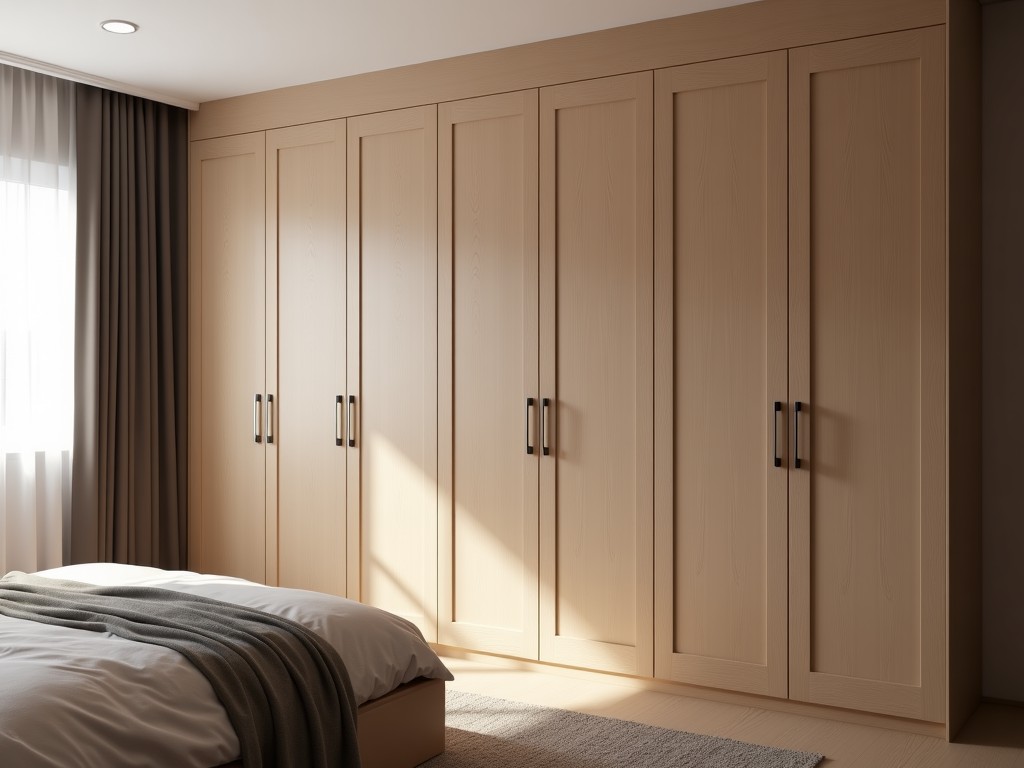
Custom Bedroom Storage Cabinets Top Supplier
Inquire Now
Custom Bedroom Storage Cabinets – Technical Overview
Bedroom storage cabinets supplied to OEM furniture manufacturers and interior fit‑out contractors are built to exact dimensional specifications that match bedroom module layouts, door swing clearances, and internal accessory configurations. Supplying these units as custom‑fabricated components reduces on‑site assembly time and minimizes material waste in high‑volume production lines.
Material Selection and Structural Characteristics
Core panels are typically manufactured from three engineered wood families: particleboard (density 600‑650 kg/m³, MOR 12‑15 MPa), medium density fibreboard (MDF, density 700‑800 kg/m³, MOR 18‑22 MPa), and hardwood‑faced plywood (density 550‑650 kg/m³, MOR 25‑30 MPa). Surface finishes include melamine‑impregnated paper, PVC edge banding, or UV‑cured acrylic lacquer, each offering specific abrasion resistance (Taber wear index < 80 mg/1000 cycles for melamine, < 30 mg for UV lacquer) and moisture uptake (swelling < 0.2 % after 24 h at 90 % RH).
- Particleboard core – cost‑effective, suitable for low‑load interior shelving.
- MDF core – superior screw holding strength (≥ 1200 N withdrawal) and smooth finish for painted surfaces.
- Plywood core – higher impact resistance, preferred for doors subject to frequent use.
- Metal reinforcement strips (0.8 mm steel) – added to shelf spans > 600 mm to limit deflection < 1 mm under 150 kg uniform load.
Dimensional Flexibility and Customization Parameters
Standard cabinet modules are produced in width increments of 50 mm (300 mm‑1200 mm), height steps of 100 mm (800 mm‑2400 mm), and depth options of 400 mm, 500 mm, or 600 mm. Interior layouts can incorporate adjustable shelf pins (spacing 32 mm), full‑extension drawer slides (load rating 30 kg per pair), or hinged doors with 110° opening angle. Hardware mounting holes are pre‑drilled to ISO 9001 tolerances (±0.2 mm) to ensure repeatable fit of OEM‑specified handles, locks, and lighting fixtures.
Typical Material Property Table
| Material | Density (kg/m³) | Modulus of Rupture (MPa) | Screw Withdrawal (N) | Surface Wear Index (mg/1000 cycles) |
|---|---|---|---|---|
| Particleboard | 620 | 13 | 800 | 78 |
| MDF | 750 | 20 | 1250 | 45 |
| Hardwood Plywood | 600 | 28 | 1100 | 22 |
Manufacturing Process and Tolerance Control
Panel blanks are cut on 5‑axis CNC routers with positioning accuracy ±0.1 mm. Edge banding is applied via hot‑melt adhesive rollers, achieving bond strength > 1.8 MPa. Dowel and cam‑lock holes are drilled using programmable spindle heads, maintaining hole diameter tolerance ±0.05 mm. Assembly is performed on automated jig stations where shelf pins are inserted to a depth of 12 mm ± 0.3 mm, ensuring consistent load distribution. Final squareness of the cabinet frame is verified with laser gauges, targeting deviation < 0.5 mm over a 1000 mm diagonal.
Quality Assurance and Testing Protocol
Each production lot undergoes incoming material inspection (density, moisture content < 8 %), in‑process checks (dimensional accuracy, edge adhesion), and final product validation. Load testing applies 150 kg uniform load to shelves for 24 h, measuring deflection (< 2 mm) and permanent set (< 0.5 mg). Door cycle testing executes 20 000 opening‑closing motions at 0.5 Hz, evaluating hinge wear and screw retention. Finish adhesion is measured via cross‑hatch tape test (ISO 2409), requiring rating ≤ 1 (no removal). All results are recorded in a traceable batch record linked to the customer’s order number.
Applications in Bedroom Furniture Supply Chains
Custom cabinets enable OEMs to standardize bedroom modules across multiple product lines while accommodating regional variations in ceiling height and wardrobe depth. For multi‑family developers, factory‑finished units reduce on‑site labor by up to 30 % and eliminate finish‑matching issues between separate trade contractors. Hospitality suppliers benefit from interchangeable drawer and accessory kits that support rapid room refurbishment cycles without re‑engineering the carcass. The ability to specify exact hardware hole patterns also streamlines integration of proprietary lighting or electronic lock systems supplied by the OEM.
Packaging and Logistics Considerations
Cabinets are shipped flat‑packed in corrugated double‑wall cartons with internal corner protectors (0.25 mm PE foam) and edge guards (15 mm thick cardboard). Each carton includes a desiccant packet to maintain internal relative humidity below 50 % during transit. Stacking limits are set at 10 units per pallet (max height 1.8 m) based on compressive strength testing of the carton (≥ 8 kPa). Pallets are stretch‑wrapped with 80 µm film and secured with polyester strapping (break strength ≥ 550 kg) to prevent shifting during ocean freight. Shipping documentation includes material safety data sheets (MSDS) for finishes and fumigation certificates for wood components where required.
Frequently Asked Questions
Can dimensions be customized beyond the standard increments? Yes. Non‑standard widths, heights, or depths are achievable through custom CNC programming; tolerances remain ±0.2 mm for cut features and ±0.3 mm for drilled holes.
What information is required before quotation? We need a detailed specification sheet: overall dimensions, panel material and thickness, finish type, hardware list (including hole patterns), desired interior accessories, and any regulatory compliance (e.g., CARB Phase 2, FSC).
What material options are available? Particleboard, MDF, and hardwood‑faced plywood cores with melamine, PVC, or UV‑cured acrylic surface finishes; metal reinforcement strips can be added on request.
How is quality inspected? Incoming material checks, in‑process dimensional and adhesion verification, final load and cycle testing, and finish adhesion testing per ISO standards; all results are documented per batch.
What packaging methods are available? Standard flat‑pack cartons with corner and edge protection; optional palletized crating for high‑value projects; humidity‑controlled packaging available upon request.
How are export shipments protected? Desiccant packets, stretch‑wrap, polyester strapping, and ISPM‑15 compliant pallets; fumigation certificates provided for wood‑based shipments.
What is the typical production lead time? Lead time ranges from 3‑5 weeks for standard material grades; expedited schedules of 10‑12 working days are available for stocked panels and finishes, subject to capacity.
How are samples arranged? Sample panels (300 mm × 300 mm) with selected finish and edge banding can be shipped within 5‑7 working days; sample cabinets (single module) require 10‑12 working days due to assembly and QC.
To discuss your specific bedroom storage cabinet requirements, request a detailed quotation, or obtain technical datasheets, please contact our engineering team via the inquiry form linked below.
Request Technical QuoteRelated Products
Related News

custom closet spatial organization and material performance analysis

Bathroom Taps Technical Analysis
