
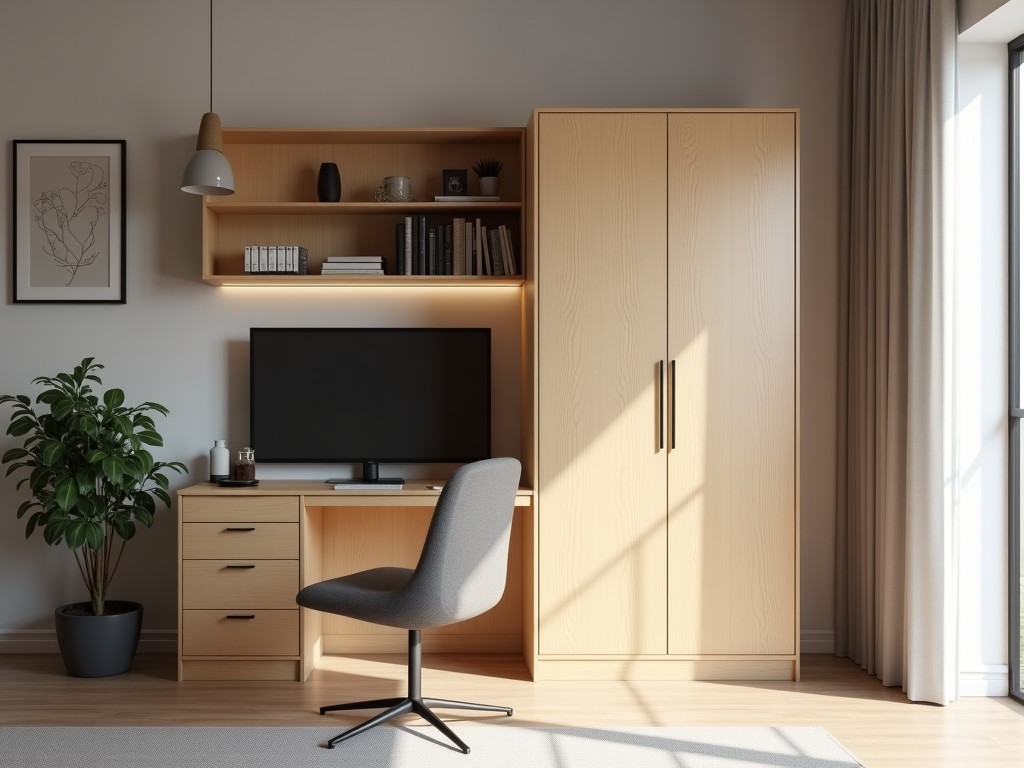
Custom Office Storage Cabinets Factory
Inquire Now
Custom Office Storage Cabinets Factory
A factory that produces custom office storage cabinets works from detailed specifications to create units that fit exact dimensional, load, and finish requirements of a workspace. The process begins with interpreting architectural plans or user needs and translating them into manufacturable designs.
Design and Engineering Considerations
Before any material is cut, engineers assess the intended load per shelf, frequency of access, and environmental factors such as humidity or temperature fluctuations. These inputs determine the required material thickness, reinforcement placement, and clearance tolerances, typically expressed as ±0.5 mm for critical interfaces.
Ergonomic studies influence handle height, door swing direction, and internal shelf spacing to reduce user strain. The design phase also includes planning for future reconfiguration, which is achieved through modular mounting systems that allow cabinets to be relocated without damaging the finish.
Material Options
- Cold‑rolled steel sheet, thickness ranging from 0.8 mm to 2.0 mm, provides high tensile strength and is suited for heavy‑duty loading.
- Aluminum extrusion profiles offer corrosion resistance and lower weight, with typical wall thickness of 1.2 mm.
- Medium‑density fiberboard (MDF) faced with melamine laminate delivers a smooth surface and good screw‑holding capacity, commonly used in 18 mm panels.
- High‑pressure laminate (HPL) over particleboard provides increased wear resistance, with surface hardness ratings suitable for high‑traffic areas.
Each material is selected based on project‑specific criteria such as required load capacity, desired finish, and budget constraints. The factory can provide material data sheets upon request.
Customization Process
The factory follows a structured workflow: first, a detailed brief is collected, including dimensions, load expectations, accessory needs, and preferred finish. Second, CAD models are generated and reviewed for interference and manufacturability.
Third, tolerance stacks are calculated to ensure that assembled units meet the specified fit, with critical dimensions verified against ISO 2768‑m standards. Fourth, a prototype or first‑article sample is produced for customer approval before full‑scale production begins.
Manufacturing Methods
Cutting is performed on CNC turret punches or laser systems, achieving positional accuracy of ±0.1 mm. Bending and forming use press brakes with calibrated tonnage to maintain consistent bend angles, typically within ±0.5°.
Welding, when required, follows MIG or TIG procedures with filler material matched to the base alloy, and weld beads are inspected for porosity and penetration. Surface preparation includes degreasing, phosphating, and application of powder coating to a uniform thickness of 60‑80 µm, cured at 180 °C for 10 minutes.
Hardware such as locks, hinges, and drawer slides is installed using torque‑controlled fastening to prevent over‑tightening that could deform thin‑gauge panels.
Quality Control and Testing
Dimensional inspection is carried out on a coordinate measuring machine (CMM) with a repeatability of 0.02 mm, verifying hole patterns, overall height, width, and depth against the approved drawing.
Finish adhesion is evaluated using cross‑hatch tape tests per ASTM D3359, targeting a rating of 5B (no coating removal). Load testing applies a uniformly distributed load to shelves, measuring deflection; acceptance criteria typically limit sag to less than L/200 where L is the shelf span.
Functional checks include door alignment, latch engagement, and smooth operation of moving parts. All inspection results are recorded and traceable to the specific production lot.
Applications and Value in Office Environments
Custom storage solutions enable efficient use of floor space by fitting precisely into niches, under workstations, or along corridors, reducing the need for filler pieces that waste area.
By specifying lock types and internal configurations, organizations can secure sensitive documents or valuable equipment while maintaining accessibility for authorized personnel.
The ability to match finishes to existing furniture or corporate branding supports a cohesive aesthetic, which can influence employee perception and client impressions.
Because each unit is engineered to the exact load profile, the risk of over‑stressing shelves or premature wear is minimized, contributing to a longer service life and lower total cost of ownership.
Typical Specifications
| Parameter | Typical Range / Option |
|---|---|
| Overall Height | 600 mm – 2100 mm (customizable) |
| Overall Width | 300 mm – 1200 mm (customizable) |
| Overall Depth | 400 mm – 600 mm (customizable) |
| Material Thickness (Steel) | 0.8 mm – 2.0 mm |
| Shelf Load Capacity | Up to 150 kg per shelf (depends on thickness & support spacing) |
| Finish Type | Powder coating (standard colors), Melamine laminate, HPL, Anodized aluminum |
| Door Swing Options | Left‑hand, Right‑hand, Overlay, Inset, Sliding |
| Locking Mechanisms | Cam lock, Electronic keypad, RFID, Mechanical combination |
Frequently Asked Questions
- Can dimensions be customized to match existing architectural layouts? Yes, the factory produces cabinets to millimeter‑level tolerances based on supplied drawings or site measurements.
- What information is required before a quotation can be issued? Detailed dimensions, load requirements per shelf, preferred material and finish, hardware specifications, and any applicable standards or certifications.
- Which materials are available for the cabinet body? Cold‑rolled steel, aluminum extrusion, MDF with melamine, and particleboard with high‑pressure laminate are stocked; other alloys or composites can be sourced upon request.
- How is quality inspected during production? Each lot undergoes dimensional CMM verification, finish adhesion testing, and functional operation checks; results are retained for traceability.
- What packaging methods protect the cabinets during transit? Units are wrapped in protective film, placed on pallets with corner protectors, and secured with strapping; optional wooden crates are available for overseas shipments.
- What is the typical production lead time? Lead time varies with complexity and material availability; standard configurations usually ship within 3‑4 weeks after drawing approval, while custom alloys or special finishes may extend the schedule.
Next Steps
To discuss your specific storage requirements, provide a brief that includes overall dimensions, expected load per shelf, material preference, and finish color. Our engineering team will review the details and return a preliminary design with cost estimate.
Related Products
Related News

custom closet spatial organization and material performance analysis

Bathroom Taps Technical Analysis
