
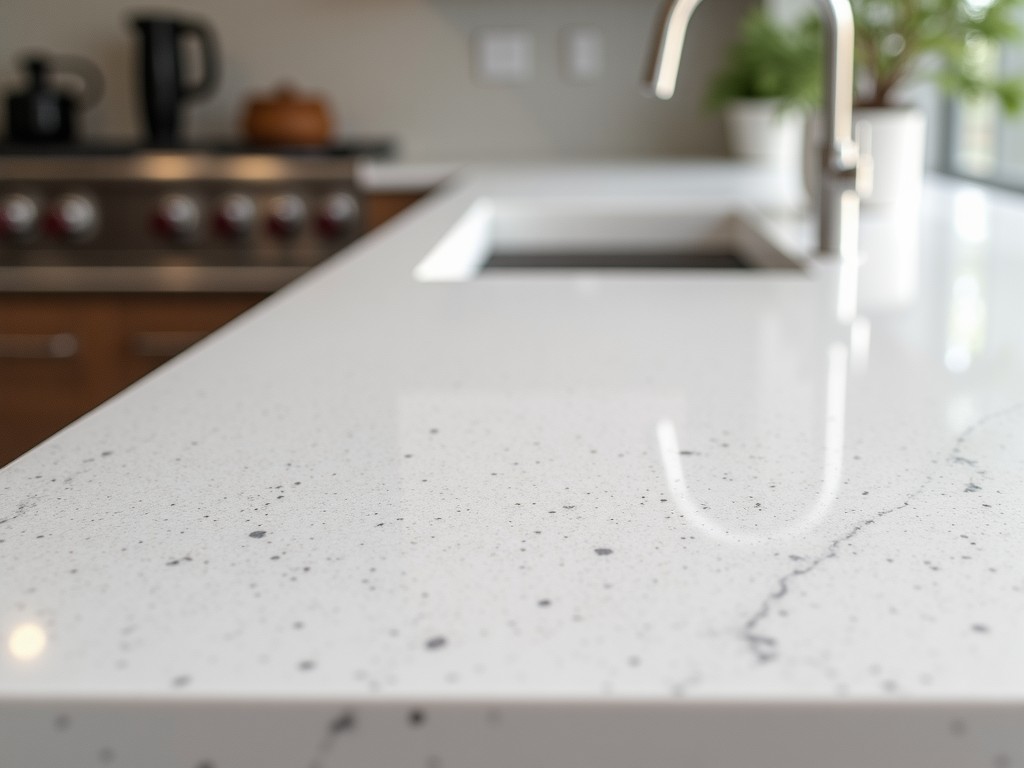
Glitter White Sparkle Quartz Countertops
Inquire Now
Glitter White Sparkle Quartz Countertops
These countertops consist of approximately 92% natural quartz aggregate bound with a polymer resin matrix. The glitter effect is achieved by adding uniformly distributed mica or glass flakes that reflect light across the surface.
Material Composition and Properties
The quartz content provides a Mohs hardness of 7, comparable to granite. Flexural strength typically ranges from 45 to 55 MPa, and water absorption is below 0.05 % by weight, meeting ASTM C97 specifications.
Density falls between 2.3 and 2.5 g/cm³, contributing to dimensional stability under temperature fluctuations. The resin component offers chemical resistance to common acids and alkalis up to pH 10.
Manufacturing Process
Raw quartz, resin, pigment, and glitter additives are mixed under vacuum to eliminate air bubbles. The mixture is then vibro‑compressed into slabs, cured at 80–90 °C for 30 minutes, and cooled under controlled conditions to prevent internal stress.
Slabs are produced in standard thicknesses of 20 mm and 30 mm, with typical dimensions of 3000 mm × 1400 mm. Thickness tolerances are held to ±0.5 mm across the slab.
Dimensional Tolerances and Customization
| Parameter | Typical Value | Customizable? |
|---|---|---|
| Thickness | 20 mm or 30 mm | Yes – custom thicknesses up to 40 mm |
| Slab Size | 3000 mm × 1400 mm | Yes – cut‑to‑size per project |
| Length Tolerance | ±0.5 mm | No – standard process limit |
| Width Tolerance | ±0.5 mm | No – standard process limit |
| Thickness Tolerance | ±0.5 mm | No – standard process limit |
Surface Finish Options
- Polished – high gloss, enhances sparkle visibility
- Honed – matte appearance, reduces glare while retaining glitter effect
- Leather – textured feel, provides slip‑resistant surface
- Brushed – subtle satin, suitable for vertical applications
Performance Characteristics
Stain resistance is demonstrated by less than 2 % color change after 24 hour exposure to coffee, wine, and oil based on ASTM C1353 testing.
Heat tolerance allows brief contact with surfaces up to 150 °C without resin degradation; prolonged exposure above this temperature may cause discoloration.
Impact resistance, measured by falling ball test, shows no cracking when a 500 g steel ball is dropped from 1 m height onto a 20 mm slab.
Applications in Industrial Settings
In laboratory environments, the non‑porous surface prevents microbial growth and facilitates cleaning with standard disinfectants.
Food processing facilities benefit from the material’s resistance to food acids and its ability to withstand frequent wash‑down cycles.
Healthcare installations choose these countertops for their seamless appearance, which eliminates crevices where contaminants could accumulate.
Quality Control and Testing
Each slab undergoes visual inspection for color uniformity and glitter distribution under 500 lux illumination.
Dimensional verification uses laser scanning to confirm thickness and flatness within specified tolerances.
Chemical resistance is validated by immersing samples in sulfuric acid (10 %) and sodium hydroxide (10 %) solutions for 48 hours, followed by visual and weight change assessment.
Customization and Ordering Information
Edge profiles such as eased, bullnose, ogee, and waterfall can be CNC‑machined to match project specifications.
Lead time for standard slabs is typically 3–4 weeks after receipt of approved shop drawings; custom colors or special glitter concentrations may extend this period.
Frequently Asked Questions
Can dimensions be customized?
Yes. Slabs can be cut to any length and width within the manufacturing envelope, and edge profiles are machined per customer drawings.
What information is required before quotation?
Project drawings indicating slab sizes, thicknesses, edge details, and finish type are needed. Additionally, any special glitter concentration or color matching requirements should be specified.
How is quality inspected?
Inspection includes visual checks, dimensional laser scanning, hardness testing, and chemical resistance assays per ASTM standards.
What packaging methods are available?
Slabs are packed in wooden crates with corner protectors, foam interleaving, and moisture‑barrier wrapping for overseas shipment.
What is the typical production lead time?
Standard lead time is 3–4 weeks; custom glitter or pigment formulations may add 1–2 weeks.
Contact for Technical Inquiry
For further details on material data sheets, customization options, or project‑specific consultation, please submit an inquiry.
Related Products
Related News

custom closet spatial organization and material performance analysis

Bathroom Taps Technical Analysis
