
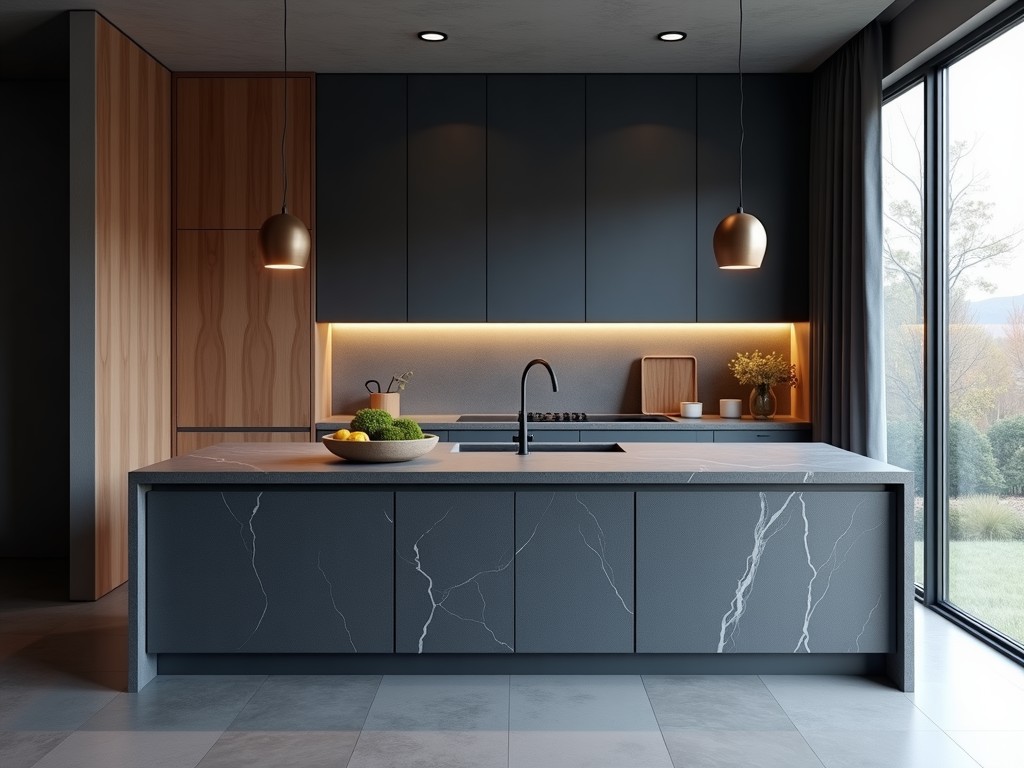
Oem Dark Blue Brown Grey Quartz Countertops
Inquire Now
OEM Dark Blue Brown Grey Quartz Countertops
Overview
These engineered stone slabs combine natural quartz aggregates with polymer resins to produce a non‑porous surface suitable for high‑traffic commercial environments. The color palette blends dark blue, brown, and grey tones through controlled pigment distribution, achieving consistent hue across large format panels.
Typical slab dimensions are 3200 mm × 1600 mm with thicknesses of 20 mm or 30 mm, allowing seamless installation in countertop, wall cladding, and flooring applications. The manufacturing process uses vacuum vibration and high‑pressure curing to minimize voids and ensure uniform density.
Material Composition
The base consists of 90‑95 % crushed quartz by weight, selected for hardness (Mohs 7) and chemical inertness. The remaining 5‑10 % is a proprietary blend of unsaturated polyester resin, UV stabilizers, and color pigments that bind the aggregate and provide the desired dark blue‑brown‑grey appearance.
Resin content is optimized to balance flexural strength and resistance to thermal shock, while UV inhibitors prevent discoloration under prolonged sunlight exposure. Fillers such as recycled glass or mirror chips may be added upon request to modify visual depth without affecting mechanical performance.
Mechanical Properties
| Property | Typical Value | Test Standard |
|---|---|---|
| Flexural Strength | 45‑55 MPa | ASTM C880 |
| Compressive Strength | 180‑220 MPa | ASTM C170 |
| Water Absorption | ≤0.05 % | ASTM C97 |
| Abrasion Resistance (Volume Loss) | ≤120 mm³ | ASTM C241/C241M |
| Thermal Expansion Coefficient | 22 × 10⁻⁶ /°C | ASTM C531 |
Surface Finish Options
Finished surfaces are available in polished, honed, brushed, and leather textures. Polished finish yields a gloss reflectance of 55‑65 % at 60 °, honed provides a matte appearance with reflectance below 10 %, while brushed and leather finishes create directional slip‑resistant patterns suitable for wet areas.
Finish selection impacts both aesthetic perception and functional performance; for example, a leather texture increases the wet‑slip resistance coefficient to approximately 0.6, meeting many commercial kitchen safety guidelines.
Typical Applications
In hospitality environments, these countertops withstand frequent cleaning agents, hot cookware, and impact from service carts due to their high compressive strength and low porosity. The dark colour scheme conceals minor wear, extending visual service life in high‑traffic lobbies and reception desks.
Laboratory settings benefit from the chemical resistance of the resin matrix, which remains stable when exposed to dilute acids, bases, and organic solvents commonly used in analytical procedures. The non‑porous surface prevents microbial ingress, supporting compliance with hygiene standards.
Retail fixtures and display counters utilize the material’s ability to be fabricated into complex edges (e.g., ogee, bullnose, waterfall) without chipping, enabling seamless integration with back‑lit signage or embedded LED strips.
Customization Capabilities
Color pigment ratios can be adjusted to shift the dominant hue toward more blue, brown, or grey while maintaining overall darkness. Custom veining patterns are achievable through controlled dispersion of contrasting granules during the mixing stage, allowing designers to replicate natural stone motifs.
Edge profiles, cut‑outs for sinks or appliances, and thickness variations are programmed via CNC routing based on supplied CAD files. Tolerances of ±0.5 mm on dimensions and ±0.1 mm on thickness are standard for production runs.
Quality Assurance
Each slab undergoes ultrasonic inspection to detect internal voids or delaminations that could compromise structural integrity. Surface quality is evaluated using a gloss meter and a visual defect chart under standardized lighting (5000 K, 1000 lx).
Batch testing includes repeat flexural and compressive strength measurements on three specimens per lot, with acceptance criteria set at 95 % of the mean values shown in the mechanical properties table. Documentation of test results is provided with each shipment upon request.
Packaging and Logistics
Slabs are packed in vertical A‑frame wooden crates with corner protectors and interstitial foam sheets to prevent edge chipping during transit. Each crate holds a maximum weight of 2500 kg, conforming to standard container load limits.
For overseas shipments, crates are sealed with moisture‑barrier film and secured with steel straps. Shock‑absorbing pallets are used forklift handling, and a tilt‑watch indicator monitors excessive inclination (>15 °) during transport.
Frequently Asked Questions
Can dimensions be customized?
Yes, length, width, and thickness can be tailored to project specifications within the manufacturing limits of 3400 mm × 1800 mm × 40 mm. Exact tolerances depend on the selected edge profile and are confirmed during the quoting phase.
What information is required before quotation?
To generate a detailed quote we need the slab dimensions, desired finish, edge profile, quantity, and delivery destination. If custom color matching is required, a physical sample or Pantone reference helps ensure accurate pigment formulation.
How is quality inspected?
Inspection includes ultrasonic internal testing, surface gloss measurement, visual defect assessment, and mechanical testing on representative samples. All results are traceable to the specific batch number.
Contact for Technical Inquiry
For further details on customization, lead times, or to request a material data sheet, please reach out to our engineering team.
Related Products
Related News

custom closet spatial organization and material performance analysis

Bathroom Taps Technical Analysis
