
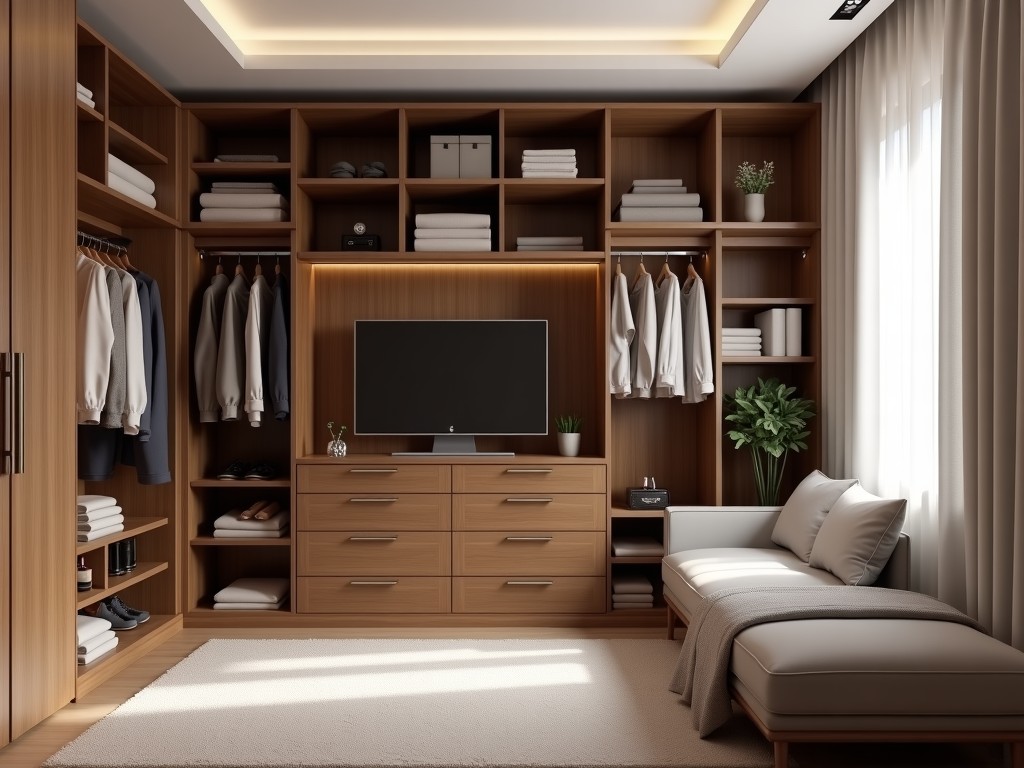
The Custom Closet Company Top Suppliers
Inquire Now
Top Suppliers for Custom Closet Systems
Selecting the right supplier directly influences the dimensional stability, finish durability, and installation efficiency of custom closet systems. Engineers and procurement teams evaluate suppliers based on measurable capabilities such as CNC tolerance, edge‑band adhesion strength, and finish thickness uniformity.
Why Supplier Selection Matters
A supplier that maintains tight tolerances (±0.1 mm) on panel cuts reduces on‑site rework and material waste. Consistent finish thickness (≥0.25 mm UV‑cured coating) ensures long‑term resistance to scratching and moisture ingress in residential environments.
Key Evaluation Criteria
- Dimensional accuracy: CNC routing tolerance, typically ±0.08 mm for 18 mm particleboard.
- Edge‑band adhesion: peel strength ≥1.5 N/mm after 48 h conditioning at 23 °C/50 % RH.
- Finish thickness uniformity: variance ≤0.02 mm across a 300 mm panel.
- Material substrate options: MDF, particleboard, plywood, with density ranges 600–800 kg/m³.
- Production flexibility: ability to run batch sizes from 10 units to 500 units per SKU without retooling penalties.
Typical Supplier Capabilities
| Capability | Typical Range | Notes |
|---|---|---|
| Panel thickness | 12 mm – 25 mm | Available in 1 mm increments. |
| CNC positioning accuracy | ±0.05 mm | Measured on 500 mm travel. |
| Edge‑band types | PVC, ABS, melamine, wood veneer | Adhesive systems: hot‑melt, PUR. |
| Finish options | UV‑cured, water‑based lacquer, laminate | Gloss levels 10–90 GU. |
| Standard lead time | 10–18 working days | Depends on order complexity and material availability. |
Materials and Finishes
Substrate choice affects load bearing, screw retention, and environmental response. For example, 18 mm MDF with density 720 kg/m³ provides a modulus of rupture ≈28 MPa, suitable for shelving loads up to 30 kg per linear meter when supported at 400 mm intervals.
| Material | Density (kg/m³) | Typical Screw Withdrawal (N) | Moisture Expansion (% ) |
|---|---|---|---|
| Particleboard | 600–650 | 800–1000 | 0.3–0.5 |
| MDF | 700–780 | 1100–1300 | 0.2–0.4 |
| Plywood (birch) | 600–700 | 1500–1800 | 0.1–0.3 |
Customization Options
Custom closet systems often require non‑standard dimensions, integrated lighting channels, and specialized hardware mounts. Suppliers that offer parametric CAD‑driven nesting can adjust panel sizes in 1 mm steps while maintaining grain direction consistency across mating parts.
- Variable depth sections: 300 mm–600 mm in 10 mm increments.
- Integrated LED channels: routed 12 mm wide, depth 8 mm, with diffuser provisions.
- Hardware prep: pre‑drilled 5 mm holes for cam dowels, spacing 32 mm grid.
- Edge treatments: rounded 2 mm radius, beveled 45°, or applied PVC edge‑band.
Quality Assurance and Inspection
Quality control typically includes incoming material verification, in‑process dimensional checks, and final audit of finish appearance. A common sampling plan is ANSI/ASQ Z1.4‑2008 Level II, which yields an acceptance quality limit (AQL) of 0.65 % for critical dimensions.
- Panel thickness variance measured at five points per board.
- Edge‑band pull test after 24 h conditioning.
- Gloss meter reading across three locations; deviation ≤5 GU from target.
- Visual inspection for surface defects under 500 lux illumination.
Lead Times, Logistics, Packaging
Efficient nesting reduces scrap, which can shorten cutting time by up to 12 % compared to manual layout. Finished panels are typically stacked on pallets with interleaving corrugated sheets and secured with PET strapping, limiting edge damage during transit.
| Packaging Level | Description | Typical Use |
|---|---|---|
| Standard | Flat‑stacked panels, corner boards, stretch film | Domestic truckload |
| Export | Heat‑treated pallets, moisture barrier, desiccant packs | International container |
| Custom | Custom foam inserts, labelled kits per SKU | High‑mix, low‑volume orders |
Frequently Asked Questions
Yes. Suppliers equipped with CNC routers can produce panels in 1 mm increments within the machine’s working envelope, typically up to 2800 mm × 2070 mm.
A complete Bill of Materials (BOM) listing panel sizes, thicknesses, material grade, finish type, edge‑band specification, and any hardware cut‑outs is needed. CAD files (DXF/DWG) or detailed sketches accelerate the process.
Finish thickness is measured with a dry‑film gauge at five points per panel; gloss is measured with a 60° gloss meter. Results are logged against specification limits and any deviation triggers a rework or scrap decision.
Related Products
Related News

custom closet spatial organization and material performance analysis

Bathroom Taps Technical Analysis
