
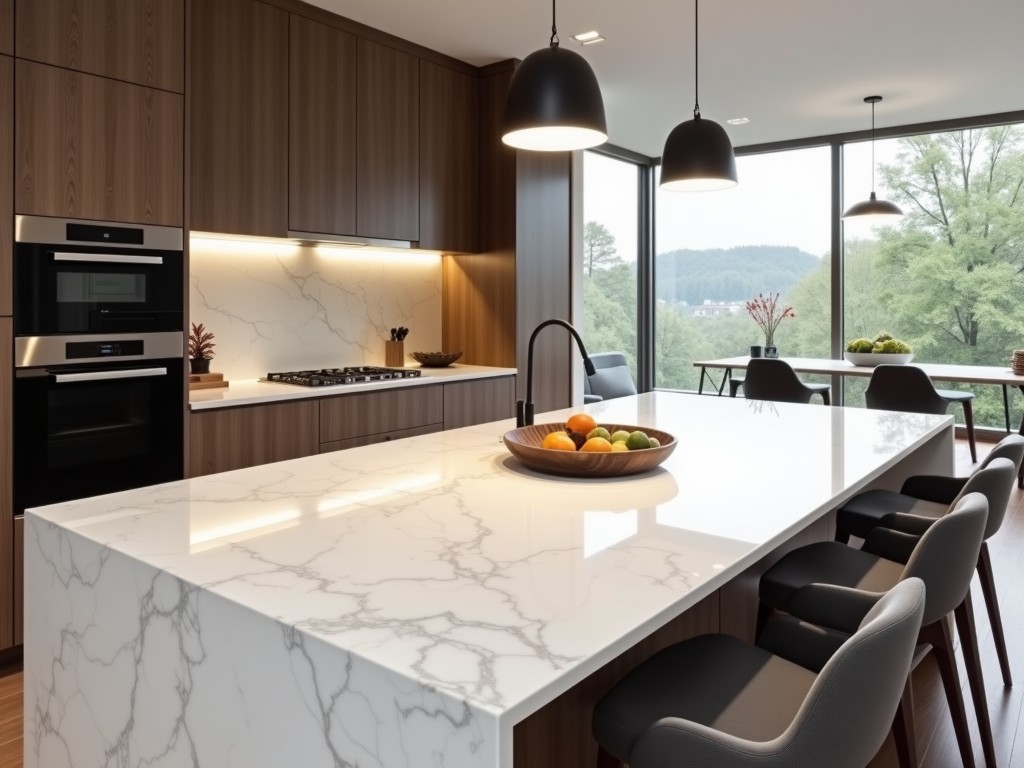
Types Of Quartz Countertops
Inquire Now
Types of Quartz Countertops
Engineered quartz countertops are composite panels made from ground natural quartz crystals bound with polymer resin and pigments. The quartz fraction typically accounts for 90‑95 % of the weight, providing the primary load‑bearing structure, while the resin matrix contributes cohesion and enables surface finishes. This composition results in a non‑porous surface with consistent color distribution.
Material Composition
The quartz aggregate is sourced from quarried silica rock and processed to a granular size ranging from 0.1 mm to 2 mm, which influences packing density and mechanical interlock. Polymer resins, usually unsaturated polyester or acrylic, constitute 5‑10 % of the mix and are cured via exothermic reaction to form a solid matrix. Pigments and additives are dispersed to achieve desired hue, veining, or functional properties such as UV stabilizers.
Classification by Visual Characteristics
Visual appearance is the primary basis for categorizing quartz countertops in architectural specifications. Four common appearance families are recognized: solid‑color, veined, speckled, and recycled‑content panels. Each family is defined by the distribution and contrast of pigments within the quartz‑resin matrix.
- Solid‑color: Uniform pigment dispersion yields a consistent hue across the slab, suitable for applications requiring minimal visual variation.
- Veined: Controlled introduction of contrasting resin streams mimics natural stone veining, producing linear patterns that vary in width and intensity.
- Speckled: Randomly distributed pigment granules create a granular texture reminiscent of natural granite, offering a non‑directional appearance.
- Recycled‑content: Incorporates post‑consumer glass or ceramic particles into the quartz blend, reducing virgin material use while maintaining mechanical performance.
Classification by Finish and Thickness
Beyond visual classification, countertops are differentiated by surface finish and slab thickness, which affect both aesthetics and functional performance. Finishes range from high‑gloss polish to matte honed or textured leathered surfaces, each altering slip resistance and light reflectance. Standard thicknesses are 2 cm (¾ inch) and 3 cm (1¼ inch), with thicker slabs offering increased flexural rigidity for overhangs without additional support.
Performance Characteristics
| Property | Typical Range | Relevance to Application |
|---|---|---|
| Compressive strength | 150‑250 MPa | Indicates load‑bearing capacity for heavy equipment bases. |
| Flexural strength | 40‑60 MPa | Determines resistance to bending under overhangs. |
| Water absorption | ≤0.05 % (by weight) | Ensures stain resistance and hygiene in wet environments. |
| Abrasion resistance | < 100 mm³ loss (Taber abrasion) | Reflects surface durability in high‑traffic areas. |
| Heat resistance (short‑term) | Up to 150 °C for brief contact | Suitable for hot plate placement with limited duration. |
| Stain resistance | No visible staining after 24 h exposure to common reagents | Important for laboratory and food‑service surfaces. |
Applications in Industrial Settings
In environments where hygiene and chemical resistance are critical, quartz countertops provide a seamless, non‑porous surface that inhibits bacterial growth and resists staining from acids, alkalis, and solvents. Their low water absorption simplifies cleaning protocols in laboratories, pharmaceutical facilities, and food preparation areas. Additionally, the consistent appearance supports aesthetic requirements in hospitality and retail spaces while maintaining durability under frequent use.
Selection Considerations for Engineers
When specifying quartz surfaces for structural applications, engineers must evaluate the anticipated load distribution, edge support conditions, and potential thermal cycling. The modulus of elasticity and flexural strength determine allowable overhangs without additional brackets, while the coefficient of thermal expansion informs joint design to prevent cracking. Compatibility with adhesives and sealants used for undermount sinks or backsplashes should also be verified to ensure long‑term bond integrity.
Quality Control and Testing
Quality control begins with raw material verification, including quartz particle size distribution and resin viscosity, to ensure consistent mixing ratios. During production, curing temperature and time are monitored to achieve optimal cross‑linking, which directly influences mechanical performance. Finished slabs undergo dimensional tolerance checks, thickness variation measurement, and surface gloss or roughness assessment to meet specification limits.
Customization Options
Customization extends beyond color selection to include edge profiles such as eased, beveled, ogee, or waterfall, which can be machined to precise radii. Integrated cut‑outs for cooktops, sinks, or appliances are fabricated using CNC routing to maintain structural integrity. Optional features like antimicrobial additives, UV‑stable pigments, or recycled‑content blends can be incorporated based on project‑specific sustainability or performance targets.
Related Products
Related News

custom closet spatial organization and material performance analysis

Bathroom Taps Technical Analysis
