
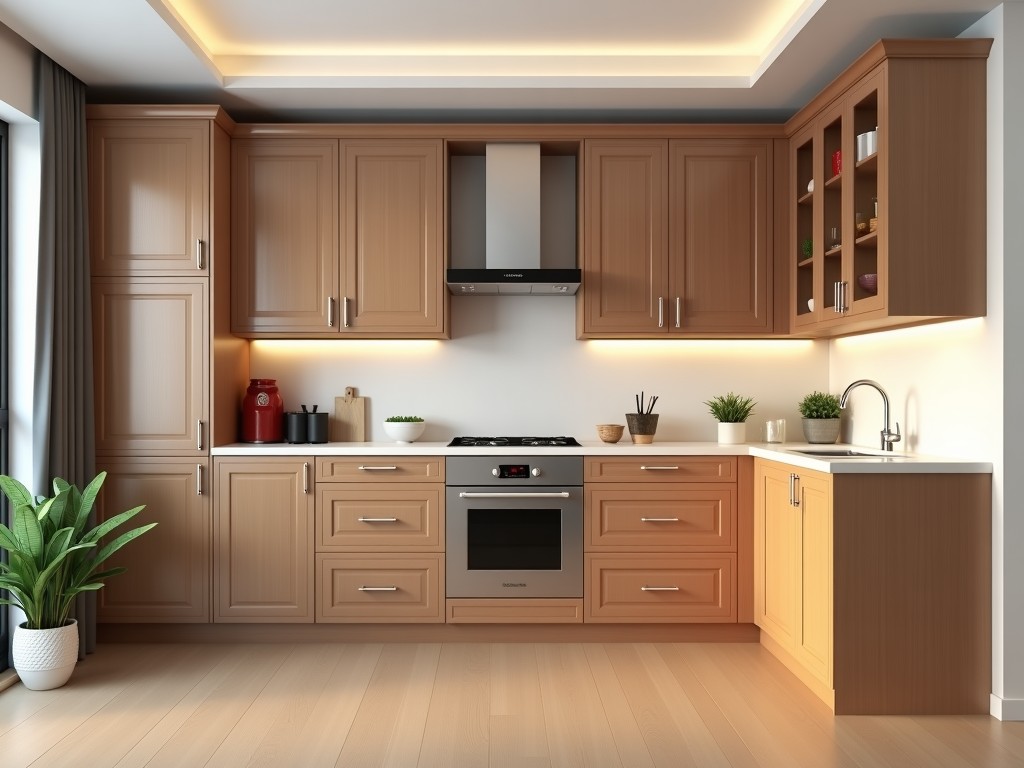
B2B Cheap Custom Kitchen Cabinets
Inquire Now
B2B Custom Kitchen Cabinets – Cost‑Effective Solutions for Commercial Projects
Industrial buyers evaluate kitchen cabinetry based on total cost of ownership, dimensional consistency, and ease of installation across multiple units. For B2B projects such as hotels, student housing, or office break rooms, the ability to repeat exact specifications while controlling material expense directly impacts budget adherence and schedule reliability.
Material choice drives both unit price and long‑term performance. Typical substrates include particleboard (density 600‑650 kg/m³, modulus of elasticity ~2.5 GPa), medium‑density fiberboard (MDF, density 700‑800 kg/m³, modulus ~3.0 GPa), and plywood (density 500‑600 kg/m³, modulus ~4.5 GPa). Higher density generally improves screw hold‑out resistance and reduces edge chipping during handling.
Manufacturing methods affect repeatable tolerances and labor cost. CNC panel saws achieve cutting accuracy within ±0.2 mm, while automated edge‑banding applies PVC or ABS strips with thickness variation under ±0.1 mm. These processes minimize rework and ensure that cabinet carcasses align within a 1.5 mm gap when installed side‑by‑side in a row.
Customization Options
- Overall cabinet dimensions adjustable in 1 mm increments for height, width, and depth.
- Door styles: flat slab, shaker, raised panel, or inset with optional glass inserts.
- Hardware selection: concealed hinges (opening angle 110°), soft‑close drawer slides (dynamic load 30 kg), and pull‑out shelves.
- Finish choices: melamine foil (abrasion resistance 150 cycles), PVC laminate (impact resistance 2 J), or UV‑cured acrylic coating (gloss 80‑90 GU).
- Interior accessories: adjustable shelving (load capacity 20 kg per shelf), pull‑out waste bins, and integrated lighting strips (12 V LED, 400 lm/m).
Material Comparison
| Property | Particleboard | MDF | Plywood | Solid Wood (e.g., Birch) |
|---|---|---|---|---|
| Typical Density (kg/m³) | 620 | 750 | 540 | 650 |
| Modulus of Elasticity (GPa) | 2.5 | 3.0 | 4.5 | 8.0 |
| Moisture Resistance (Swelling % after 24 h) | 12‑15 | 8‑10 | 5‑7 | 3‑5 |
| Relative Cost Index (base = Particleboard) | 1.0 | 1.2 | 1.5 | 2.2 |
Quality Control Philosophy
Each production batch undergoes incoming material verification: density measured via gas displacement, thickness checked with micrometer (±0.05 mm), and moisture content tested to stay within 6‑8 % for interior applications. In‑process checks include CNC program validation (first‑piece inspection) and edge‑band adhesion pull‑test (minimum 1.5 N/mm). Final inspection verifies door alignment (±1.0 mm), hinge operation smoothness (torque <0.2 Nm), and surface finish uniformity (ΔE <2 CIELAB).
Typical Applications
In multifamily housing, cabinet interiors experience frequent loading cycles; the selected substrate’s screw hold‑out resistance (≥150 N for particleboard, ≥250 N for plywood) reduces fastener pull‑out over time. For hospitality environments, resistance to surface abrasion (≥150 cycles for melamine) and ease of cleaning (non‑porous finishes) support hygiene standards while keeping replacement costs low. Office break rooms benefit from modular designs that allow reconfiguration without damaging adjacent units, a feature enabled by cam‑lock connectors rated for 50 kg shear load.
Frequently Asked Questions
Can dimensions be customized to match existing millwork?
Yes. Cabinets are produced to nominal sizes with 1 mm tolerance, allowing alignment with field‑measured openings or existing soffits.
What information is required before quotation?
Project layout (plan view), desired material substrate, door style, hardware specifications, finish type, and quantity per size variant.
Which materials are available for cost‑sensitive projects?
Particleboard with melamine foil offers the lowest unit cost while meeting typical interior load requirements; MDF provides a smoother surface for painted finishes at a modest premium.
How is quality inspected before shipment?
Each unit receives a dimensional check, hardware functional test, and surface appearance audit; a statistical sample (1 % of lot) undergoes load‑cycle testing on doors and drawers.
What packaging methods protect cabinets during transit?
Flat‑packed panels are separated by corrugated dividers, corner protectors applied, and the pallet stretch‑wrapped with 80 µm film; optional foam edge guards available for high‑impact routes.
Next Steps
To obtain a detailed quote tailored to your project’s specifications, provide the layout drawings and material preferences. Our engineering team will review tolerances, generate a cut‑list, and confirm lead times based on current capacity.
Request a QuoteRelated Products
Related News

custom closet spatial organization and material performance analysis

Bathroom Taps Technical Analysis
