
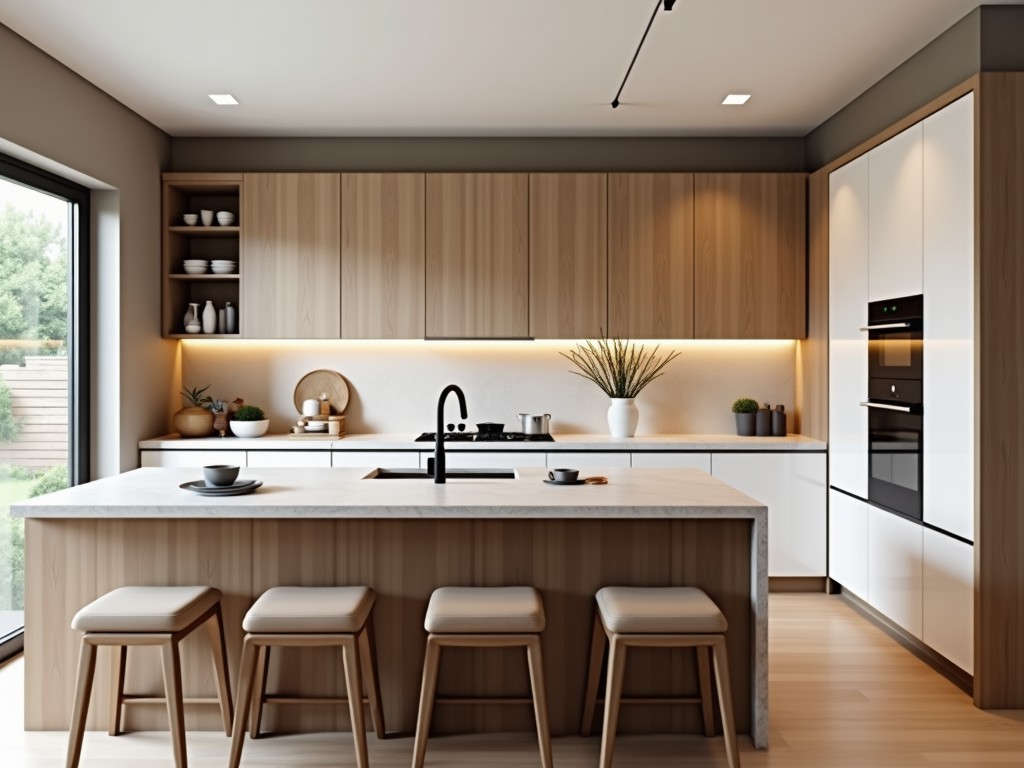
B2B Custom Kitchen Cabinet Makers
Inquire Now
B2B Custom Kitchen Cabinet Makers
Custom kitchen cabinet manufacturers serve businesses that require cabinetry built to exact project specifications rather than off‑the‑shelf units. These suppliers interpret architectural drawings, produce shop‑level CAD models, and fabricate cabinets using CNC cutting, edge banding, and finishing lines that meet dimensional tolerances required for commercial installations.
Material Selection and Structural Characteristics
Core panels are typically chosen from three substrate families: particleboard (density 600‑650 kg/m³, thickness 16‑19 mm), medium‑density fiberboard (MDF, density 700‑800 kg/m³, thickness 16‑19 mm), and hardwood plywood (density 500‑650 kg/m³, thickness 12‑18 mm). Each offers distinct screw‑holding strength, edge‑band adhesion, and resistance to sag under load. For high‑humidity environments, moisture‑resistant (MR) grades or marine plywood are specified, providing swelling rates below 0.2 % after 24 h water immersion.
Door and drawer fronts are fabricated from the same substrate or from solid wood veneers (oak, maple, walnut) with a typical veneer thickness of 0.6 mm. Edge banding is applied using PVC or ABS tape (0.4‑0.6 mm thick) bonded with hot‑melt adhesive, delivering peel strength greater than 1.5 N/mm. The resulting assembly achieves a flexural modulus of approximately 2.5 GPa for particleboard cores, sufficient to support typical door loads of 15‑20 kg per hinge.
Door Styles, Hinge Systems, and Functional Hardware
Three primary door configurations are offered: full overlay (door covers cabinet face frame by 22 mm), half overlay (12 mm), and inset (door sits flush within the frame, requiring 2‑mm clearance). Each configuration influences the required hinge cup depth and reveals. Concealed European hinges are standard, with cup diameters of 35 mm, opening angles of 110°, and static load ratings of 40 kg per hinge. Soft‑close dampers are integrated, providing a closing speed of 0.2 m/s and a damping force of 2 N.
Drawer systems employ side‑mounted ball‑bearing slides (full extension, 450 mm load capacity) or undermount slides (30 mm side clearance, 35 kg load). Slide travel tolerance is held to ±0.2 mm, ensuring smooth operation after 50,000 cycles. Locking mechanisms, when specified, use cam locks with a torque rating of 1.2 Nm, suitable for secure storage in hospitality or laboratory settings.
Customization Process from Design to Delivery
The workflow begins with receipt of architectural CAD files (DWG/DXF) or PDF sketches. Engineers validate dimensions against standard cabinet modules (600 mm width increments) and generate shop drawings that include panel layouts, hardware locations, and edge‑band directions. CNC nesting software optimizes material utilization, targeting a yield of 85‑90 % for sheet goods.
Panels are cut on 5‑axis routers with positional accuracy of ±0.1 mm. Edge banding is applied in-line, followed by sanding to a surface roughness of Ra ≤ 0.8 mm. Finishing options include melamine laminate (thickness 0.15 mm, abrasion rating AC4), UV‑cured acrylic coating (hardness 2H), or water‑based polyurethane (dry film thickness 30 µm, VOC < 50 g/L). Each finish undergoes adhesion testing (cross‑hatch method, classification 5B) before packing.
Completed cabinets are packed in flat‑pack or assembled configurations, using corner protectors, edge foam, and five‑layer corrugated cartons (ECT ≥ 44). Palletized loads are secured with stretch film and strapping, meeting ISPM‑15 standards for export. Typical lead time from approved drawings to ex‑factory shipment ranges from 3‑5 weeks, depending on material availability and finish complexity.
Quality Control Philosophy and Inspection Criteria
Quality assurance is performed at three checkpoints: incoming material, in‑process, and final audit. Incoming panels are checked for thickness variation (±0.2 mm), moisture content (≤ 8 % for MDF, ≤ 12 % for particleboard), and formaldehyde emission (E1 class, ≤ 0.1 ppm). During production, CNC programs are verified via laser measurement of first‑article parts, ensuring dimensional conformity to ±0.3 mm on critical features such as hinge cup centers.
Final inspection includes a functional test of all doors and drawers (open/close cycles 50×), verification of soft‑close engagement, and a visual assessment of finish uniformity under 500 lux illumination. Packaging integrity is confirmed by drop‑test simulation (ISO 2248) at a height of 600 mm on all corners. Only units that pass all criteria receive a release label with a unique serial number for traceability.
Typical Applications in Commercial Projects
Multi‑family residential developers specify custom cabinets to achieve unit‑specific layouts while maintaining a consistent finish across buildings. The ability to replicate door styles and hardware placements reduces on‑site adjustment time, cutting installation labor by an estimated 15‑20 % compared with field‑built casework.
Hospitality projects, such as boutique hotels and extended‑stay suites, require cabinets that resist frequent use and cleaning cycles. MR‑grade substrates paired with UV‑cured acrylic finishes provide surface wear resistance exceeding 400 cycles (Taber Abrader, CS‑10 wheel) and prevent delamination under humid conditions typical of laundry‑adjacent areas.
Office fit‑outs and laboratory environments benefit from the precise dimensional control of custom cabinets, allowing integration with modular wall systems and service conduits. The specified load ratings of hinges and slides ensure that heavy equipment (e.g., analytical balances up to 25 kg) can be stored safely without sagging over a five‑year service life.
Technical Specifications (Typical Values)
| Parameter | Typical Value / Range | Notes |
|---|---|---|
| Core Substrate | Particleboard, MDF, Hardwood Plywood | MR grades available | Panel Thickness | 12‑19 mm | Dependent on load span |
| Door Overlay | Full (22 mm), Half (12 mm), Inset (flush) | Affects hinge cup depth |
| Hinge Type | Concealed European, 110° opening | Soft‑close, 40 kg rating |
| Drawer Slide Load | 35‑45 kg (side‑mount), 30 kg (undermount) | Full extension, ±0.2 mm travel tolerance |
| Finish Options | Melamine (AC4), UV‑Acrylic (2H), Water‑Based PU (30 µm) | Adhesion class 5B (cross‑hatch) |
| Lead Time (Ex‑Factory) | 3‑5 weeks | After drawing approval, material dependent |
| Packaging | Flat‑pack or assembled, 5‑layer carton, ECT ≥ 44 | ISPM‑15 compliant for export |
Frequently Asked Questions
- Can dimensions be customized to match non‑standard module sizes? Yes. CNC programming allows any width, height, or depth within material limits; custom stiles and rails are fabricated to suit project‑specific openings.
- What information is required before a quotation can be issued? Preliminary drawings (plan, elevation, section), material preferences, finish type, hardware specifications, and desired delivery schedule.
- Are edge‑banding materials selectable for different aesthetic or durability needs? Options include PVC (0.4 mm), ABS (0.6 mm), and wood veneer tape, each with distinct peel strength and resistance to heat or moisture.
- How is quality inspected for hardware installation? Torque‑controlled drivers are used for hinge screws (specified 0.8 Nm) and cam locks (1.2 Nm); random pull‑off tests validate adhesion strength (>1.5 N/mm).
- What packaging methods protect cabinets during long‑haul transport? Corner protectors, edge foam, and five‑layer corrugated cartons with strapping; palletized units receive stretch film and corner boards to resist shifting.
- Is it possible to obtain samples of finishes or door styles before full production? Sample panels (300 × 300 mm) with selected finish and edge band can be shipped upon request; lead time is typically 5‑7 business days.
Next Steps
To begin a custom cabinet quotation for your commercial project, provide the project drawings, material preferences, and required hardware. Our engineering team will review the package, generate a detailed cost breakdown, and return a formal proposal within two business days.
Related Products
Related News

custom closet spatial organization and material performance analysis

Bathroom Taps Technical Analysis
