
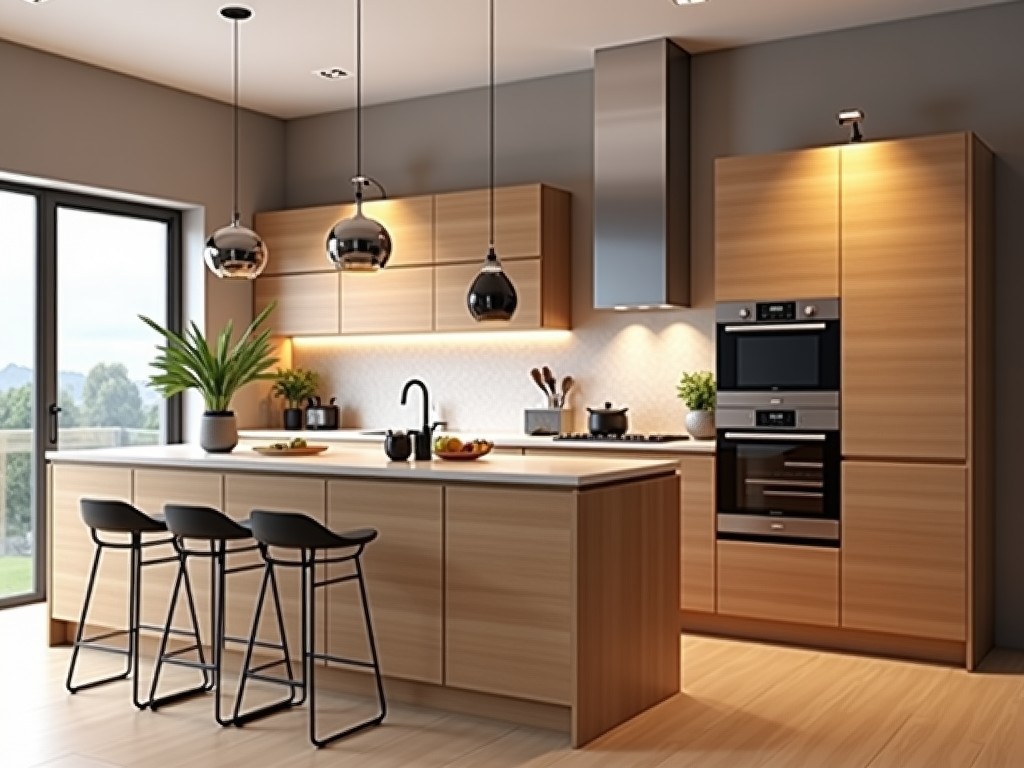
B2B Custom Plywood Kitchen Cabinets
Inquire Now
B2B Custom Plywood Kitchen Cabinets
Overview
Custom plywood kitchen cabinets are fabricated from engineered wood panels that consist of thin veneer layers bonded with adhesive under heat and pressure. The cross‑laminated construction provides dimensional stability, resisting warping and twisting that can affect solid wood in humid kitchen environments.
Material Specifications
Panel thickness typically ranges from 12 mm to 18 mm for carcass construction, while door fronts may use 6 mm to 10 mm veneer‑over‑plywood for reduced weight. Core layers are usually poplar or birch, selected for uniform density (approximately 500–650 kg/m³) and low internal stress.
Adhesive systems meet E1 or CARB2 formaldehyde emission limits, ensuring indoor air quality compliance. Surface finishes can be specified as melamine, PVC laminate, or water‑based UV coating, each offering different abrasion resistance (Taber values 80–150 mg loss per 1000 cycles).
Customization Options
- Cabinet dimensions: width, height, depth adjustable in 1 mm increments to fit modular layouts.
- Door styles: slab, shaker, raised panel, or inset with optional bevel edges.
- Hardware integration: pre‑drilled holes for European hinges, soft‑close runners, and pull‑out accessories.
- Interior accessories: adjustable shelving, pull‑out trays, waste bins, and lighting channels.
- Finish selection: matte, gloss, textured, or wood‑grain veneer with custom color matching.
Manufacturing Process
Panels are cut on CNC routers with positional accuracy ±0.1 mm, ensuring repeatable joint alignment. Edge banding is applied using hot‑melt EVA adhesive, providing a seal that prevents moisture ingress at the panel edges.
Assembly employs dowel, cam, and confir‑mit fasteners, combined with glue‑up under controlled clamp pressure (≈0.5 MPa) to achieve joint shear strength exceeding 2.5 MPa. Post‑assembly, cabinets undergo a 24‑hour conditioning cycle at 20 °C/50 % RH to stabilize dimensions before finishing.
Quality Control
Each batch undergoes dimensional inspection using laser scanners; tolerance limits are ±0.5 mm for overall dimensions and ±0.2 mm for door reveal gaps. Surface finish is evaluated with gloss meters (target 20–80 GU depending on finish) and adhesion cross‑hatch tests (ASTM D3359) requiring a minimum rating of 4B.
Load testing simulates typical kitchen loads: shelves are subjected to 150 kg uniformly distributed weight for 24 hours with deflection limited to 2 mm. All results are recorded and traceable to the production order number.
Applications
Custom plywood cabinets are suited for commercial kitchens, hospitality venues, and multifamily residential projects where consistent performance and rapid installation are critical. The material’s stability reduces callbacks related to seasonal humidity swings, while the ability to match exact dimensions minimizes on‑site filler work.
Technical Data
| Property | Typical Value | Test Method |
|---|---|---|
| Panel Thickness | 12 mm – 18 mm | Caliper measurement |
| Density | 500–650 kg/m³ | ISO 13061-1 |
| Formaldehyde Emission | ≤0.1 ppm (E1) | ASTM D5116 |
| Modulus of Elasticity (Bending) | 2.5–3.5 GPa | ISO 3133 |
| Surface Abrasion Resistance (Melamine) | 80 mg loss/1000 cycles (Taber) | ASTM D4060 |
Frequently Asked Questions
Can dimensions be customized?
Yes. Width, height, and depth can be specified in 1 mm increments to match modular layouts or existing openings.
What information is required before quotation?
A preliminary layout showing cabinet locations, required dimensions, door style preferences, finish type, and hardware specifications enables an accurate quote.
What materials are available?
Core options include poplar, birch, or combination hardwood plies; surface finishes range from melamine laminate to UV‑cured acrylic coatings.
How is quality inspected?
Dimensional checks, finish adhesion, gloss, and load testing are performed per internal standards, with records tied to each production order.
What packaging methods are available?
Cabinets are packed flat‑packed with corner protectors, stretch film, and placed in corrugated cartons rated for 30 kg stacking load; optional palletization is available for bulk orders.
Get a Quote
To discuss your project requirements, provide your layout sketches, material preferences, and target quantities. Our engineering team will review the details and return a detailed quotation within two business days.
Request QuoteRelated Products
Related News

custom closet spatial organization and material performance analysis

Bathroom Taps Technical Analysis
