
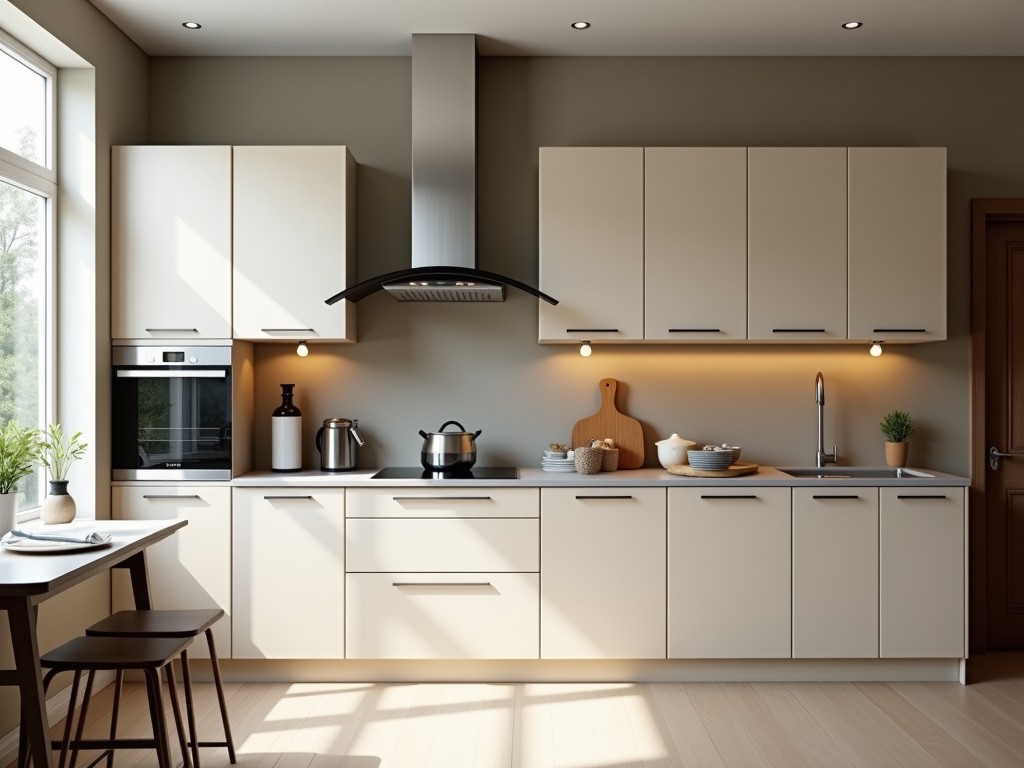
Bulk Custom Metal Kitchen Cabinets
Inquire Now
Bulk Custom Metal Kitchen Cabinets
Industrial kitchens require storage solutions that withstand constant use, moisture, and cleaning agents. Metal cabinets provide dimensional stability, resistance to warping, and predictable load‑bearing performance compared to wood‑based alternatives.
When supplied in bulk, these units can be engineered to match exact layout dimensions, reducing on‑site modifications and installation time.
Material Selection and Properties
Common base materials include cold‑rolled steel (CRS), stainless steel grade 304, and aluminum alloy 5052. CRS is typically supplied at 1.2 mm thickness with a yield strength of approximately 250 MPa, suitable for dry‑area storage. Stainless steel offers corrosion resistance rated to ASTM B117 salt‑spray testing of 500 hours without red rust, ideal for wet zones. Aluminum provides a density of 2.7 g/cm³, delivering a 30 % weight reduction while maintaining a tensile strength of about 190 MPa.
Surface treatments such as powder coating (epoxy‑polyester blend, 80 µm thickness) or clear anodizing (15 µm) add abrasion resistance and further protect against chemical exposure. Coating hardness is measured at 2H–3H on the pencil scale, ensuring durability under routine scrubbing.
Customization Capabilities
Dimensions are adjustable in 1 mm increments for width, height, and depth, allowing tight integration with existing equipment footprints. Door configurations include flush overlay, inset, and sliding panels, each compatible with concealed hinges or roller mechanisms rated for 50,000 cycles.
Interior accessories such as adjustable shelving (25 mm pitch), pull‑out baskets, and utensil dividers can be positioned using threaded inserts welded to the cabinet frame. Hardware options cover stainless steel pulls (100 mm center‑to‑center), magnetic catches, and soft‑close dampers with a closing speed of 0.3 m/s.
All custom features are defined via CAD models (STEP or IGES) submitted by the client, ensuring zero tolerance stack‑up between mating parts.
Manufacturing Process Overview
Production begins with CNC laser cutting of sheet stock to ±0.1 mm positional accuracy. Bent forms are achieved using CNC press brakes with a repeatability of ±0.2° on bend angles. Joints are joined by robotic MIG welding, delivering a bead width of 0.8 mm and penetration depth of 60 % of material thickness.
After welding, assemblies undergo a degreasing bath, followed by a phosphating pretreatment to improve coating adhesion. Powder coating is applied via electrostatic spray guns at 80–100 kV, then cured in a convection oven at 180 °C for 20 minutes, resulting in a uniform film thickness measured by dry‑film DFT gauge.
Quality Control and Testing
Each cabinet undergoes a three‑point dimensional inspection: width, height, and diagonal squareness, with acceptance criteria of ±0.5 mm on linear dimensions and ±1.0 mm on diagonal difference. Surface finish is evaluated using a gloss meter (60° geometry) targeting 70–85 GU for powder‑coated parts.
Load testing places a uniformly distributed weight of 150 kg on each shelf for 24 hours; deflection is measured with a dial indicator and must remain under 2 mm. Corrosion resistance is validated by cyclic salt‑spray exposure (ASTM B117) for 1,000 hours, followed by visual inspection for red rust.
All inspection results are recorded in a digital traceability system linked to the part’s serial number, facilitating audit trails for OEM customers.
Typical Applications
In commercial kitchens, metal cabinets support heavy cookware, bulk ingredient bins, and stainless steel worktables without sagging, maintaining alignment with equipment height standards (typically 900 mm to 950 mm). Their non‑porous surface permits routine sanitation with alkaline detergents and high‑temperature steam, reducing microbial harborage.
Laboratory environments benefit from the material’s resistance to chemical spills (acids, bases, solvents) and its ability to be grounded for static‑dissipative requirements, meeting IEC 61340‑5‑1 standards when equipped with appropriate finishes.
Technical Specifications
| Parameter | Typical Value / Options |
|---|---|
| Base Material | Cold‑rolled steel (CRS), Stainless steel 304, Aluminum 5052 |
| Sheet Thickness | 0.8 mm – 2.0 mm (in 0.2 mm steps) |
| Finish | Powder coating (epoxy‑polyester, 80 µm), Clear anodizing (15 µm), Brushed stainless |
| Door Style | Flush overlay, Inset, Sliding panel |
| Shelf Load Capacity | Up to 150 kg uniformly distributed (deflection <2 mm) |
| Corrosion Resistance | ASTM B117 salt‑spray 500 h (CRS+coating), 1000 h (Stainless 304) |
| Lead Time (bulk order) | 4–6 weeks after drawing approval, dependent on material availability |
Frequently Asked Questions
- Can dimensions be customized to match existing layout? Yes, width, height, and depth are adjustable in 1 mm increments based on supplied CAD models.
- What information is required before quotation? Detailed layout drawings, material preference, finish type, hardware selections, and quantity.
- What materials are available for corrosive environments? Stainless steel grade 304 or 316, optionally with passivation treatment, provides resistance to prolonged exposure to acids and chlorides.
- How is quality inspected? Each unit receives dimensional checks, gloss measurement, load deflection testing, and salt‑spray validation per the specifications above.
- What packaging methods are available for export? Cabinets are packed in corrugated cardboard with corner protectors, wrapped in polyethylene film, and secured on pallets with strapping; custom crating is available upon request.
- What is the typical production lead time? For standard CRS with powder coating, lead time averages 4–6 weeks; stainless steel or aluminum may extend to 6–8 weeks due to material sourcing.
Get a Quote
To begin a bulk order, provide your project specifications including layout dimensions, material choice, finish, and required accessories. Our engineering team will review the documents, confirm tolerances, and return a detailed quotation with lead time and packaging options.
Related Products
Related News

custom closet spatial organization and material performance analysis

Bathroom Taps Technical Analysis
