
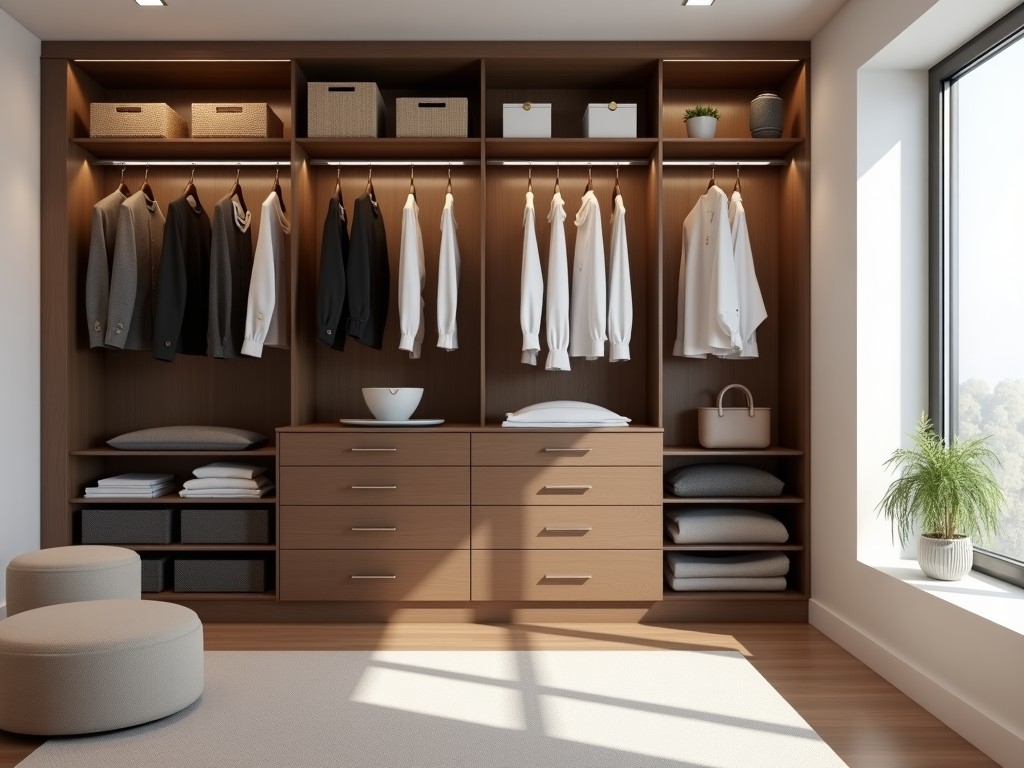
Bulk Custom Walk In Closet Cost Price
Inquire Now
Bulk Custom Walk-In Closet Systems – Cost and Pricing Overview
When ordering walk‑in closet systems in volume, the unit price is driven by a combination of design complexity, material selection, hardware specifications, and production efficiencies. Understanding these variables helps procurement engineers compare quotes and avoid hidden costs.
Design and Engineering Considerations
Each closet layout begins with a CAD model that defines panel dimensions, door swing, shelving depth, and accessory integration. The more non‑standard angles, curved panels, or integrated lighting, the higher the engineering hours required.
For bulk orders, repetitive modules can be standardized to reduce design time, while still allowing customer‑specific finishes within a defined parameter set.
Material Options and Their Cost Impact
- Melamine‑faced particle board – typical density 600‑650 kg/m³, cost baseline for standard finishes.
- Veneer‑covered MDF – offers wood grain appearance, adds ~15‑20 % material cost versus melamine.
- Laminate‑over‑plywood – higher impact resistance, adds ~25‑30 % cost, suitable for high‑traffic commercial installations.
- Metal frame systems (aluminum extrusion) – provides modular adjustability, material cost ~40‑50 % higher than wood‑based panels but reduces on‑site labor.
Manufacturing Process Influences on Price
Panel cutting is performed on CNC routers with tolerance ±0.2 mm. Edge banding is applied via hot‑melt EVA, ensuring seal integrity. For metal frames, extrusion cutting and CNC machining of connector holes are standard.
Batch production allows nesting optimization, reducing raw‑material waste by up to 12 % compared with one‑off cuts. Labor cost per unit drops approximately 8‑10 % when the run exceeds 50 identical modules.
Cost Factors Summary Table
| Cost Factor | Typical Influence on Unit Price | Notes for Bulk Orders |
|---|---|---|
| Panel Material | Base to +30 % depending on finish | Standardize finish across >30 units to lock in volume discount |
| Hardware (hinges, drawer slides) | +5‑15 % (soft‑close adds ~8 %) | Bulk purchasing of hardware reduces per‑unit cost by 10‑12 % |
| Design Complexity (angles, curves) | +10‑25 % engineering time | Group similar complex modules to amortize engineering |
| Surface Treatment (paint, UV coating) | +12‑20 % | Can be applied in line after panel cutting for efficiency |
| Packaging & Logistics | +3‑7 % (depends on distance) | Palletization and flat‑pack design lower freight volume |
Pricing Models for Bulk Purchases
Manufacturers typically quote using a tiered structure:
- Base price per module – calculated from material, hardware, and standard labor.
- Volume discount – applied when order quantity exceeds predefined breakpoints (e.g., 20‑49 units – 5 %; 50‑99 units – 8 %; 100+ units – 12 %).
- Engineering surcharge – one‑time fee for custom design work, spread across the order volume.
- Logistics fee – based on shipment weight and destination, often reduced with full‑truckload loads.
Requesting a detailed quote that separates these components enables the buyer to verify that discounts are applied correctly and to compare alternative material selections.
Quality Assurance and Testing
Dimensional verification is performed on a sampling basis: first article inspection (FAI) checks panel squareness within 0.5 mm and hole location tolerance ±0.1 mm. Functional testing includes 5,000 cycle operation of drawer slides and hinge load testing to 150 N.
Surface finish adhesion is evaluated via cross‑hatch test (ASTM D3359) with a target rating of 4B or better. For coated panels, UV stability is assessed after 500 hours of accelerated exposure, targeting <2 ΔE color shift.
Lead Times and Packaging
Standard production lead time for a bulk order of 50‑200 units ranges from 3 to 4 weeks after design approval, assuming material availability. Expedited options can reduce this to 10‑12 working days with a corresponding surcharge.
Units are flat‑packed in corrugated cardboard with corner protectors, then stacked on pallets and stretch‑wrapped. Each pallet includes a packing list and QR code linking to the installation guide.
Frequently Asked Questions
Yes. While the panel system uses a standard module grid, individual widths, heights, and depths can be adjusted in 1 mm increments. Custom dimensions are treated as a design variation and may affect the engineering surcharge.
Q: What information is required before receiving a quotation?A preliminary layout sketch or CAD file, desired material finish, hardware preferences (e.g., soft‑close hinges), estimated quantity, and delivery destination. Providing a bill of materials for accessories (lighting, rods) improves quote accuracy.
Q: How is quality inspected before shipment?Each production lot undergoes first article inspection, random dimensional checks (5 % of units), and functional hardware testing. A final visual inspection verifies surface finish and edge banding integrity before packaging.
Q: What packaging methods are available for export shipments?Standard export‑grade pallets with ISPM‑15 compliant wood, corner boards, and moisture‑barrier film. Optional wooden crates or reusable plastic totes are available upon request for high‑value or fragile configurations.
Q: What is the typical production lead time?For orders of 50‑200 units with standard melamine finish, lead time is 3‑4 weeks post‑design approval. Lead times extend proportionally with specialty finishes or non‑standard hardware.
Related Products
Related News

custom closet spatial organization and material performance analysis

Bathroom Taps Technical Analysis
