
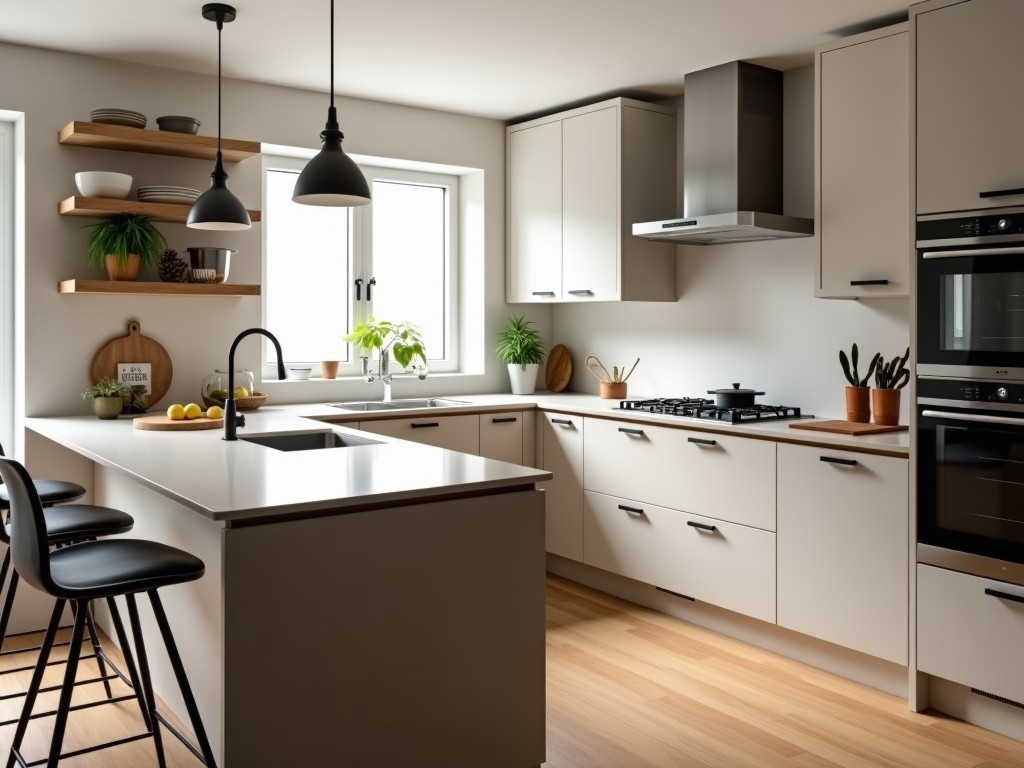
Buy Best Custom Kitchen Cabinets
Inquire Now
Buy Best Custom Kitchen Cabinets
Custom kitchen cabinets are fabricated to match specific dimensional, load‑bearing, and aesthetic requirements of a project. The manufacturing process begins with detailed shop drawings that define panel thicknesses, joint types, hardware locations, and finish specifications.
Overview of Custom Kitchen Cabinet Manufacturing
Panel components are typically cut from sheet stock using CNC routers to achieve tolerances within ±0.2 mm. Edge banding is applied with hot‑melt adhesive to seal exposed cores and provide a uniform surface for finishing. Cabinet boxes are assembled using dowel, cam, or confirmat fasteners, which allow disassembly for site adjustments if required.
Material Selection and Performance Characteristics
The choice of substrate influences stiffness, moisture resistance, and screw holding strength. Common substrates include particleboard, medium density fibreboard (MDF), and plywood, each offering distinct mechanical properties.
| Material | Density (kg/m³) | Modulus of Elasticity (GPa) | Typical Use | Customization Notes |
|---|---|---|---|---|
| Particleboard | 600‑700 | 2.5‑3.5 | Standard carcasses, shelving | Available with melamine, veneer, or lacquer finishes |
| MDF | 700‑800 | 3.0‑4.0 | Door panels, decorative mouldings | Machinable to complex profiles; accepts paint uniformly |
| Plywood (birch core) | 500‑650 | 4.0‑5.5 | High‑load cabinets, wet‑area units | Can be left exposed or overlaid with veneer/laminate |
Customization Process and Design Flexibility
Design input is received as CAD files or detailed sketches. Engineers verify clearance for appliances, calculate required reinforcement for heavy countertops, and generate nesting layouts to optimize material yield. Adjustable shelving systems, pull‑out mechanisms, and integrated lighting channels are incorporated as parametric features within the CAD model.
Hardware selection includes soft‑close hinges rated for 30 000 cycles, drawer slides with dynamic load capacities of 35 kg, and mounting brackets tested to withstand shear forces of 1.2 kN. All hardware is pre‑drilled to match the specified cabinet layout, reducing on‑site labor.
Quality Control and Inspection Protocol
Each production lot undergoes three inspection stages: incoming material verification, in‑process dimensional checks, and final assembly audit. Material verification confirms thickness, density, and formaldehyde emissions per EN 717‑1. In‑process checks use laser measurement systems to validate panel squareness and edge‑band adhesion strength (>1.5 N/mm). Final audit includes functional testing of hinges and slides, surface finish uniformity (ΔE<2), and packaging integrity.
- Material thickness tolerance ±0.1 mm
- Door alignment gap ≤1.5 mm
- Soft‑close cycle endurance ≥20 000
- Finish adhesion (cross‑hatch) rating 5B per ASTM D3359
Applications in Commercial and Residential Projects
In multi‑family residential developments, cabinets are specified for unit kitchens where rapid installation and consistent appearance reduce schedule risk. The ability to produce matching vanity units and storage columns from the same material batch ensures aesthetic continuity across bathrooms and kitchens.
For commercial food‑service environments, cabinets are constructed from marine‑grade plywood with sealed edges to resist moisture ingress and cleaning agents. Load‑rated shelving supports heavy pots and equipment, while hardware meets NSF/ANSI 2 standards for food‑zone safety.
Technical Specifications
| Parameter | Value / Range | Standard / Reference |
|---|---|---|
| Panel Thickness | 16 mm, 18 mm, 22 mm | Customer‑specified |
| Edge Band Thickness | 0.4 mm – 2.0 mm PVC or ABS | EN 14322 |
| Hinge Opening Angle | 110° (optional 165°) | BS EN 15570 |
| Drawer Slide Load Capacity | 25 kg – 40 kg (dynamic) | DIN 4554 |
| Formaldehyde Emission | ≤0.05 ppm (class E1) | EN 717‑1 |
Frequently Asked Questions
- Can dimensions be customized to match existing wall studs? Yes, cabinets are produced to exact width, height, and depth based on field measurements supplied by the client.
- What information is required before quotation? A layout plan, material preference, hardware specifications, and finish details are needed to generate an accurate cost estimate.
- What materials are available for humid environments? Marine‑grade plywood, moisture‑resistant MDF, and PVC‑coated particleboard are offered with sealed edges.
- How is quality inspected before shipment? Each unit undergoes dimensional verification, hardware functional testing, and finish audit as outlined in our QC protocol.
Related Products
Related News

custom closet spatial organization and material performance analysis

Bathroom Taps Technical Analysis
