
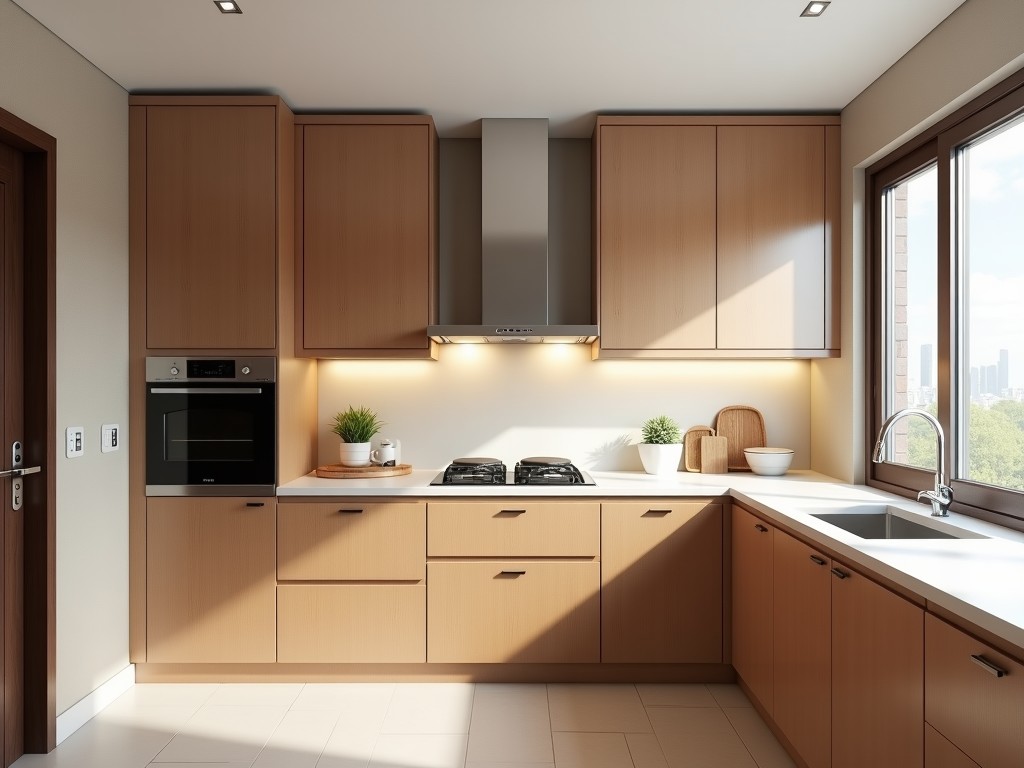
China Custom Kitchen Cabinet Fronts
Inquire Now
China Custom Kitchen Cabinet Fronts
Industrial buyers require cabinet fronts that meet precise dimensional tolerances, resist moisture and chemical exposure, and integrate seamlessly with modular framing systems. This page explains the engineering considerations behind custom cabinet fronts sourced from China, focusing on measurable specifications, material behavior, and quality controls that reduce procurement risk.
Overview of Core Requirements
Kitchen cabinet fronts in commercial environments face repeated cleaning cycles, temperature fluctuations, and occasional impact from kitchen equipment. The primary performance criteria include edge stability under humidity changes, surface hardness to resist scratching, and adhesive bond strength for laminated overlays. Meeting these criteria begins with substrate selection and continues through finishing and assembly.
Material Selection and Properties
Substrates are chosen based on modulus of elasticity, moisture absorption rate, and screw holding capacity. Common options include:
- Medium-density fiberboard (MDF) with density 680‑720 kg/m³, thickness tolerance ±0.2 mm, formaldehyde emission ≤0.05 ppm (CARB Phase 2).
- Particleboard with density 600‑650 kg/m³, thickness tolerance ±0.3 mm, internal bond strength ≥0.8 MPa.
- Marine-grade plywood, 5‑ply, cross‑banded, thickness tolerance ±0.2 mm, water absorption ≤5 % after 24 h soak.
Dimensional Tolerances and Fit
Consistent gap dimensions are essential for door alignment and hardware function. The following table shows typical tolerances that can be held on CNC‑routed panels; tighter values are available upon request.
| Parameter | Typical Tolerance | Measurement Method |
|---|---|---|
| Overall width | ±0.3 mm | Caliper at three points |
| Overall height | ±0.3 mm | Caliper at three points |
| Thickness | ±0.2 mm | Micrometer mid‑span |
| Edge squareness | ≤0.2 mm deviation over 100 mm | Feeler gauge |
| Hole center distance (for hinges) | ±0.15 mm | Coordinate measuring machine |
Surface Finish Options
Finishes affect both appearance and durability. The table below lists common finishes with their key performance metrics.
| Finish Type | Abrasion Resistance (Taber cycles) | Chemical Resistance (ISO 2812‑1) | UV Stability (ΔE after 500 h) |
|---|---|---|---|
| Melamine laminate | ≥1500 | Rating 5 (no change) | ≤2 |
| PVC foil | ≥2000 | Rating 5 | ≤1.5 |
| UV‑cured acrylic coating | ≥3000 | Rating 5 | ≤0.8 |
| Water‑based polyurethane | ≥2500 | Rating 4‑5 | ≤1.2 |
Customization Workflow
The process translates customer drawings into production files while maintaining traceability. Steps include:
- Receipt of CAD/DXF files with material callouts and finish specifications.
- Design for manufacturability review: checking tool clearance, grain direction, and edge banding feasibility.
- Nesting optimization to maximize sheet utilization, targeting ≥85 % yield.
- CNC routing and drilling, with in‑process measurement of critical dimensions.
- Edge banding application using hot‑melt adhesive, peel strength tested ≥1.5 N/mm.
- Surface finishing per selected method, followed by curing time verification.
- Final inspection: dimensional check, visual defect grading, and adhesion test.
- Packaging: flat‑pack with corner protectors, humidity‑indicating cards, and stretch‑film wrapping.
Quality Assurance Philosophy
Quality control is built into each operation rather than relying solely on end‑of‑line testing. Key control points are:
- Material lot verification: density, moisture content, and emission testing upon receipt.
- In‑process dimension sampling every 20 parts, with SPC charts for width, height, and thickness.
- Adhesive bond test on a sample edge‑banded piece using ASTM D903 peel test.
- Surface finish inspection under 45° lighting for gloss uniformity and defect detection.
- Functional test of hardware installation: hinge torque and drawer slide smoothness.
- Random audit of packaged units for corner protection and label accuracy.
Applications in Industrial Kitchens
In high‑volume food service facilities, cabinet fronts must endure constant opening and closing, exposure to steam, and occasional contact with cleaning agents. The selected substrates and finishes described above provide:
- Dimensional stability that prevents door warping, maintaining consistent reveal gaps for seamless alignment with adjacent units.
- Surface hardness that resists scratching from utensil trays and impact from pots, extending service life before refinishing is required.
- Low VOC emissions that comply with indoor air quality standards for commercial kitchens, supporting health and safety certifications.
- Ease of cleaning due to non‑porous finishes, allowing routine wiping with approved detergents without surface degradation.
Technical Specification Summary
| Attribute | Value / Range |
|---|---|
| Substrate thickness | 16 mm, 18 mm, 22 mm (customizable) |
| Maximum panel size | 1220 mm × 2440 mm (standard sheet) |
| Edge band thickness | 0.4 mm – 2.0 mm (PVC, ABS, wood veneer) |
| Finish gloss level | 10 % – 90 % (matte to high gloss) |
| Production lead time | 15‑25 working days after final drawing approval (depends on complexity) |
| Packaging | Flat‑pack, 5‑layer corrugated corner protectors, stretch film, humidity indicator |
Frequently Asked Questions
A: Yes. Width, height, and thickness can be adjusted to ±0.1 mm increments based on provided CAD data.
Q: What information is required before quotation?
A: Panel dimensions, substrate choice, finish type, edge band material, hardware hole locations, and any special tolerances.
Q: What materials are available for sustainable projects?
A: Low‑formaldehyde MDF (CARB Phase 2, FSC‑certified upon request) and recycled‑content particleboard are offered.
Q: How is quality inspected?
A: In‑process SPC on critical dimensions, adhesion testing of edge bonds, and visual finish grading per ISO 12944‑5.
Q: What packaging methods protect against moisture during transit?
A: Each panel is wrapped in moisture‑resistant stretch film, placed in a corrugated crate with corner protectors, and includes a humidity indicator card.
Q: How are export shipments handled?
A: Goods are loaded onto pallets, secured with strapping, and shipped via FCL or LCL with standard export documentation (commercial invoice, packing list, certificate of origin).
Q: What is the typical production lead time?
A: 15‑25 working days after drawing approval; expedited options are available for urgent projects.
Get a Quote
To begin a quotation, please provide your project specifications via the contact form. Our engineering team will review the files, confirm tolerances, and return a detailed cost breakdown within one business day.
Request QuoteRelated Products
Related News

custom closet spatial organization and material performance analysis

Bathroom Taps Technical Analysis
