
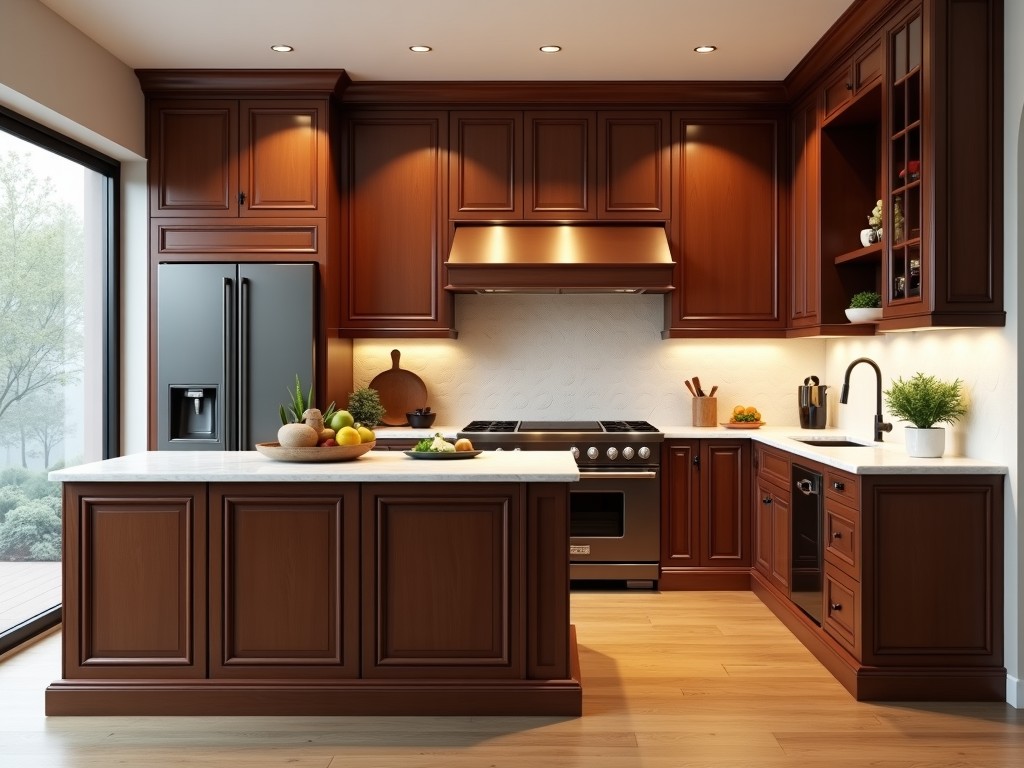
China Custom Rustic Kitchen Cabinets
Inquire Now
China Custom Rustic Kitchen Cabinets
Overview of Rustic Cabinet Construction
Rustic kitchen cabinets are characterized by visible grain, distressed finishes, and robust joinery that emulate traditional craftsmanship while meeting modern durability requirements.
Typical panel thickness ranges from 18 mm to 22 mm for carcass and 16 mm to 18 mm for doors, providing sufficient rigidity to resist sagging over spans of 600 mm or more.
Material Options and Performance Characteristics
Solid wood species such as European oak, American maple, and reclaimed pine are commonly selected for their inherent hardness (Janka rating 1200–1500 lbf) and ability to accept hand‑applied stains.
Engineered alternatives include multi‑ply birch plywood with a minimum of 5 plies and a face veneer thickness of 0.6 mm, offering dimensional stability under humidity fluctuations of ±15 % RH.
- Solid wood: moisture content stabilized to 8 % ± 2 % before machining.
- Plywood: cross‑band orientation reduces warp to less than 0.5 mm over 1 m length.
- MDF with melamine overlay is avoided for rustic finishes due to limited grain visibility.
Design Flexibility and Customization Parameters
Cabinet dimensions are adjustable in 1 mm increments to accommodate specific kitchen layouts, with standard base cabinet heights of 720 mm, 760 mm, or 800 mm and wall cabinet heights of 360 mm, 420 mm, or 480 mm.
Door styles include raised panel, slab, and shiplap, each achievable with a variety of edge profiles such as ogee, bevel, or square.
- Finish options: hand‑rubbed oil, water‑based lacquer (30 µm dry film thickness), or distressed chalk paint.
- Hardware: soft‑close hinges rated for 50,000 cycles, concealed drawer slides with 30 kg dynamic load capacity.
- Accessories: pull‑out spice racks (150 mm width), integrated wine holders (diameter 80 mm), and adjustable shelving pins (5 mm diameter).
Manufacturing Workflow and Tolerance Control
Raw panels are CNC‑cut to ±0.2 mm positional accuracy, followed by edge banding with PVC or wood veneer applied at 180 °C to achieve a bond strength exceeding 1.5 MPa.
Joinery utilizes dowel‑reinforced mortise‑and‑tenon joints, with dowel diameters of 8 mm and insertion depth of 20 mm, providing shear resistance comparable to traditional dovetail.
Finishing involves a two‑stage sanding sequence (120 grit then 220 grit) before stain application, ensuring surface roughness (Ra) below 0.8 µm for uniform coating adhesion.
Inspection and Testing Protocols
Each cabinet undergoes a dimensional audit: width, height, and depth measured at three points, with acceptable deviation limited to ±0.5 mm.
Finish adhesion is tested via cross‑hatch ASTM D3359; a rating of 5B (no peeling) is required before packaging.
Load testing of doors and drawers is performed at 150 % of rated capacity for 10 cycles to verify long‑term functionality.
- Visual inspection for grain consistency and distress uniformity under 500 lux lighting.
- Moisture content verification post‑finish (target 6 % ± 1 %).
- Packaging integrity: corner protectors and 5‑mm corrugated cardboard to withstand 15 kg stacking pressure.
Typical Industrial and Commercial Applications
Beyond residential kitchens, these cabinets are specified for hotel suites, restaurant service stations, and institutional food‑prep areas where a warm aesthetic must coexist with high‑frequency use.
The structural design supports countertop overhangs of up to 150 mm without additional brackets, suitable for solid surface or quartz tops weighing up to 80 kg per linear meter.
In high‑humidity environments such as coastal resorts, the selected plywood core with sealed edges maintains dimensional change below 0.3 % over a 12‑month period.
Technical Specifications
| Parameter | Typical Value / Range |
|---|---|
| Carcass thickness | 18 mm – 22 mm solid wood or plywood |
| Door thickness | 16 mm – 18 mm |
| Panel density (solid wood) | 600 – 750 kg/m³ |
| Moisture content (post‑finish) | 6 % ± 1 % |
| Finish dry film thickness | 30 µm (lacquer) or 50 µm (oil) |
| Hinge cycle rating | ≥ 50,000 cycles |
| Drawer slide load capacity | 30 kg dynamic |
| Edge bond strength | > 1.5 MPa |
| Surface roughness (Ra) | ≤ 0.8 µm |
| Standard lead time | 4–6 weeks (depends on complexity) |
Frequently Asked Questions
- Can dimensions be customized? Yes, width, height, and depth are adjustable in 1 mm increments to match site measurements.
- What information is required before quotation? Detailed layout drawings, material preference (solid wood species or plywood), finish type, hardware specifications, and required quantities.
- What materials are available? European oak, American maple, reclaimed pine, multi‑ply birch plywood, and optional MDF with veneer for non‑visible panels.
- How is quality inspected? Dimensional tolerance checks, finish adhesion (ASTM D3359 5B), moisture content verification, and load cycle testing.
- What packaging methods are available? Flat‑pack with corner protectors, 5‑mm corrugated cardboard, and optional wooden crates for overseas shipments.
- How are export shipments protected? Palletized, stretch‑wrapped, and fitted with humidity indicator cards to monitor transit conditions.
- What is the typical production lead time? 4–6 weeks after approval of final drawings, subject to material availability.
- How are samples arranged? Sample doors or cabinet sections can be shipped via express courier; charges are credited against the first order.
Request a Technical Quotation
To begin a custom rustic kitchen cabinet project, please submit your layout drawings, material preferences, and finish requirements. Our engineering team will review the specifications and return a detailed quotation with lead‑time estimates.
Submit InquiryRelated Products
Related News

custom closet spatial organization and material performance analysis

Bathroom Taps Technical Analysis
