
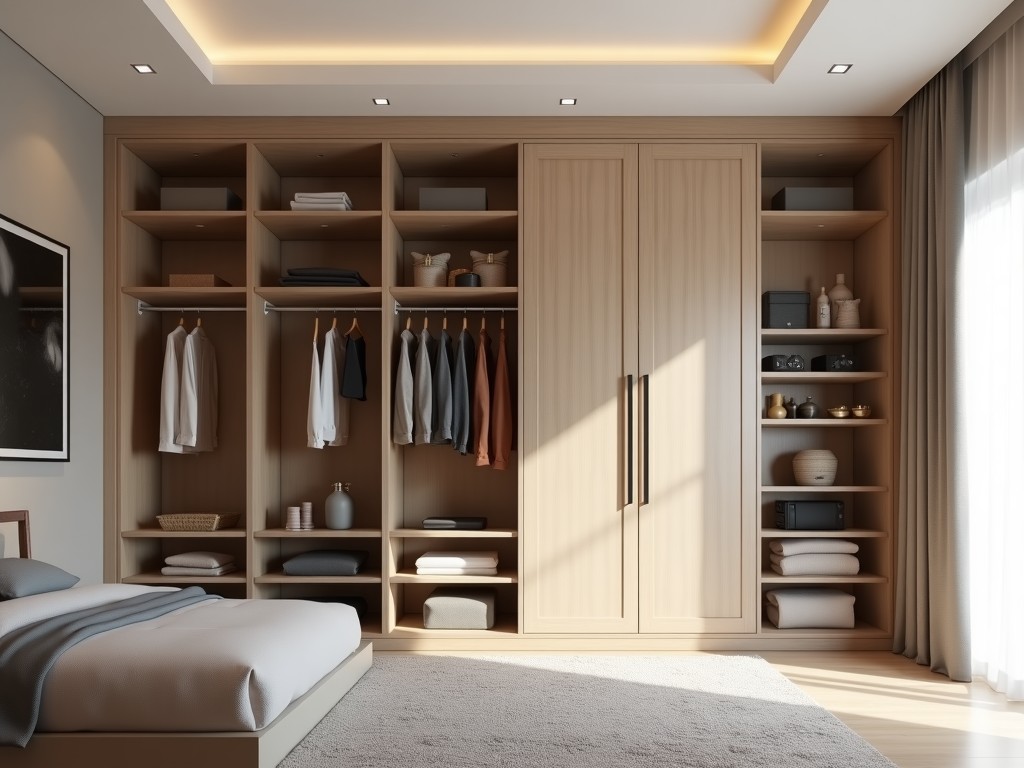
Custom Built In Closet Cost
Inquire Now
Custom Built-In Closet Cost: Factors, Materials, and Value
The total price of a built‑in closet depends on three primary cost drivers: material selection, dimensional complexity, and labor intensity. Each driver can be quantified and compared across projects to estimate a realistic budget before detailed design begins.
Material choice influences both unit price per square foot and long‑term maintenance. Typical panel substrates range from 18 mm particleboard (≈ $12/ft²) to 25 mm moisture‑resistant MDF (≈ $18/ft²) and to 30 mm hardwood veneer (≈ $35/ft²). Hardware such as soft‑close hinges and drawer slides adds a fixed per‑unit cost that varies with load rating and cycle life.
Material Selection and Its Cost Impact
Panel thickness directly affects stiffness and deflection under load. A 25 mm MDF panel with a 0.7 mm laminate finish exhibits a flexural modulus of approximately 3.5 GPa, sufficient for shelf loads up to 30 kg per linear meter without noticeable sag.
Surface finishes are specified by abrasion resistance (Taber test) and moisture swelling. A melamine‑faced board with a Taber wear index of ≤ 80 mg/1000 cycles provides a scratch‑resistant surface suitable for high‑traffic wardrobe interiors.
- Particleboard core: density 600–650 kg/m³, typical cost $10–$14/ft².
- MDF core: density 700–800 kg/m³, typical cost $16–$22/ft², offers smoother finish for paint or veneer.
- Hardwood veneer over MDF: species such as oak or maple, cost $30–$45/ft², provides natural grain and higher impact resistance.
Design Complexity and Labor Requirements
Labor cost scales with the number of unique cut‑outs, dado joints, and hardware installations. A standard rectangular reach‑in closet with two fixed shelves and a hanging rod typically requires 4–6 hours of carpentry time per unit.
Adding features such as pull‑out shoe racks, integrated lighting, or angled corner units increases the part count and introduces additional machining steps. Each pull‑out module adds approximately 1.2 hours of labor due to drawer slide installation and alignment.
Shop drawings and CNC nesting efficiency also affect material waste. Optimized nesting can reduce scrap from 12 % to under 6 %, directly lowering material cost per square foot.
Typical Cost Ranges (USD)
The following table shows indicative price ranges for a 2 m × 0.6 m × 2.4 m reach‑in closet, including panels, hardware, and labor. Actual quotes vary with project‑specific dimensions, finish level, and regional labor rates.
| Configuration | Material Tier | Estimated Cost (USD) |
|---|---|---|
| Basic reach‑in, 2 shelves, rod | Particleboard core, melamine finish | $620 – $780 |
| Standard reach‑in, 3 shelves, rod, soft‑close hinges | MDF core, painted finish | $850 – $1,050 |
| Premium reach‑in, 4 shelves, rod, pull‑out shoe rack, LED lighting | Hardwood veneer, UV‑cured coating | $1,300 – $1,650 |
Value Engineering and Long‑Term Considerations
Selecting a substrate with higher moisture resistance reduces the risk of swelling in humid environments, which can extend service life by 5–8 years compared to standard particleboard. This durability translates into lower lifecycle cost despite a higher upfront material price.
Hardware rated for 50,000 cycles (e.g., soft‑close hinges) maintains consistent operation over a typical residential usage pattern of 10 cycles per day for over 13 years. Specifying such hardware avoids premature replacement and associated labor.
Design for disassembly—using cam locks and modular brackets—facilitates future reconfiguration or relocation, preserving up to 70 % of the original material value in retrofit scenarios.
Frequently Asked Questions
Request a Detailed Quote
To obtain a project‑specific estimate, provide the closet dimensions, desired interior layout, and finish preferences. Our engineering team will review the inputs and return a itemized cost breakdown within one business day.
Related Products
Related News

custom closet spatial organization and material performance analysis

Bathroom Taps Technical Analysis
