
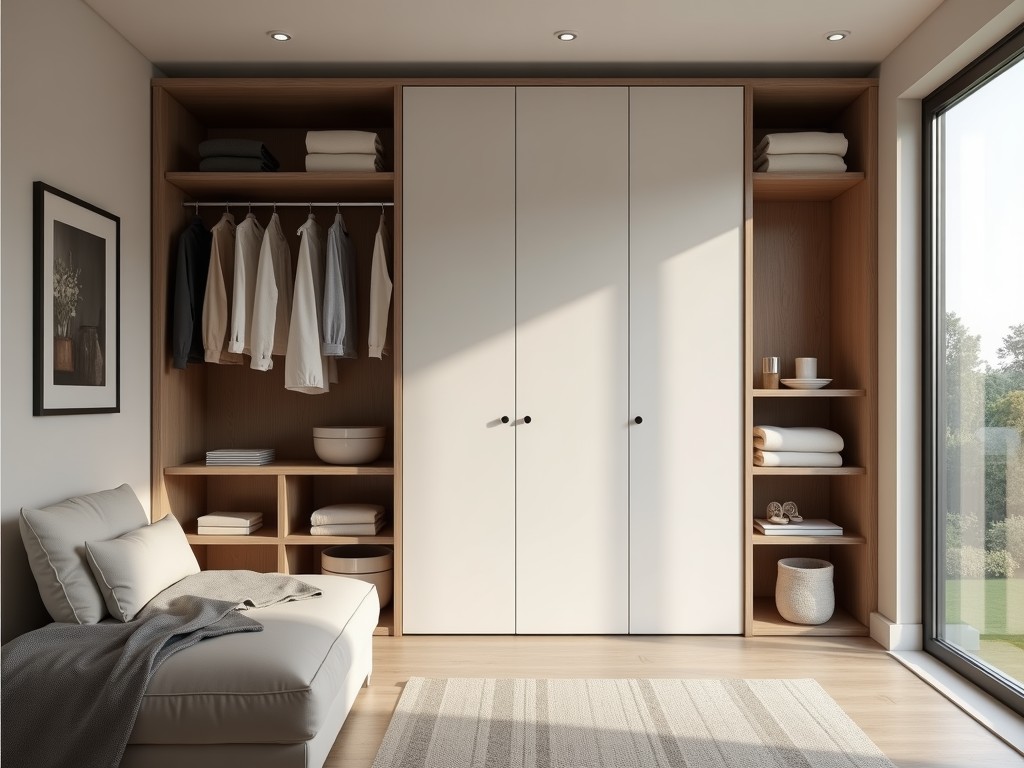
Custom Built Linen Closet Factory
Inquire Now
Custom Built Linen Closet Factory
A linen closet factory produces storage units designed for textiles, linens, and related household goods. The design must accommodate variable load densities, frequent access, and environmental conditions such as humidity fluctuations in residential or commercial settings.
Design and Engineering Approach
Engineers begin by analyzing the required storage volume, door opening frequency, and panel deflection limits. Finite element analysis is used to size shelving thicknesses and bracket spacings so that sag remains under 0.5 mm under a uniform load of 40 kg per shelf.
Modular framing allows reconfiguration without structural compromise. Connection details employ shear‑resistant dowels and cam locks that provide a tensile capacity exceeding 2 kN per joint, verified by pull‑out testing per ASTM F1667.
Material Selection
| Material | Typical Density (kg/m³) | Moisture Resistance (RH %) | Finish Options |
|---|---|---|---|
| Particleboard (E1) | 650 | ≤65 | Melamine, PVC laminate |
| MDF (CARB2) | 720 | ≤70 | Paint, veneer, laminate |
| Plywood (Baltic birch) | 600 | ≤80 | Clear coat, stain, laminate |
| Steel (cold‑rolled, galvanized) | 7850 | ≤95 (with coating) | Powder coat (RAL colors) |
Customization Capabilities
- Overall dimensions adjustable in 50 mm increments for height, width, and depth.
- Shelf pitch variable from 200 mm to 400 mm with optional removable dividers.
- Door types: hinged, sliding, or bi‑fold, each with soft‑close dampers rated for 50 000 cycles.
- Interior accessories: pull‑out baskets, tilt‑out hampers, and integrated lighting (LED strips, 12 V, IP44).
- Surface finishes: matte, gloss, textured, or antimicrobial coating upon request.
Manufacturing Process
Panels are cut on CNC routers with positional accuracy ±0.1 mm. Edge banding is applied via hot‑melt adhesive at 180 °C, providing a bond strength greater than 1.2 MPa. All components undergo pre‑assembly checking for squareness using laser triangulation.
Assembly lines utilize pneumatic clamps that apply a consistent 250 N force, ensuring joint alignment before fastener insertion. Fasteners are torque‑controlled to 2.5 Nm ±10 %, documented via embedded data loggers for traceability.
Quality Assurance
| Inspection Item | Method | Acceptance Criterion |
|---|---|---|
| Dimensional tolerance | CMM measurement | ±0.5 mm on critical faces |
| Shelf deflection under load | Dial gauge, 40 kg uniform load | ≤0.5 mm mid‑span |
| Door closing force | Force gauge, cyclic test | 15 N–25 N, <5 % variation over 5 000 cycles |
| Surface adhesion (laminate) | Cross‑hatch tape test (ASTM D3359) | Rating 5B (no removal) |
Industrial Applications
Linen closets supplied to hotels must withstand high‑frequency use by housekeeping staff and resist moisture from laundering areas. The specified steel frame with powder‑coat finish provides corrosion resistance in environments with relative humidity up to 80 % and allows rapid re‑configuration for room refurbishment cycles.
In healthcare facilities, closets store sterile linens and require surfaces that tolerate disinfectant wipes. Choosing melamine‑coated particleboard with sealed edges ensures minimal particle release and compatibility with hospital‑grade cleaning agents, reducing contamination risk.
Frequently Asked Questions
- Can dimensions be customized? Yes, height, width, and depth are adjustable in 50 mm modules to fit specific floor plans.
- What information is required before quotation? Required details include overall dimensions, desired material, shelf layout, door type, and any accessories such as lighting or pull‑out baskets.
- What materials are available? Particleboard, MDF, plywood, and galvanized steel, each with multiple finish options.
- How is quality inspected? Dimensional checks, load deflection tests, door force measurements, and adhesion assessments are performed on each production batch per the table above.
- What packaging methods are available? Units are packed in flat‑pack kits with corner protectors, stretch film, and palletized for export; optional crate packaging is available for high‑value projects.
- How are export shipments protected? Pallets are strapped and wrapped with VCI film to inhibit corrosion during transit; shock indicators monitor handling.
- What is the typical production lead time? Lead time ranges from 4 to 6 weeks after drawing approval, depending on material availability and order complexity.
- How are samples arranged? Sample panels or door assemblies can be shipped upon request; freight charges apply and are credited against the final order.
Get a Quote
To discuss your project requirements, provide the dimensions, material preference, and accessory list. Our engineering team will return a detailed quotation with lead time and pricing within two business days.
Request a QuoteRelated Products
Related News

custom closet spatial organization and material performance analysis

Bathroom Taps Technical Analysis
