
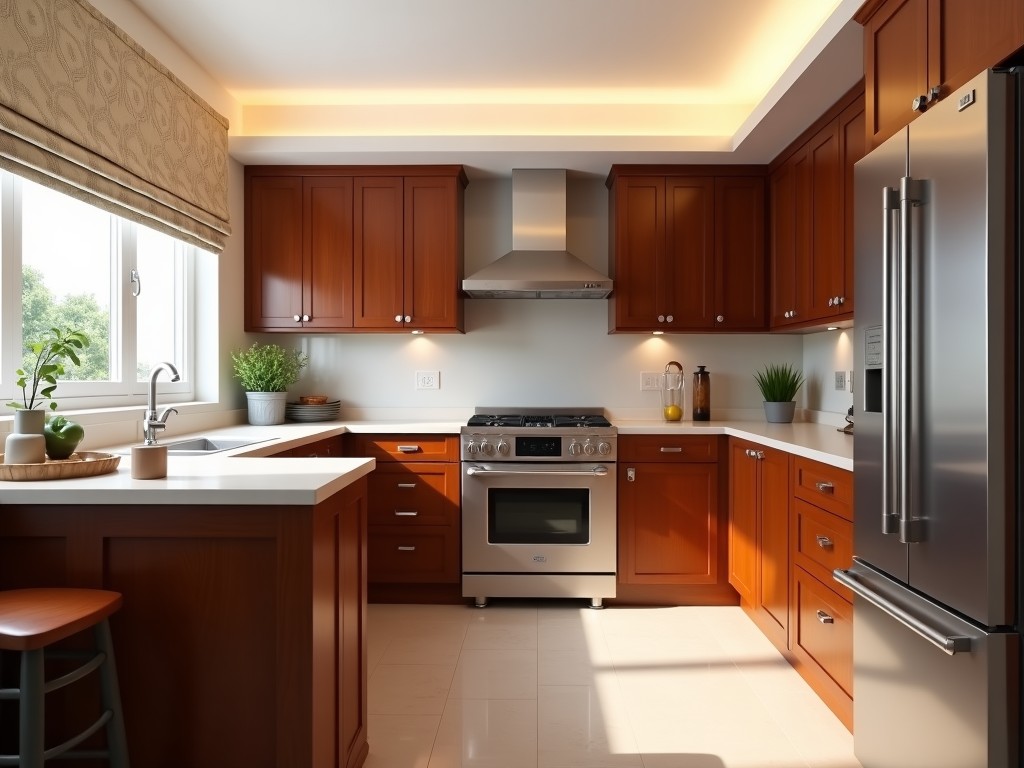
Custom Cherry Kitchen Cabinets Factory
Inquire Now
Custom Cherry Kitchen Cabinets Factory
Overview
Cherry wood exhibits a fine, uniform grain with a natural reddish hue that deepens over time. Its moderate hardness provides resistance to dents while allowing clean machining for tight joinery.
Factories select cherry for applications where aesthetic continuity and dimensional stability are priorities, particularly in exposed cabinetry where finish consistency affects long‑term appearance.
Material Selection
Solid cherry boards are sourced from kiln‑dried lumber with moisture content stabilized between 6 % and 8 %. Each board is inspected for knots, sap streaks, and grain orientation before entering production.
- Select grade – minimal knots, uniform color
- #1 Common – allowable small knots, suitable for painted or stained finishes
- #2 Common – larger character marks, used where rustic appearance is accepted
Customization Process
Design flexibility begins with precise CAD modeling that captures door styles, overlay configurations, and interior accessory layouts. Adjustments to dimensions, reveal sizes, and hardware locations are processed in the digital nest before any material is cut.
- Door styles: raised panel, shaker, slab, beaded inset
- Overlay types: full overlay, partial overlay, inset
- Interior accessories: pull‑out shelves, blind corner organizers, spice racks
- Hardware locations: pre‑drilled 32 mm system, custom hole patterns per client spec
Manufacturing & Tolerances
Cabinet panels are cut to a tolerance of ±0.5 mm on length and width, ensuring consistent reveal alignment across multi‑unit installations. Edge banding is applied with hot‑melt adhesive to achieve a bond strength exceeding 1.2 MPa.
- Panel cutting: CNC saw with laser positioning
- Joinery: dowel, mortise‑and‑tenon, or cam lock systems based on load requirements
- Sanding progression: 80 → 120 → 180 grit before finishing
- Finish application: UV‑cured clear coat or solvent‑based stain system
Quality Control
Each unit undergoes dimensional verification using calibrated CMM probes to confirm cabinet squareness within 0.3 mm per diagonal. Finish thickness is measured with dry‑film gauges to ensure coating uniformity of 35‑45 µm.
- Visual inspection for color variation, grain matching, and surface defects
- Functional test of door swing, hinge alignment, and drawer glide travel
- Packaging integrity check: corner protection, barrier film, and pallet stability
Applications
In residential kitchens, cherry cabinets provide a warm tonal base that complements both traditional and transitional design schemes, reducing the need for extensive staining or glazing.
Multi‑family developments benefit from the material’s consistent aging characteristics, which helps maintain a uniform appearance across units over years of occupancy.
- Custom home kitchen suites
- High‑end apartment renovations
- Commercial break‑room cabinetry where aesthetic appeal impacts employee satisfaction
- Boutique hotel suite kitchenettes
Technical Specifications
| Parameter | Typical Value | Notes |
|---|---|---|
| Material | Solid American Black Cherry | Available in Select, #1 Common, #2 Common grades |
| Moisture Content | 6‑8 % | Kiln‑dried to stabilise movement |
| Density | ≈0.55 g/cm³ | Typical for hardwood species |
| Hardness (Janka) | ≈950 lbf | Suitable for cabinet doors and frames |
| Standard Thickness | Door: 16 mm • Box: 18 mm | Custom thicknesses available per project |
| Finish Options | Clear coat, stain, glaze, painted | UV‑cured or solvent‑based systems |
| Edge Profile | Square, eased, ogee, custom | Profiles defined in CAD |
| Hardware Mounting | Pre‑drilled 32 mm system | Alternative patterns per client specification |
| Lead Time | 4‑6 weeks | Depends on order volume and complexity |
Frequently Asked Questions
Contact Us
Submit your project specifications for a technical review and a detailed quotation.
Request a QuoteRelated Products
Related News

custom closet spatial organization and material performance analysis

Bathroom Taps Technical Analysis
