
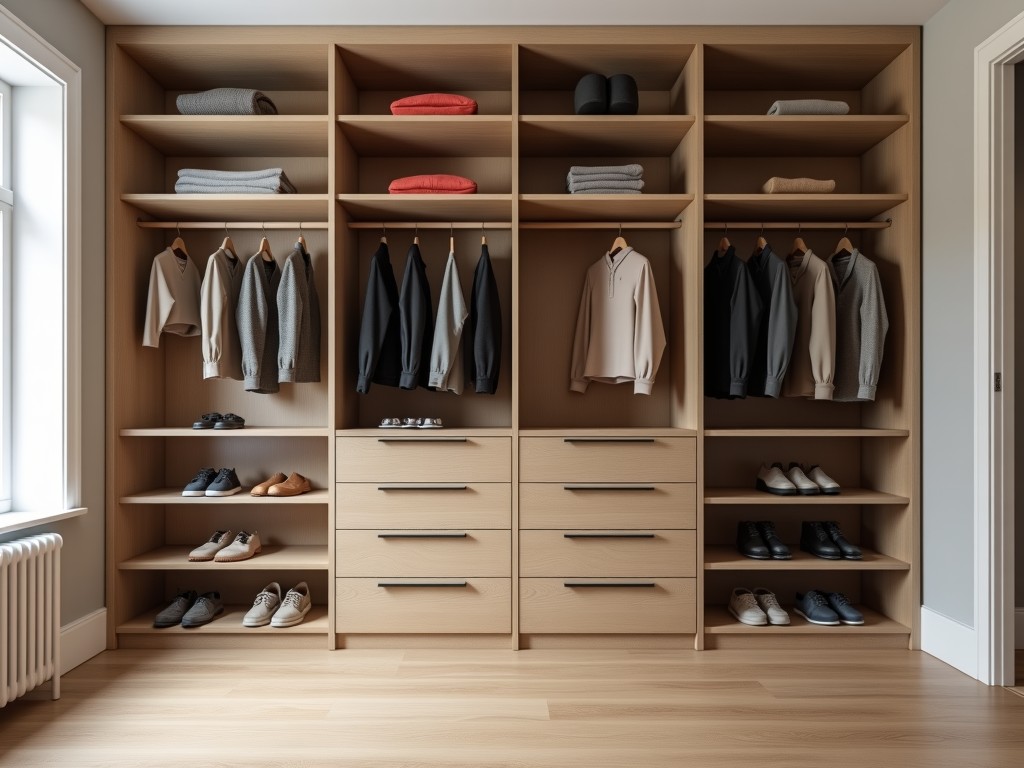
Custom Closet Organizer Shelving Storage Systems
Inquire Now
Custom Closet Organizer Shelving Storage Systems
Overview
Closet organizer systems are modular framing assemblies that support shelves, rods, and accessories within residential or commercial storage spaces. They are engineered to accommodate variable load patterns while maintaining dimensional stability over repeated adjustment cycles.
Typical configurations use vertical uprights with perforated mounting slots, allowing shelf brackets to be repositioned in increments of 25 mm or 32 mm. This adjustability reduces the need for permanent fixtures and supports re‑layout as storage requirements evolve.
Material Options
Selecting the appropriate base material influences corrosion resistance, weight, and finish adhesion. The following table summarizes common choices for the structural members and shelf panels.
| Material | Typical Thickness (mm) | Finish Options | Corrosion Resistance (ISO 9223) |
|---|---|---|---|
| Cold‑rolled steel | 1.2 – 2.0 | Powder coat (epoxy/polyester), galvanized | C3 – medium |
| Stainless steel (AISI 304) | 1.0 – 1.5 | Brushed, passivated | C5 – very high |
| Aluminum alloy 6063 | 1.5 – 2.5 | Anodized (clear, color), powder coat | C4 – high |
| High‑density particleboard (melamine faced) | 16 – 25 | Melamine laminate, PVC edge | C1 – low (indoor only) |
Design & Customization
Modularity is achieved through standardized mounting patterns that accept a range of accessories without re‑machining. This enables specifiers to tailor the system to specific storage mixes while keeping part counts low.
- Adjustable shelf brackets with 25 mm increment slots.
- Interchangeable hanging rods for garments, available in solid steel or tubular aluminum.
- Optional pull‑out baskets and drawer modules that attach to the same upright rails.
- Integrated LED strip channels powered by low‑voltage drivers, rated for 12 V DC.
- Door accessories including bifold, sliding, or hinged panels with concealed hinges.
All mating surfaces are designed to tolerate ±0.2 mm positional variance, ensuring repeatable fit after multiple re‑configurations.
Load & Performance Specifications
Structural capacity is defined by the maximum uniformly distributed load per shelf before elastic deformation exceeds allowable limits. Values depend on material, span, and bracket geometry.
| Shelf Span (mm) | Material | Max Uniform Load (kg) | Deflection Limit (mm) |
|---|---|---|---|
| 600 | Cold‑rolled steel (1.5 mm) | 80 | ≤ 2 |
| 600 | Stainless steel (1.2 mm) | 70 | ≤ 2 |
| 900 | Aluminum 6063 (2.0 mm) | 55 | ≤ 3 |
| 900 | Particleboard (18 mm melamine) | 30 | ≤ 4 |
Safety factors are applied per EN 14749 for storage equipment, typically 1.6 × yield strength for steel components.
Typical Applications
Residential walk‑in closets benefit from the system’s ability to reconfigure shelf heights as seasonal clothing volumes change, reducing the need for permanent built‑in millwork.
Multi‑family developments specify the organizer for unit‑level storage because the modular frames can be installed quickly, demounted for turnover, and reused across projects, lowering lifecycle cost.
Retail environments use the same uprights to support display fixtures, allowing merchandisers to adjust product presentation without structural alterations.
Quality Assurance
Each production lot undergoes dimensional inspection of upright hole patterns using CMM probes, with positional tolerance held to ±0.15 mm. Finish adhesion is measured via cross‑hatch tape test per ASTM D3359, targeting a rating of 5B.
Load verification is performed on a representative sample from each batch, applying incremental weights until deflection reaches the prescribed limit, then recording the ultimate load. Results are retained for traceability.
Material certificates are supplied for steel and aluminum grades, confirming compliance with ASTM A1008/A1008M and ASTM B209 respectively.
Frequently Asked Questions
- Can dimensions be customized? Yes, upright lengths, shelf depths, and accessory spacing are adjusted per project drawings; standard increments are 25 mm for vertical adjustment and 50 mm for horizontal depth.
- What information is required before quotation? Required inputs include overall enclosure dimensions, desired shelf count, load expectations per shelf, material preference, and any accessory types (rods, baskets, lighting).
- What materials are available? See the Material Options table; additional grades such as marine‑grade aluminum or coated galvanized steel are available upon request.
- How is quality inspected? Dimensional checks, finish adhesion testing, and load verification as described in the Quality Assurance section.
- What packaging methods are available? Components are packed in corrugated cartons with interleaving foam panels; palletized shipments use stretch wrap and corner protectors for export.
- How are export shipments protected? Each pallet receives a moisture‑barrier liner and is secured with steel straps to prevent shifting during transit.
- What is the typical production lead time? Lead time ranges from 3 to 4 weeks after receipt of approved drawings, depending on material availability and order complexity.
- How are samples arranged? Sample kits containing a representative upright, shelf bracket, and finish swatch can be dispatched within 5 business days; charges are credited toward the first order.
Request a Quote
To begin a quotation, provide your project specifications via the contact form or email. Our engineering team will review load requirements, material selections, and delivery timelines before issuing a formal proposal.
Related Products
Related News

custom closet spatial organization and material performance analysis

Bathroom Taps Technical Analysis
