
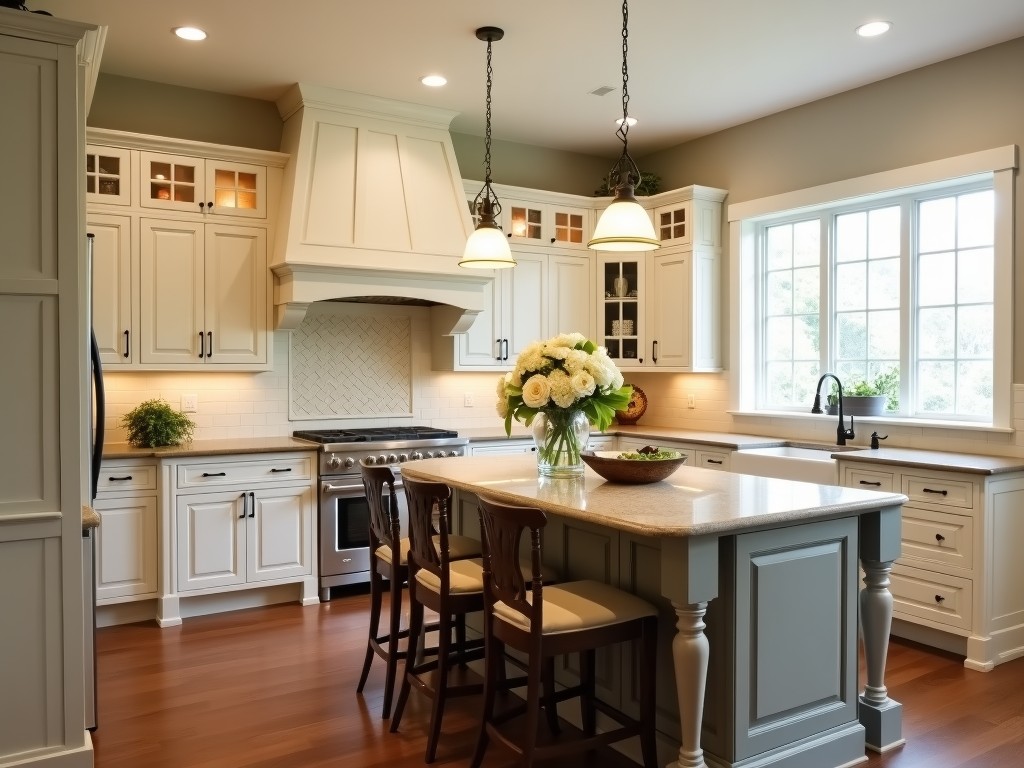
Custom Country Kitchen Cabinets Suppliers
Inquire Now
Custom Country Kitchen Cabinets Suppliers
Selecting the right cabinet supplier involves evaluating both design flexibility and manufacturing precision.
For country‑style kitchens, the aesthetic must balance rustic charm with the durability required in commercial food‑service settings.
Material Selection and Performance
Solid hardwood offers a dense grain structure, typically exhibiting a modulus of rupture around 100 MPa and excellent screw holding capacity.
Engineered plywood consists of multiple veneer layers bonded with phenolic resin, providing dimensional stability with expansion coefficients below 0.002%/°C.
MDF panels feature a uniform density of approximately 700 kg/m³, allowing consistent CNC routing but requiring edge sealing to prevent moisture uptake.
Structural Design and Joinery Techniques
Joinery method directly affects cabinet rigidity and load‑bearing capability.
Traditional dovetail joints provide tensile shear resistance exceeding 2.5 kN per joint, making them suitable for drawer boxes.
Euro‑style cam locks and confirmat screws enable rapid assembly while maintaining alignment tolerances within ±0.2 mm.
Reinforcing corner blocks with plywood gussets increases racking resistance by approximately 30% compared to unreinforced frames.
Customization Workflow
The process starts with precise field measurements captured via laser scanning or digital templating.
These measurements feed into parametric CAD models that automatically generate cabinet layouts, stile and rail dimensions, and hardware placements.
CAM software then drives 5‑axis CNC routers to cut panels to tolerances of ±0.1 mm, ensuring repeatable fit across production runs.
Finish application follows a controlled spray booth schedule, with UV‑cured coatings achieving hardness ratings of 2H on the pencil scale.
Quality Assurance and Testing
Dimensional verification uses coordinate measuring machines to confirm that overall cabinet height, width, and depth remain within ±0.5 mm of nominal.
Door swing tests perform 50,000 cycles at 90° to verify hinge durability and hinge cup wear under load.
Finish adhesion is assessed via ASTM D3359 tape test, requiring a minimum rating of 4B for acceptable performance.
Packaging includes corner protectors, stretch film, and palletizing with ISPM‑15 compliant wood to reduce transit damage.
Typical Applications in Food Service and Hospitality
Country‑style cabinets are often installed in upscale diners, boutique hotels, and institutional kitchens where visual warmth supports brand identity.
The design accommodates easy cleaning surfaces, with sealed edges preventing ingress of food particles and moisture.
Load requirements for pantry storage typically reach 150 kg per shelf, which the described joinery and panel thickness can sustain without deflection.
| Feature | Typical Value | Customizable According to Project Requirements |
|---|---|---|
| Panel Thickness | 18‑22 mm (solid wood or plywood) | Yes – options include 16 mm MDF or 25 mm hardwood |
| Door Overlay | Full overlay | Yes – partial overlay, inset available |
| Hinge Type | Concealed soft‑close | Yes – exposed, self‑close, or heavy‑duty |
| Finish Type | UV‑cured polyurethane | Yes – lacquer, laminate, or custom paint |
| Interior Shelf Load Capacity | 150 kg uniformly distributed | Yes – reinforced shelving or adjustable brackets |
| Lead Time | 4‑6 weeks after approval | Yes – expedited 2‑week option available |
Frequently Asked Questions
Q: Can dimensions be customized to fit irregular wall layouts?
A: Yes. Our CNC programming accepts parametric inputs, allowing non‑standard widths, heights, and depths while maintaining joint integrity.
Q: What information is required before a quotation can be issued?
A: Preliminary layout sketches, desired material species, finish preferences, hardware specifications, and any regulatory constraints (e.g., fire‑rating).
Q: Which wood species are available for country‑style doors?
A: Common choices include maple, white oak, hickory, and cherry, each offered in select, #1 common, or rustic grades.
Q: How is finish adhesion validated for high‑humidity environments?
A: Finish samples undergo ASTM D3359 cross‑hatch tape testing after 24‑hour exposure to 90 % relative humidity at 38 °C, with a minimum pass rating of 4B.
Q: What packaging methods protect cabinets during overseas shipment?
A: Cabinets are wrapped in polyethylene film, fitted with cardboard corner guards, placed on ISPM‑15 heat‑treated pallets, and secured with polyester strapping.
Q: Are samples available for finish and material evaluation?
A: Yes. Sample doors measuring 300 mm × 300 mm can be shipped upon request, typically within five business days.
Get Started
Related Products
Related News

custom closet spatial organization and material performance analysis

Bathroom Taps Technical Analysis
