
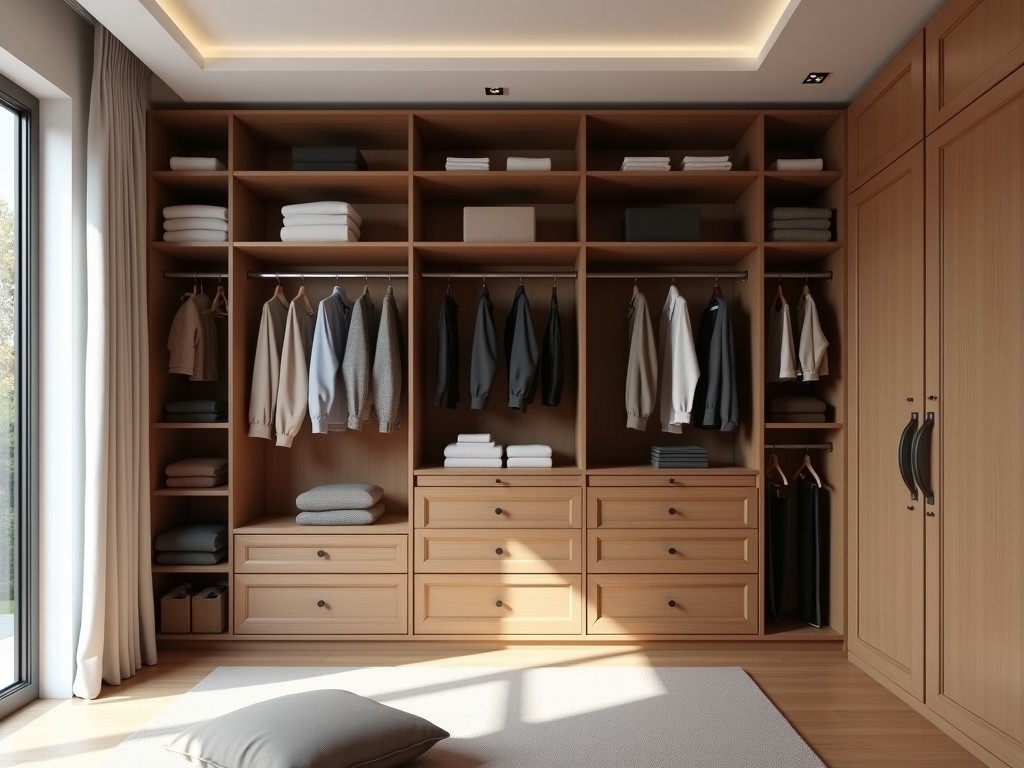
Custom Factory Average Cost Of A Custom Closet
Inquire Now
Understanding the Average Cost of a Custom Closet from a Factory
The price of a custom closet produced in a factory setting depends on several measurable variables. These include material selection, dimensional complexity, hardware specifications, and surface finish requirements.
Material choice often drives the largest portion of the total cost. Common options range from particleboard with melamine laminate at approximately $12 per square foot to hardwood veneered plywood exceeding $35 per square foot. Thickness typically varies from 16 mm for shelving to 25 mm for load‑bearing uprights.
Labor and machine time are calculated based on cutting, edge banding, drilling, and assembly operations. A standard CNC panel saw can process a 4‑by‑8 sheet in about 45 seconds, while edge banding adds roughly 12 seconds per linear meter. Drilling for shelf pins and hinge holes averages 0.8 seconds per hole. Assembly time per unit averages 18 minutes when using pre‑drilled cam locks and confirmit fasteners. Overhead costs such as fixture depreciation and quality inspection are allocated at a rate of $8 per machine hour.
Hardware and accessories contribute a separate line item. Typical soft‑close hinges cost $4.20 each, while full‑extension drawer slides average $9.50 per pair.
Surface finishing options include PVC edge banding, veneer staining, or powder‑coated metal accents. PVC edge banding adds $0.60 per linear foot, whereas a stained veneer finish can increase material cost by 18 %. Powder‑coated steel brackets are priced at $3.10 each.
Typical Cost Breakdown
| Cost Component | Typical Range (USD per unit) | Notes |
|---|---|---|
| Materials (panel stock) | $180 – $420 | Based on 2 m × 2.4 m footprint, 18 mm core |
| Labor & machining | $90 – $150 | Cutting, edge banding, drilling, assembly |
| Hardware (hinges, slides, fasteners) | $30 – $55 | Soft‑close hinges, full‑extension slides |
| Finishing (edge banding, stain, coating) | $20 – $45 | PVC banding or veneer stain |
| Overhead & QC | $25 – $40 | Fixture depreciation, inspection |
| Total Estimated Cost | $345 – $710 | Standard reach‑in closet, two shelves, one rod |
These figures are indicative for a standard 2‑meter wide, 2.4‑meter high reach‑in closet with two adjustable shelves and a single hanging rod. Actual quotations will reflect project‑specific dimensions, door configurations, and any integrated lighting or accessory modules. Factories typically provide a detailed cost sheet that breaks down each line item for transparency.
Customization Options
Customization extends beyond dimensions to include functional and aesthetic choices that affect both cost and lead time. The following options are commonly available from factory‑based suppliers.
- Adjustable shelf systems with pin‑hole increments of 32 mm
- Integrated LED lighting strips with drivers rated for 12 V DC
- Pull‑out accessories such as trouser racks, tie holders, and jewelry drawers
- Door variants: sliding, hinged, or bi‑fold with optional soft‑close mechanisms
- Interior finishes: matte, gloss, or textured laminate; veneer staining; or powder‑coated metal panels
Lead time depends primarily on the complexity of the selected options. A basic configuration without lighting or specialty hardware typically moves through production in 7‑10 business days. Adding integrated lighting or custom door mechanisms can extend the schedule to 12‑16 business days due to additional wiring, testing, and finishing steps.
Quality Assurance
Factories apply a series of measurable checks to ensure dimensional accuracy and surface integrity. Panel squareness is verified within ±0.2 mm across a 1‑meter span using calibrated laser gauges. Edge band adhesion is tested with a 90‑degree peel test targeting a minimum bond strength of 1.5 N/mm. Hardware installation torque is recorded to confirm fastener preload stays within 10 % of specification. Final inspection includes a visual scan for surface defects under 500 lux illumination, with acceptance criteria of no visible blemishes larger than 0.5 mm.
Applications in Industrial Settings
Factories excel at producing closet systems for multi‑family housing, hospitality, and healthcare projects where repeatability and material consistency reduce on‑site variability. The ability to nest panels on standard 4‑by‑8 sheets minimizes waste, while CNC drilling ensures hole placement accuracy that aligns with prefabricated wall studs. This repeatability translates into lower installation labor and fewer field modifications, which is valuable for large‑scale rollouts.
Frequently Asked Questions
What information is required before a quotation?
Overall dimensions (width, height, depth), desired interior layout (shelves, rods, drawers), material preference, hardware specifications, and any finish or lighting requirements.
Can dimensions be customized to fit irregular spaces?
Yes. Factories can adjust panel sizes in 1‑mm increments and produce filler strips or scribe pieces to accommodate out‑of‑square openings.
How is quality inspected before shipment?
Each unit undergoes dimensional checks, edge‑band adhesion testing, hardware torque verification, and a visual surface audit under standardized lighting.
What packaging methods protect the product during transit?
Panels are stacked on pallets with corner protectors, wrapped in stretch film, and separated by corrugated sheets. Hardware is packed in labeled, moisture‑resistant bags attached to the pallet.
Request a Detailed Quote
To obtain a project‑specific cost breakdown, provide your layout sketch, material preferences, and hardware list. Our engineering team will return a formal quotation with lead time and payment terms within two business days.
Related Products
Related News

custom closet spatial organization and material performance analysis

Bathroom Taps Technical Analysis
