
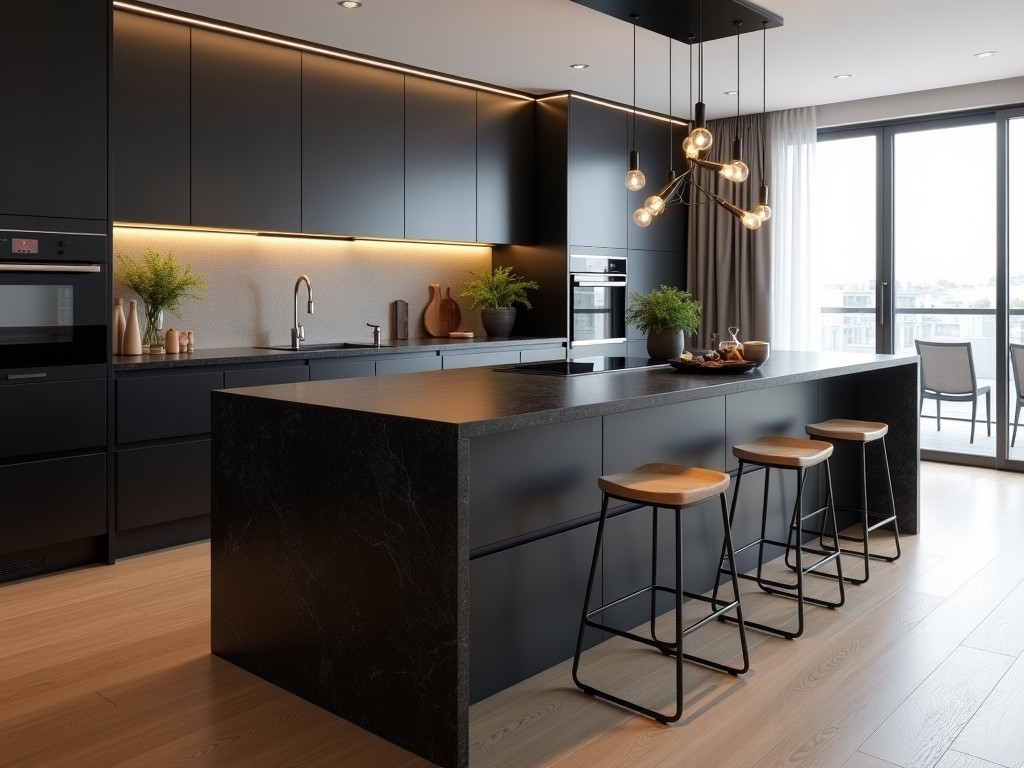
Custom Factory Black Quartz Kitchen Countertops
Inquire Now
Custom Factory Black Quartz Kitchen Countertops
Material Composition and Properties
The countertop consists of approximately 93% ground natural quartz aggregate bound with 7% polymer resin and pigments. This composition yields a non‑porous surface with water absorption typically below 0.05% by weight. The resin system provides flexibility while the quartz contributes to hardness, resulting in a Mohs rating of 7.
Density ranges from 2.3 to 2.5 g/cm³ depending on aggregate grading. Flexural strength measured per ASTM C1240 commonly exceeds 45 MPa, and compressive strength often surpasses 200 MPa. These values are typical; actual figures vary with specific resin formulation and curing cycle.
Manufacturing Process
Raw quartz is crushed, sorted, and blended with resin, pigment, and additives in a vacuum mixer to eliminate entrapped air. The mixture is then poured into molds and subjected to vibration and vacuum pressure to achieve uniform density.
Curing occurs in a controlled‑temperature oven at approximately 80‑90 °C for 60‑90 minutes, allowing the resin to polymerize fully. After demolding, slabs undergo calibration, polishing, and inspection before cutting to customer dimensions.
Technical Specifications
| Property | Typical Value | Test Standard |
|---|---|---|
| Water Absorption | <0.05% | ASTM C97 |
| Flexural Strength | >45 MPa | ASTM C1240 |
| Compressive Strength | >200 MPa | ASTM C170 |
| Mohs Hardness | 7 | ASTM E384 |
| Thermal Expansion Coefficient | 25 × 10⁻⁶/°C | ASTM E228 |
| Stain Resistance (Rating) | No visible stain after 24 h exposure to coffee, oil, wine | ANSI/SSINA |
Customization Options
- Thickness options: 20 mm, 30 mm, 40 mm (custom thicknesses available upon request).
- Edge profiles: eased, beveled, bullnose, ogee, waterfall, and custom CNC‑formed profiles.
- Surface finishes: polished (gloss level 80‑90 GU), honed (matte 10‑20 GU), leathered, and brushed.
- Size limits: maximum slab dimensions 3200 mm × 1600 mm; larger areas achieved through seamless joining with color‑matched epoxy.
- Integrated features: drain grooves, undermount sink cut‑outs, backsplash upstands, and decorative inlays (e.g., metallic flecks, glass chips).
Industrial Applications
In food‑processing facilities, the non‑porous surface prevents bacterial ingress and simplifies sanitation protocols, meeting FDA 21 CFR 177.2600 requirements for indirect food contact.
Laboratories benefit from chemical resistance to common reagents such as ethanol, acetone, and dilute acids, reducing the risk of surface degradation during routine cleaning.
High‑traffic commercial kitchens select this material for its impact resistance; dropped pots typically produce no chipping due to the homogeneous quartz‑matrix structure.
Quality Control and Testing
Each slab undergoes dimensional verification using laser scanners, ensuring thickness tolerance within ±0.5 mm and length/width tolerance within ±2 mm.
Surface quality is assessed by visual inspection under 500 lux illumination; any visible pits, scratches, or color inconsistencies trigger rework or rejection.
Batch samples are sent for third‑party flexural and compressive testing; results are archived and available to customers upon request.
Packaging and Logistics
Finished slabs are stacked on A‑frame pallets with polyethylene corner protectors and secured with polyester straps.
Interleaving layers of low‑density foam prevent abrasion during transit; each pallet is labeled with weight, dimensions, and handling instructions.
For overseas shipments, crates are fumigated and sealed to comply with ISPM 15 standards, reducing the risk of customs delays.
Frequently Asked Questions
Can dimensions be customized? Yes, length, width, and thickness are cut to project specifications; standard tolerances apply.
What information is required before quotation? We need slab dimensions, edge profile, finish type, cut‑out locations, and any integrated features.
What materials are available? Our standard offering is black quartz; other colors and patterns are available upon request.
How is quality inspected? Dimensional checks, visual surface grading, and mechanical testing per ASTM standards are performed on each batch.
What packaging methods are available? Palletized with foam interleaving, strapped, and corner‑protected; custom crating for export is offered.
How are export shipments protected? Crates are heat‑treated, sealed, and include moisture‑barrier liners to meet international phytosanitary requirements.
What is the typical production lead time? Lead time ranges from 3 to 5 weeks depending on order complexity and current capacity; exact schedule is confirmed at quote.
How are samples arranged? Small sample tiles (100 mm × 100 mm) can be shipped via courier; larger slab sections require freight arrangements.
To discuss your specific requirements, request a quotation, or obtain technical data sheets, please contact our engineering team.
Request a quotationRelated Products
Related News

custom closet spatial organization and material performance analysis

Bathroom Taps Technical Analysis
