
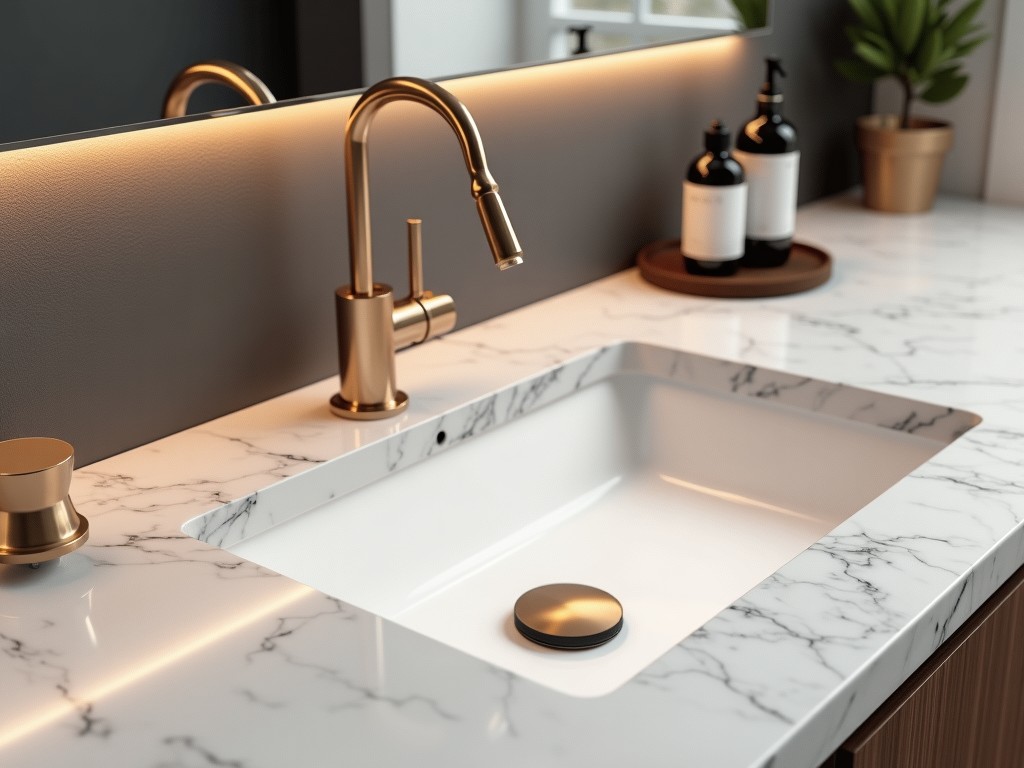
Custom Factory Level 3 Quartz Countertops
Inquire Now
Custom Factory Level 3 Quartz Countertops
Factory‑level 3 quartz countertops are engineered slabs that combine natural quartz aggregate with a polymer resin system to achieve a dense, non‑porous surface suitable for high‑traffic industrial environments.
Material Composition and Structure
The slab typically contains 90‑95 % ground quartz by weight, with the remaining 5‑10 % consisting of a methyl methacrylate‑based resin, pigments, and optional performance additives. This composition yields a compressive strength exceeding 130 MPa and a flexural modulus around 20 GPa, measured according to ASTM C1354.
Manufacturing Process Overview
Raw quartz is sorted, crushed to a controlled granulometry, then mixed with resin under vacuum to eliminate air entrapment. The mixture is compacted in a press at pressures up to 100 bar and cured in a controlled‑temperature oven (≈85 °C) for a prescribed cycle, producing a homogeneous slab with a thickness tolerance of ±0.5 mm.
Typical Technical Specifications
| Property | Typical Value | Test Method |
|---|---|---|
| Density | 2.4 g/cm³ | ASTM C97 |
| Water Absorption | ≤0.02 % | ASTM C97 |
| Compressive Strength | 130–150 MPa | ASTM C1354 |
| Flexural Strength | 40–50 MPa | ASTM C1354 |
| Mohs Hardness | 6–7 | EN 101 |
| Thermal Expansion Coefficient | 25 × 10⁻⁶ /°C | ASTM E228 |
Customization Options
Factory level 3 slabs can be tailored to meet specific design and performance requirements. The following parameters are commonly adjusted per project:
- Thickness: 12 mm, 20 mm, 30 mm (custom thicknesses available upon request)
- Edge profiles: straight, beveled, bullnose, ogee, waterfall (CNC‑machined to ±0.2 mm tolerance)
- Surface finish: polished (gloss ≥ 80 GU), honed (gloss 10‑30 GU), brushed, or leather‑like texture
- Color palette: standard whites, greys, blacks; custom pigments can achieve RAL or PMS matches
- Additives: antimicrobial agents, UV stabilizers, or increased flexural modulus via silica fume
Industrial Applications – Why Quartz Fits
In food‑processing facilities, the non‑porous surface prevents bacterial ingress and allows cleaning with aggressive alkaline detergents without surface degradation. The chemical resistance to acids and solvents (pH 2‑12) makes it suitable for laboratory countertops where spillage of reagents is common.
For heavy‑duty manufacturing environments, the high abrasion resistance (wear loss < 0.02 g after 500 cycles per ASTM C501) reduces maintenance downtime. The dimensional stability under temperature fluctuations (±15 °C) ensures that installed countertops retain flatness, which is critical for precision assembly stations.
In pharmaceutical cleanrooms, the low particle emission (measured < 5 particles / cfm at 0.3 µm) meets ISO Class 5 requirements when combined with proper sealing of joints.
Quality Control Philosophy
Each slab undergoes inline thickness measurement via laser triangulation (±0.1 mm accuracy) and surface gloss measurement using a 60° glossometer. Random samples are taken for flexural testing and chemical resistance verification according to internal QA protocols aligned with ISO 9001.
Packaging and Shipping
Finished slabs are stacked on A‑frame steel pallets with corner protectors, then wrapped in UV‑stable stretch film. Edge protection is applied using recyclable foam strips. For export, slabs are placed in wooden crates meeting ISPM‑15 standards, with moisture‑absorbing desiccant packets to limit humidity fluctuations during transit.
Frequently Asked Questions
- Can dimensions be customized? Yes, length and width are cut to specification using CNC saws with a tolerance of ±0.5 mm.
- What information is required before quotation? Required data include slab thickness, overall dimensions, edge profile, surface finish, color code or sample, and any performance additives.
- What materials are available? Standard quartz grades (90‑95 % SiO₂) with optional resin systems; custom pigments and additives are available upon request.
- How is quality inspected? Inline dimensional checks, gloss measurement, and periodic mechanical testing per ASTM standards.
- What packaging methods are available? A‑frame pallets with stretch film, edge foam, and export‑grade wooden crates.
- How are export shipments protected? Crates are lined with moisture barrier film and include desiccant; pallets are strapped and marked for handling.
- What is the typical production lead time? Lead time ranges from 10 to 20 working days after final drawing approval, depending on thickness and custom features.
- How are samples arranged? Small sample coupons (100 mm × 100 mm) can be shipped via express courier; charges are credited against the first order.
For technical data sheets, CAD files, or to discuss a specific project requirement, please contact our engineering team.
Request a QuoteRelated Products
Related News

custom closet spatial organization and material performance analysis

Bathroom Taps Technical Analysis
