
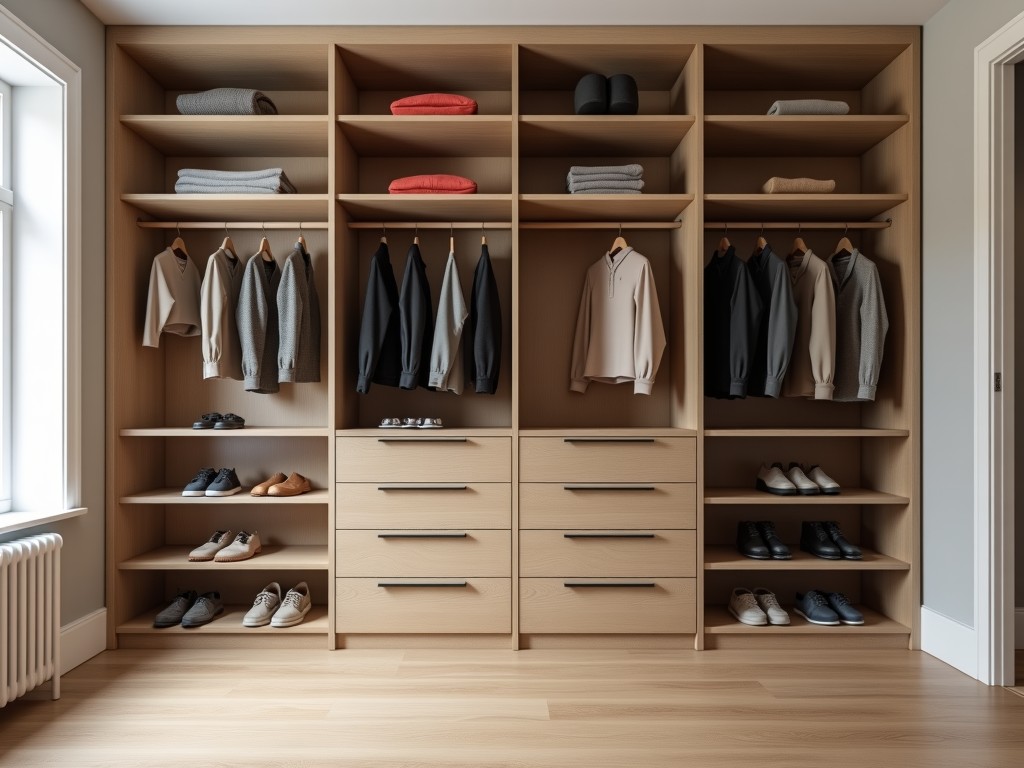
Custom Factory Master Bedroom Closets Design
Inquire Now
Custom Factory Master Bedroom Closet Systems
These closet systems are engineered for high‑volume production in a factory environment while meeting the dimensional tolerances and finish requirements of residential master‑bedroom applications. Each unit is built from panel‑based components that are cut to ±0.5 mm tolerance and assembled with cam‑lock or dowel fasteners to ensure repeatable alignment.
Design Considerations for Factory Production
When designing closets for mass production, the primary constraints are panel thickness, edge banding width, and hardware hole patterns. Standard panel thickness options are 16 mm and 18 mm (±0.2 mm), which determine shelf load capacity (approximately 30 kg per shelf for 16 mm, 45 kg for 18 mm when supported at 600 mm intervals).
Edge banding is applied automatically to all exposed edges; typical PVC banding width is 0.5 mm with a tolerance of ±0.05 mm. Hole patterns for shelf pins follow the 32 mm European system, allowing interchangeable accessories across product lines.
Material Options
- Particle board with melamine façade – density 600‑650 kg/m³, surface resistance to scratches ≥2 N (ISO 4586‑2).
- MDF core with PVC laminate – density 700‑750 kg/m³, moisture expansion ≤0.2 % after 24 h immersion.
- Plywood core (birch) with veneer – density 550‑600 kg/m³, bending strength ≥45 MPa.
Typical Dimensional and Performance Values
| Parameter | Value (Typical) | Notes |
|---|---|---|
| Panel thickness | 16 mm or 18 mm | ±0.2 mm tolerance |
| Shelf depth | 500 mm – 600 mm | Customizable in 25 mm increments |
| Maximum shelf load (uniform) | 30 kg (16 mm) / 45 kg (18 mm) | Based on 600 mm support spacing |
| Door swing angle | 110° (standard hinge) | Soft‑close option adds 10° damping |
Customization Choices
- Door types: hinged, sliding, or bi‑fold; hinge options include standard, soft‑close, or push‑to‑open.
- Interior accessories: adjustable shoe racks, pull‑out baskets, jewelry drawers with felt lining.
- Finish selections: matte melamine, high‑gloss PVC, textured wood grain, or custom lacquer (RAL matching).
- Lighting integration: LED strip channels with motion sensor, power consumption ≤2 W per linear meter.
Manufacturing Process Overview
Raw panels are cut on CNC saws with a positional accuracy of ±0.1 mm. Edge banding is applied via hot‑air adhesive rollers, followed by trimming to flush. CNC drilling machines create the 32 mm hole pattern at a rate of 200 holes per minute. Assembly lines use pneumatic cam‑lock inserters, achieving a torque of 0.8 Nm per fastener.
Finished units undergo a visual inspection station where lighting at 1000 lux detects surface defects; any panel with a defect >0.5 mm² is diverted for rework.
Quality Control Philosophy
Quality checks are performed at three stages: incoming material, in‑process, and final audit. Incoming panels are tested for formaldehyde emission (EN 717‑1) with a target ≤0.05 ppm. In‑process checks verify hole positional accuracy using a laser probe (±0.1 mm). Final audit includes a functional test of door hinges (10 000 cycles) and load verification of shelves to 125 % of rated capacity.
Applications in Residential and Multi‑Family Projects
Master‑bedroom closets in high‑density housing benefit from factory‑produced modules because they reduce on‑site labor by up to 40 % and minimize material waste through nesting optimization. The standardized 32 mm hole system allows designers to reconfigure layouts without new hardware, supporting future renovations.
Hospitality projects specify these systems for guest rooms where consistent appearance and rapid installation (average 2 hours per unit) are critical to schedule adherence.
Frequently Asked Questions
- Can dimensions be customized? Yes, width, height, and depth are adjustable in 25 mm increments based on project requirements.
- What information is required before quotation? Room clear opening dimensions, desired door type, shelf layout, and finish selection.
- How is quality inspected? Through incoming material testing, in‑process hole position verification, and final functional cycling of hardware.
- What packaging methods are available? Units are packed in flat‑pack cartons with corner protectors, each carton labeled with SKU and QR code for traceability.
To discuss your specific master‑bedroom closet requirements or request a technical data sheet, please contact our engineering team.
Request QuoteRelated Products
Related News

custom closet spatial organization and material performance analysis

Bathroom Taps Technical Analysis
