
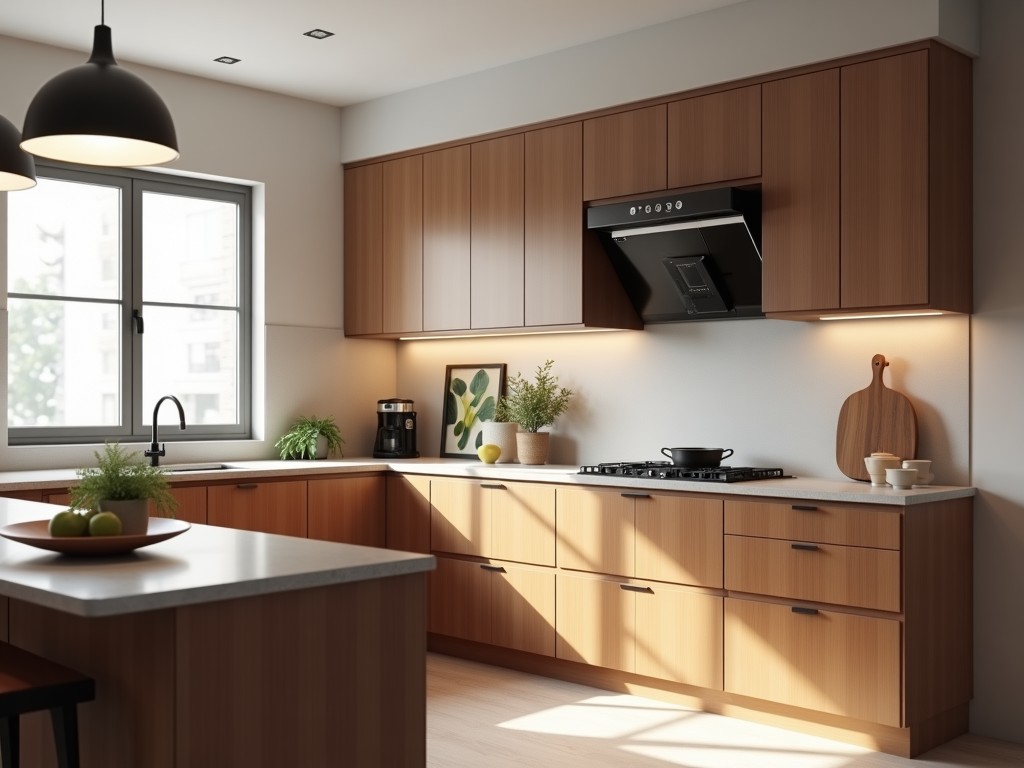
Custom Kitchen Cabinet Manufacturer Supplier
Inquire Now
Custom Kitchen Cabinet Manufacturer Supplier
Designing kitchen cabinetry for high‑traffic environments requires attention to three core performance factors: moisture stability, mechanical durability, and surface finish longevity.
Typical commercial kitchens expose cabinets to daily cleaning agents, steam, and temperature swings that can cause substrate swelling or delamination if the material selection and edge sealing are not matched to the expected humidity range of 45–75% RH.
Material Options
Substrates are chosen based on dimensional stability, resistance to moisture, and compatibility with the intended finish.
- 18 mm medium‑density fiberboard (MDF) with a melamine foil overlay – density 680 kg/m³, thickness tolerance ±0.2 mm, suitable for painted or lacquered finishes.
- 18 mm moisture‑resistant particleboard with PVC edge banding – swelling <0.5 % after 24 h water immersion, screw withdrawal strength >1 200 N.
- 18 mm hardwood plywood (birch core) with natural veneer – cross‑band construction reduces warp, modulus of elasticity ≈4 GPa.
- 25 mm solid wood core (maple or oak) for high‑impact zones – Janka hardness >1 400 lbf, provides inherent rigidity for heavy‑duty drawer boxes.
Construction & Joinery
Joint design directly influences load distribution and long‑term alignment under repeated opening cycles.
- Cam‑lock fasteners with 8 mm steel pins – recommended tightening torque 2.5 Nm, provides shear resistance >3 kN per joint.
- Dowel‑reinforced dado joints for shelf‑to‑side connections – dowel diameter 8 mm, depth 12 mm, pull‑out capacity ≈1 800 N.
- Rabbet joints for door frames – 6 mm depth, glued with PVAc adhesive, shear strength ≈2.2 MPa after 24 h cure.
- Drawer boxes constructed with dovetail or lock‑rail joints – tensile strength >4 kN, accommodates dynamic loads up to 45 kg per slide.
Customization Capabilities
Every project begins with a detailed specification sheet that translates architectural drawings into manufacturable tolerances.
- Door overlay options: full overlay (door covers 100 % of cabinet face), partial overlay (30 mm reveal), inset (door flush with face frame).
- Panel thickness range: 16 mm to 25 mm in 1 mm increments, allowing weight optimization for wall units versus base cabinets.
- Hinge selection: concealed soft‑close hinges rated for 40 kg door weight, opening angle 110°, cycle life >50 000.
- Drawer slide types: side‑mounted ball bearing (30 kg dynamic load), under‑mount soft‑close (45 kg), with travel lengths 300 mm to 600 mm.
- Finish systems: high‑pressure laminate (HPL) with 0.8 mm thickness, UV‑cured lacquer (gloss 85 %), or natural veneer with matte sealer (abrasion resistance 150 cycles).
Quality Assurance Process
Inspection points are embedded in each production stage to detect deviations before they affect field performance.
- Incoming material check – moisture content measured with capacitance meter, acceptance ≤8 % for MDF/particleboard, ≤12 % for plywood.
- Panel dimensions – laser‑scanned thickness and width, tolerance ±0.5 mm, length ±1 mm.
- Joint strength test – sample cam‑lock joints subjected to 2 kN shear load, pass if no slip or fastener deformation.
- Finish adhesion – cross‑hatch tape test (ASTM D3359), rating 5B required for lacquer and HPL.
- Cycle operation – doors and drawers operated 10 000 times with load, monitoring hinge sag (<0.2 mm) and slide friction (<0.15 N).
Applications in Commercial Kitchens
Cabinetry must support workflow efficiency while resisting the specific stressors found in food‑service environments.
- High humidity zones – steam from dishwashers and cooking surfaces; selected substrates with low swelling (<0.5 %) prevent joint loosening.
- Frequent impact – carts and trays striking cabinet edges; reinforced PVC edge bands and solid‑wood cores absorb kinetic energy.
- Chemical exposure – alkaline cleaners and acidic food residues; HPL and UV‑cured lacquer show <5 % gloss loss after 200 h exposure in ISO 2812‑1 testing.
- Load bearing – heavy pots, appliances, and bulk ingredients stored in base cabinets; drawer slides rated to 45 kg and shelving designed for 150 kg uniform load.
- Cleanability – seamless edges and non‑porous finishes reduce bacterial harborage, supporting compliance with HACCP guidelines.
Specification Comparison
| Door Style | Typical Overlay | Hinge Type | Drawer Slide Load (kg) | Lead Time (weeks) |
|---|---|---|---|---|
| Full Overlay | Door covers cabinet face | Concealed soft‑close | 30–45 | 4–5 |
| Inset | Flush with face frame | Exposed butt hinge | 30–40 | 5–6 |
| Shaker | Partial overlay (30 mm reveal) | Concealed soft‑close | 35–45 | 4–5 |
| Slab | Full overlay | Concealed soft‑close | 30–45 | 4–5 |
Frequently Asked Questions
Can dimensions be customized?
Yes. Width, height, and depth are adjusted to suit the installation space, with standard increments of 1 mm for panels and 2 mm for carcass assemblies.
What information is required before quotation?
Project drawings (plan, elevation, section), material preferences, hardware specifications, finish samples, and required tolerances for clearance and reveal.
What materials are available?
MDF, moisture‑resistant particleboard, hardwood plywood, and solid wood cores, each offered in thicknesses from 16 mm to 25 mm.
How is quality inspected?
Through incoming material checks, dimensional scanning, joint strength testing, finish adhesion tests, and functional cycle operations as detailed in the quality assurance section.
What packaging methods are used?
Flat‑packed panels with corner protectors, hardware packed in labelled bags, and assembled units wrapped in stretch film and placed on pallets with edge boards.
What is the typical production lead time?
Four to six weeks from approved drawings to ex‑works, depending on material availability and finish complexity.
How are samples arranged?
Sample doors, drawer fronts, and material coupons are shipped via express courier upon receipt of a signed NDA and project brief.
Next Steps
To begin a technical review of your kitchen cabinet requirements, share your project specifications and we will return a detailed feasibility report including material recommendations, joint options, and estimated lead times.
Related Products
Related News

custom closet spatial organization and material performance analysis

Bathroom Taps Technical Analysis
