
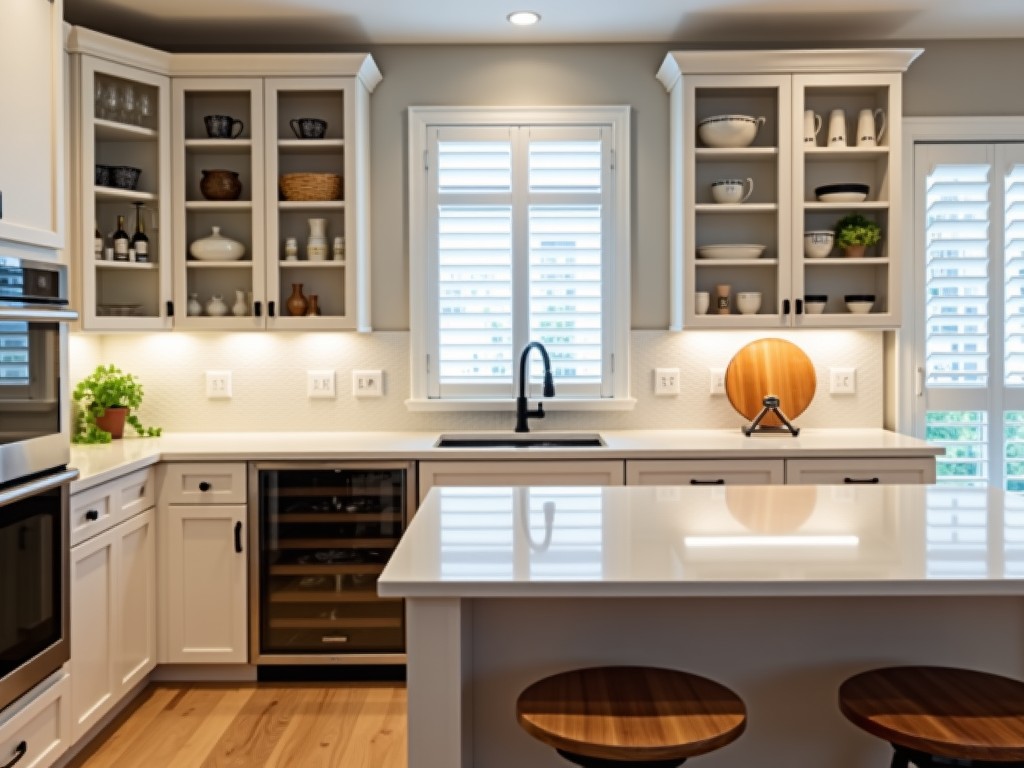
Custom Kitchen Cabinets For Sale
Inquire Now
Custom Kitchen Cabinets for Sale
Overview
Kitchen cabinets serve as the primary storage and organizational system in residential and commercial food‑preparation environments. Their performance depends on dimensional stability under varying humidity, resistance to impact from utensils, and the ability to support sustained loads from dishes, appliances, and food supplies.
Design considerations include ergonomic reach, accessibility of interior fittings, and compatibility with countertop overruns and appliance apertures. Properly engineered cabinets reduce installation time and long‑term maintenance costs.
Materials and Construction
Substrate choices affect weight, stiffness, and moisture response. Solid hardwood (e.g., maple, oak) provides a modulus of rupture around 90‑120 MPa and a density of 600‑750 kg/m³, but exhibits greater movement with humidity changes. Baltic birch plywood, composed of 5‑7 plies, offers a density of 650 kg/m³ and a modulus of rupture near 80 MPa with improved dimensional stability.
Medium‑density fiberboard (MDF) delivers a uniform density of 700‑800 kg/m³ and a smooth surface ideal for painted finishes, while its modulus of rupture ranges from 30‑45 MPa. Particleboard, the most economical option, typically shows a density of 600‑700 kg/m³ and a modulus of rupture of 20‑30 MPa, making it suitable for low‑load applications when protected by edge sealing.
Joinery methods directly influence cabinet rigidity. Dovetail joints, commonly used for drawer boxes, provide tensile shear resistance exceeding 4 kN per joint. Mortise‑and‑tenon connections in face frames deliver moment capacity suitable for loads up to 150 kg per door. Cam‑lock and confirmat fasteners allow rapid assembly while maintaining alignment tolerances within ±0.5 mm.
Customization Process
Projects begin with client‑supplied dimensions or field measurements, which are imported into parametric CAD software. The model generates panel layouts optimized for material yield, automatically placing dadoes, rabbets, and hardware locations.
Computer‑numerical‑control (CNC) routers cut panels to ±0.1 mm accuracy, followed by edge‑banding machines that apply PVC, ABS, or wood veneer strips with a melt‑temperature of 200 °C, ensuring bond strength above 1.5 MPa. After machining, components undergo sanding to a surface roughness of Ra ≤ 0.8 µm before finish application.
Finishing options include catalyzed polyurethane (dry film thickness 35‑45 µm, pencil hardness 2H), conversion varnish (VOC < 50 g/L, gloss 20‑90 %), or melamine laminate (thickness 0.8‑1.2 mm, abrasion resistance 150 cycles). Hardware selection covers soft‑close hinges (torque 0.2‑0.4 Nm, 50 000 cycle rating) and full‑extension ball‑bearing slides (load capacity 40 kg per pair).
Technical Specifications
| Property | Typical Value | Notes |
|---|---|---|
| Panel thickness (door) | 16‑19 mm | Depends on substrate; 19 mm for solid wood, 16 mm for MDF/plywood |
| Density | 600‑800 kg/m³ | Varied by material choice |
| Modulus of rupture | 30‑120 MPa | Higher for hardwood, lower for particleboard |
| Dimensional tolerance (length/width) | ±0.5 mm | Measured at 20 °C, 50 % RH |
| Finish adhesion (ASTM D3359) | 5B (no peeling) | After 24 h cure |
| Hinge cycle life | ≥50 000 cycles | Soft‑close, 10 kg door load |
Quality Assurance
Each cabinet undergoes a three‑stage inspection: (1) raw‑material verification for density and moisture content (target 8‑12 % for wood‑based panels), (2) in‑process checks of panel squareness and joint gap using calibrated gauges, and (3) final functional testing of doors and drawers for alignment, swing clearance, and hardware operation.
Finish quality is assessed by cross‑hatch adhesion testing per ASTM D3359 and gloss measurement at 60° to ensure consistency with the specified range. Any deviation beyond tolerance triggers rework or rejection before packaging.
Applications
In residential kitchens, cabinets must accommodate frequent opening cycles, resist steam and splatter, and support the weight of cookware and pantry items. The combination of high‑modulus substrates and durable finishes provides a service life exceeding 15 years under typical household conditions.
Commercial food‑service environments demand higher load capacities and stricter sanitation. Cabinets constructed from marine‑grade plywood with UV‑stable laminate finishes meet NSF/ANSI 51 standards for food‑zone surfaces, while stainless‑steel hardware resists corrosion from cleaning agents.
Frequently Asked Questions
- Can dimensions be customized? Yes, cabinets are built to exact customer‑supplied measurements; tolerances are held to ±0.5 mm.
- What information is required before quotation? A rough layout, desired material, finish type, and hardware preferences enable an accurate quote.
- What materials are available? Solid hardwood, Baltic birch plywood, MDF, and particleboard, each with optional edge‑banding.
- How is quality inspected? Dimensional checks, finish adhesion tests, and hardware cycle tests are performed on every unit.
- What packaging methods are available? Flat‑pack with corner protectors and stretch film, or fully assembled in crates with foam cushioning.
- What is the typical production lead time? Standard lead time ranges from 3‑4 weeks for stocked materials; custom finishes may extend to 6 weeks.
Contact for Inquiry
To discuss your project requirements, request a quote, or obtain sample panels, please reach out via the contact form.
Related Products
Related News

custom closet spatial organization and material performance analysis

Bathroom Taps Technical Analysis
