
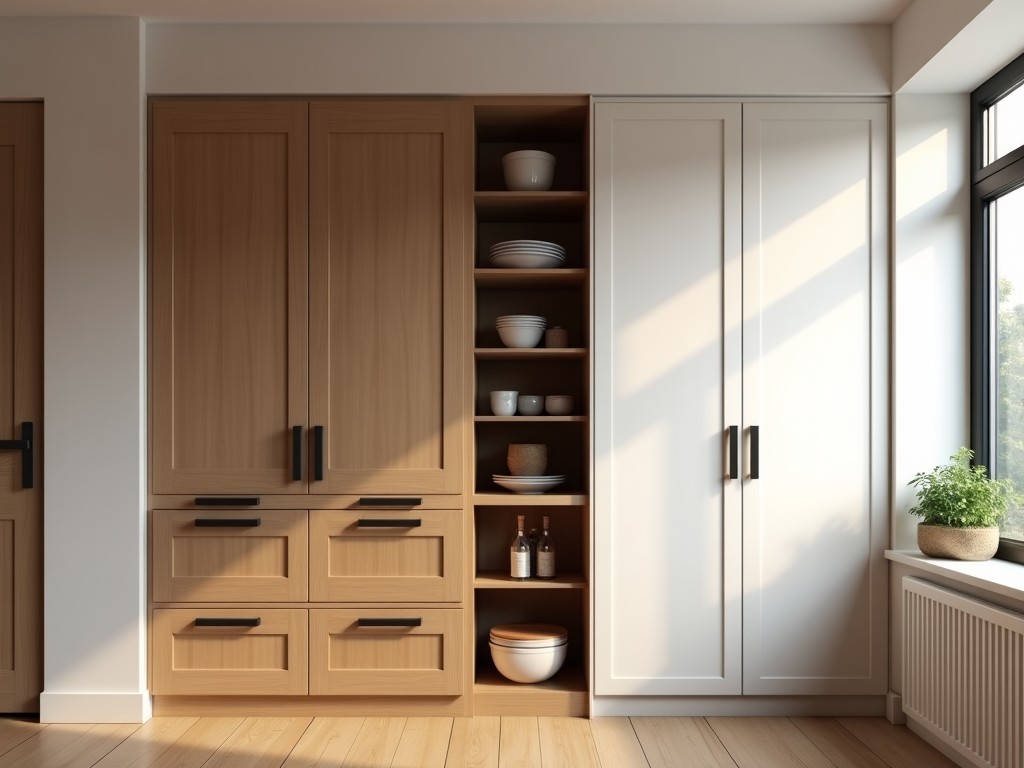
Custom Kitchen Pantry Cabinet
Inquire Now
Custom Kitchen Pantry Cabinet
Overview
A pantry cabinet provides dedicated storage for dry goods, bulk items, and kitchen accessories while keeping them within easy reach. Unlike standard uppers, its interior height and shelf arrangement are tailored to the user’s reach zone and the specific items stored, reducing the need for excessive bending or reaching.
Design considerations include load capacity per shelf, door swing clearance, and integration with adjacent appliances. By aligning cabinet dimensions with the kitchen workflow, the pantry supports efficient inventory retrieval and minimizes unused space.
Material Selection
The structural panel choice influences weight, stiffness, moisture resistance, and finish compatibility. Typical options range from engineered wood products to solid hardwood, each suited to different environmental conditions and budget constraints.
| Material | Typical Thickness (mm) | Density (kg/m³) | Moisture Resistance | Common Use |
|---|---|---|---|---|
| 18 mm Birch Plywood | 18 | 600 | Good (with sealed edges) | High‑load pantry shelves |
| 16 mm MDF | 16 | 700 | Fair (requires edge sealing) | Painted or laminated doors |
| 12 mm Particle Board | 12 | 650 | Limited (moisture barrier needed) | Cost‑sensitive interior carcass |
| 19 mm Hardwood (Maple) | 19 | 750 | Excellent (naturally stable) | Premium visible panels |
| 18 mm Laminated Panel | 18 | 620 | Very good (surface sealed) | Low‑maintenance exterior |
Design & Customization
Cabinet dimensions are defined by the kitchen’s available clearance, the user’s height, and the intended storage volume. Standard pantry heights range from 2100 mm to 2400 mm, with widths adjustable in 50 mm increments to suit wall stud spacing or island placement.
Door styles include slab, shaker, inset, and framed options, each affecting the visual profile and hardware clearance. Interior accessories such as adjustable shelving (typically 25 mm pitch), pull‑out baskets, and vertical dividers are mounted on concealed brackets that allow reconfiguration without tools.
Finish choices range from melamine foil, wood veneer, high‑pressure laminate, to spray‑painted polyurethane. Edge banding—PVC, ABS, or wood veneer—is applied to all exposed panel edges to prevent moisture ingress and provide a seamless appearance.
Manufacturing Process
Panels are cut to size on CNC routers with positional accuracy ±0.2 mm, ensuring repeatable hole placement for hinges, shelf pins, and connector hardware. Edge banding is applied using hot‑melt adhesive rollers, followed by trimming and buffing to achieve a flush surface.
Assembly relies on cam‑lock fasteners and wooden dowels for carcass joints, providing shear strength while allowing disassembly for service or relocation. Drawer and door hardware are pre‑drilled to manufacturer specifications, reducing on‑site adjustment time.
Before packaging, each unit undergoes a functional check: door swing angle, hinge soft‑close timing, shelf pin retention, and load deflection under a 150 kg distributed load.
Applications
In residential kitchens, a pantry positioned adjacent to the preparation zone reduces travel distance for ingredient retrieval, supporting efficient mise en place. The ability to store tall items such as bulk flour bags or appliances upright eliminates the need for countertop clutter.
Multi‑family developments benefit from standardized pantry modules that can be mirrored across units, simplifying procurement and installation while allowing resident‑specific interior configurations. Hospitality settings, such as hotel suites or assisted‑living facilities, utilize pantry cabinets to provide guests with accessible storage for personal groceries, enhancing perceived convenience.
Industrial buyers select pantry cabinets based on dimensional tolerance, hardware cycle life, and finish durability, all of which directly affect long‑term maintenance costs and user satisfaction.
Quality Assurance
Incoming material is inspected for thickness variance, moisture content, and surface defects using calibrated gauges and visual standards. Only panels meeting ≤0.1 mm thickness tolerance and ≤8 % moisture content proceed to production.
During assembly, torque‑controlled drivers ensure cam‑lock fasteners reach the specified clamping force, preventing joint creep over time. Completed cabinets are subjected to a 50‑cycle door open‑close test to verify hinge performance and soft‑close damping.
Finish adhesion is evaluated via cross‑hatch tape testing per ASTM D3359, with a minimum rating of 4B required for painted or laminated surfaces. Final random audits confirm dimensional accuracy within ±0.5 mm of the approved drawing before shipment.
Frequently Asked Questions
- Can dimensions be customized? Yes, height, width, and depth are adjustable to project requirements; standard increments are 50 mm for width and depth, 100 mm for height.
- What information is needed for a quotation? Provide overall dimensions, desired panel material, door style, hardware preferences, finish type, and any interior accessories.
- Which materials are available? Options include birch plywood, MDF, particle board, hardwood, and laminated panels; see the material table for typical properties.
- How is quality inspected? Incoming material checks, dimensional verification, hardware functional tests, and finish adhesion assessments are performed as described in the Quality Assurance section.
- What packaging methods are available? Cabinets are packed in corrugated cardboard with corner protectors, stretch‑wrapped, and palletized for LTL or FTL shipment.
- How are export shipments protected? Export pallets receive ISPM‑15 compliant heat treatment, moisture‑barrier sheeting, and edge boards to prevent damage during transit.
- What is the typical production lead time? Lead time ranges from 3 to 6 weeks depending on material availability and order complexity; exact timing is confirmed at quote.
- How are samples arranged? Sample doors or panel swatches can be supplied upon request; shipping costs are collected by the requester.
Get a Quote
To discuss your specific pantry cabinet requirements, contact our engineering team for a detailed quotation and lead‑time confirmation.
Request QuoteRelated Products
Related News

custom closet spatial organization and material performance analysis

Bathroom Taps Technical Analysis
