
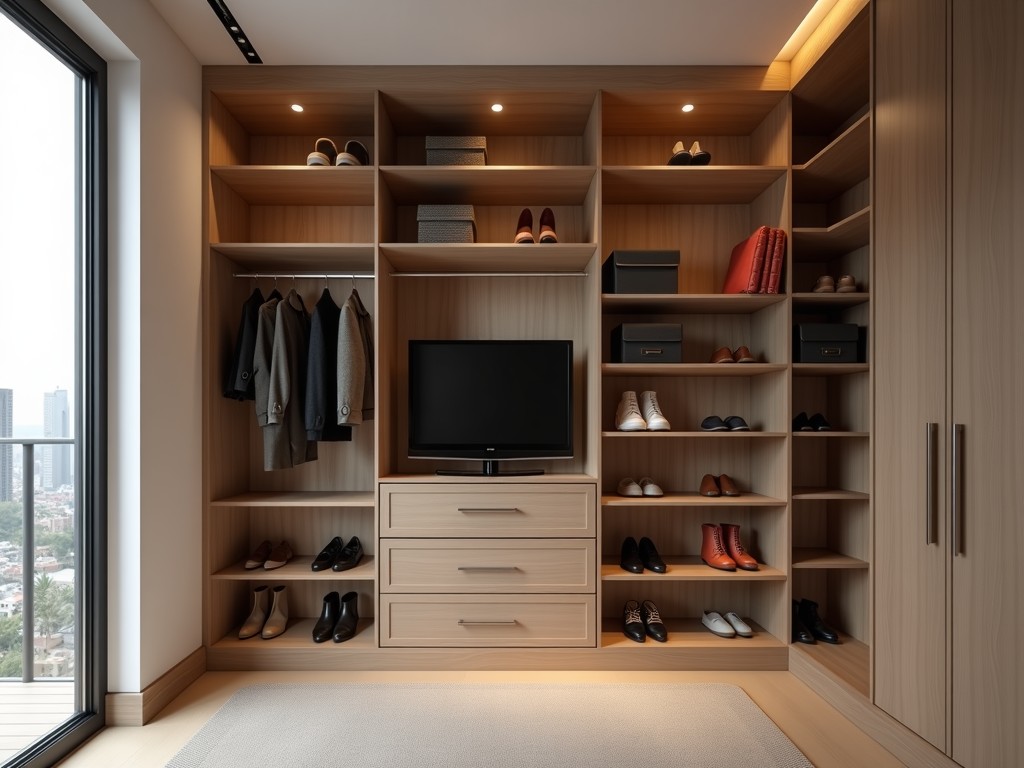
Custom Shoe Shelves For Closet
Inquire Now
Custom Shoe Shelves for Closet
Shoe storage in residential closets requires shelving that accommodates varying footwear heights while maintaining structural integrity under repeated loading. The design must balance depth, width, and vertical spacing to prevent deformation and ensure easy access.
Material Selection and Mechanical Properties
Common substrates include cold‑rolled steel, aluminum alloy, and engineered wood composites. Steel shelves are typically formed from 1.2 mm to 2.0 mm thick sheet, providing a yield strength of approximately 250 MPa and allowing powder‑coat finishes that resist corrosion. Aluminum options use 6063‑T5 alloy with thickness ranging from 1.5 mm to 3.0 mm, offering a density of 2.7 g/cm³ and natural oxidation resistance. Wood‑based shelves employ particleboard or MDF with a minimum density of 650 kg/m³, often laminated with melamine for wear resistance.
Load Capacity and Dimensional Parameters
Design calculations consider uniformly distributed loads from shoe weight, typically estimated at 0.5 kg per pair for casual footwear and up to 2.0 kg for boots. For a 600 mm wide shelf, a steel thickness of 1.5 mm yields a permissible load of approximately 120 kg before deflection exceeds L/200, where L is the span between supports. Aluminum of equivalent width requires a 2.0 mm thickness to achieve similar stiffness due to its lower modulus of elasticity. Vertical spacing between shelves is commonly set between 100 mm and 150 mm to accommodate heel heights while maximizing storage density.
Customization Options
- Width: 300 mm to 900 mm in 50 mm increments
- Depth: 200 mm to 400 mm, adjustable for shoe length
- Height increments: 25 mm vertical adjustment via slotted brackets
- Finish: powder‑coat (RAL colors), anodized aluminum, or melamine‑laminated wood
- Edge treatment: rolled, flanged, or PVC‑capped for safety
Installation Methodology
Shelves are secured to closet walls using either metal cleats screwed into studs or heavy‑duty anchor systems for drywall. Cleat designs incorporate a 20 mm flange that engages a matching groove on the shelf rear, providing shear resistance and allowing vertical repositioning without hardware removal. Load‑bearing capacity of the anchoring system should exceed the shelf’s rated load by a factor of 1.5 to account for dynamic forces during shoe placement.
Quality Assurance Procedures
Dimensional verification is performed using calibrated calipers with a tolerance of ±0.2 mm on critical features such as hole patterns and edge straightness. Surface finish adhesion is assessed via cross‑hatch tape testing per ASTM D3359, requiring a minimum rating of 4B for powder‑coat units. Load testing applies a static force equal to 125 % of the rated capacity for five minutes; permanent deflection must remain below 0.5 mm. Visual inspection checks for burrs, sharp edges, and coating uniformity.
Typical Applications
Custom shoe shelves are employed in walk‑in closets, reach‑in wardrobes, and bedroom storage systems where footwear variety demands adaptable geometry. In multi‑unit residential projects, standardized shelf modules reduce installation time while still permitting resident‑specific width adjustments. Retail display closets benefit from the ability to present shoes at eye level, improving merchandising effectiveness.
Material Comparison Table
| Property | Cold‑rolled Steel | Aluminum Alloy | Engineered Wood |
|---|---|---|---|
| Typical Thickness (mm) | 1.2 – 2.0 | 1.5 – 3.0 | 16 – 25 (panel) |
| Density (g/cm³) | 7.85 | 2.70 | 0.65 – 0.80 |
| Yield Strength (MPa) | ≈250 | ≈140 | N/A (compressive) |
| Corrosion Resistance | Requires coating | Inherent oxide layer | Laminate barrier |
| Typical Load Capacity (kg per 600 mm span) | 120 (1.5 mm) | 90 (2.0 mm) | 60 (particleboard) |
Frequently Asked Questions
Can dimensions be customized to match existing closet stud spacing?
Yes. Width and depth are adjustable in 50 mm increments, and the mounting bracket pattern can be altered to align with stud centers or alternative anchorage points.
What information is required for a quotation?
Provide desired overall width, depth, number of shelves, material preference, finish color, and any special features such as integrated lighting or shoe dividers.
How is quality inspected before shipment?
Each unit undergoes dimensional checks, finish adhesion testing, and a static load verification at 125 % of rated capacity. Documentation of these tests is available upon request.
What packaging methods protect the shelves during transit?
Shelves are wrapped in polyethylene foam, placed in corrugated cardboard sleeves with corner protectors, and strapped to pallets. For export, moisture‑barrier film and ISPM‑15 compliant wood pallets are used.
What is the typical production lead time?
Lead time ranges from 10 to 18 working days depending on material availability and finish complexity, confirmed at order acknowledgment.
Request a Quote
To discuss your specific closet shoe storage requirements, please use the contact form below. Provide the project dimensions, preferred material, and any additional features to receive a detailed technical proposal and pricing.
Request QuoteRelated Products
Related News

custom closet spatial organization and material performance analysis

Bathroom Taps Technical Analysis
