
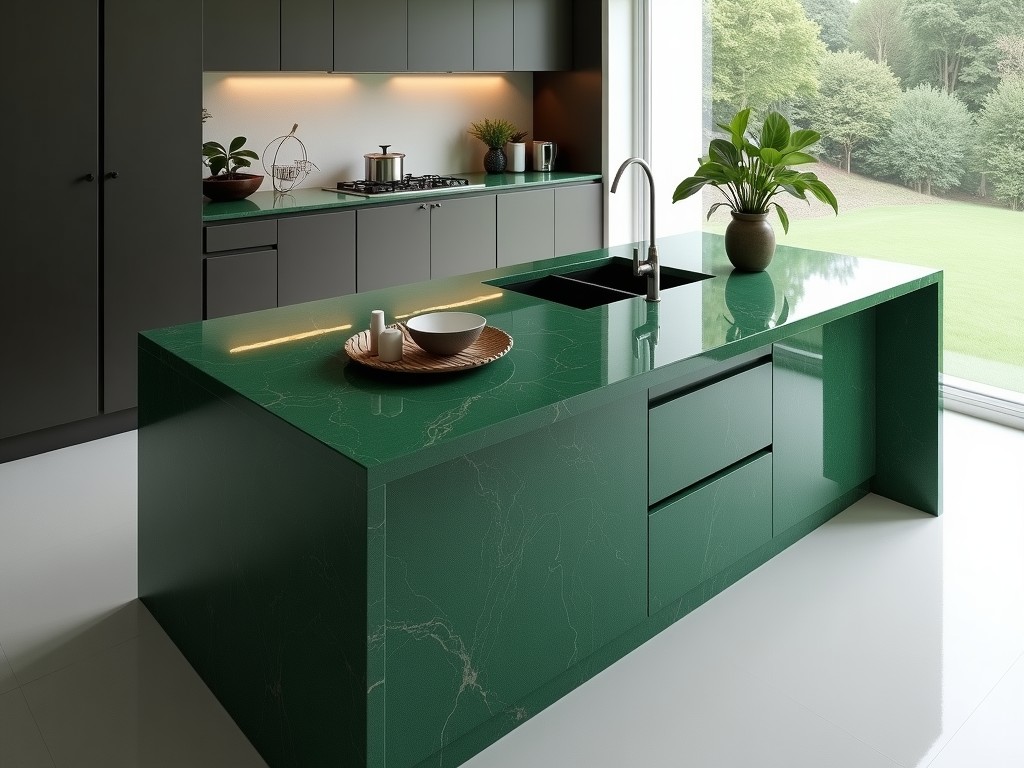
Green Quartz Kitchen Countertops Factory
Inquire Now
Green Quartz Kitchen Countertops
Overview
Green quartz countertops are engineered stone surfaces composed of natural quartz aggregates bound with polymer resins and pigments. The green hue is achieved through inorganic chromophore additives that are stable under UV exposure and typical kitchen temperatures.
Typical slab thickness ranges from 20 mm to 30 mm, with standard dimensions of 3050 mm × 1440 mm, allowing seamless fabrication for island tops and wall panels. Density falls between 2.3 g/cm³ and 2.5 g/cm³, contributing to stiffness and impact resistance. Water absorption is less than 0.05 % by weight, meeting ASTM C97 standards for low porosity.
Material Composition
The material composition influences mechanical performance and chemical resistance. Typical weight percentages are as follows:
| Component | Typical Range (% by weight) | Function |
|---|---|---|
| Quartz aggregate | 90‑95 | Structural filler providing hardness |
| Polymer resin | 5‑8 | Binder imparting flexural strength |
| Pigment (green chromophore) | 0.5‑2 | Color stability |
| Additives (UV stabilizers, coupling agents) | <0.5 | Enhance durability |
Manufacturing Process
Raw quartz is sorted by size, washed, and dried before blending with measured resin and pigment under controlled humidity.
The mixture undergoes vacuum vibration to eliminate entrapped air, then is pressed into molds at pressures exceeding 100 kN.
After curing at 80‑90 °C for 45‑60 minutes, slabs are calibrated, polished to a 0.05 µm Ra finish, and inspected for thickness tolerance.
Customization Options
Customization is driven by project‑specific fabrication constraints and aesthetic targets. Available options include:
- Edge profiles (eased, bullnose, ogee, waterfall)
- Thickness options (20 mm, 25 mm, 30 mm)
- Surface finishes (polished, honed, leathered)
- Maximum slab size (up to 3200 mm × 1600 mm)
- Custom cut‑outs for sinks and cooktops
Applications
Green quartz countertops suit commercial kitchens where chemical resistance to acidic foods and cleaning agents is required, and the non‑porous surface inhibits bacterial growth.
The color provides a design accent that complements neutral cabinetry while maintaining the durability needed for high‑traffic prep zones.
Because the material resists thermal shock up to 150 °C, it tolerates brief contact with hot pans without cracking.
Quality Assurance
Quality control follows a staged approach to verify dimensional accuracy, surface integrity, and mechanical performance. Each lot undergoes the following checks:
| Inspection Item | Method | Acceptance Criteria |
|---|---|---|
| Thickness | Caliper | ±0.1 mm |
| Length/width | Laser measurement | ±0.5 mm |
| Surface gloss | Gloss meter | ≥70 GU (polished) |
| Flexural strength | Three‑point bend | ≥45 MPa |
| Water absorption | Gravimetric | ≤0.05 % |
| Color consistency | Spectrophotometer | ΔE ≤2 |
Packaging & Logistics
Slabs are separated by corrugated cardboard layers, protected at edges with HDPE corner guards, and stacked on fumigated wooden pallets. Strapping with polyester bands secures the load, while a humidity indicator card monitors moisture during transit. Pallets are stretch‑wrapped and labeled with handling instructions to prevent surface abrasion.
Get a Quote
To discuss project‑specific dimensions, edge profiles, or lead times, please provide your specifications via the contact form.
Related Products
Related News

custom closet spatial organization and material performance analysis

Bathroom Taps Technical Analysis
