
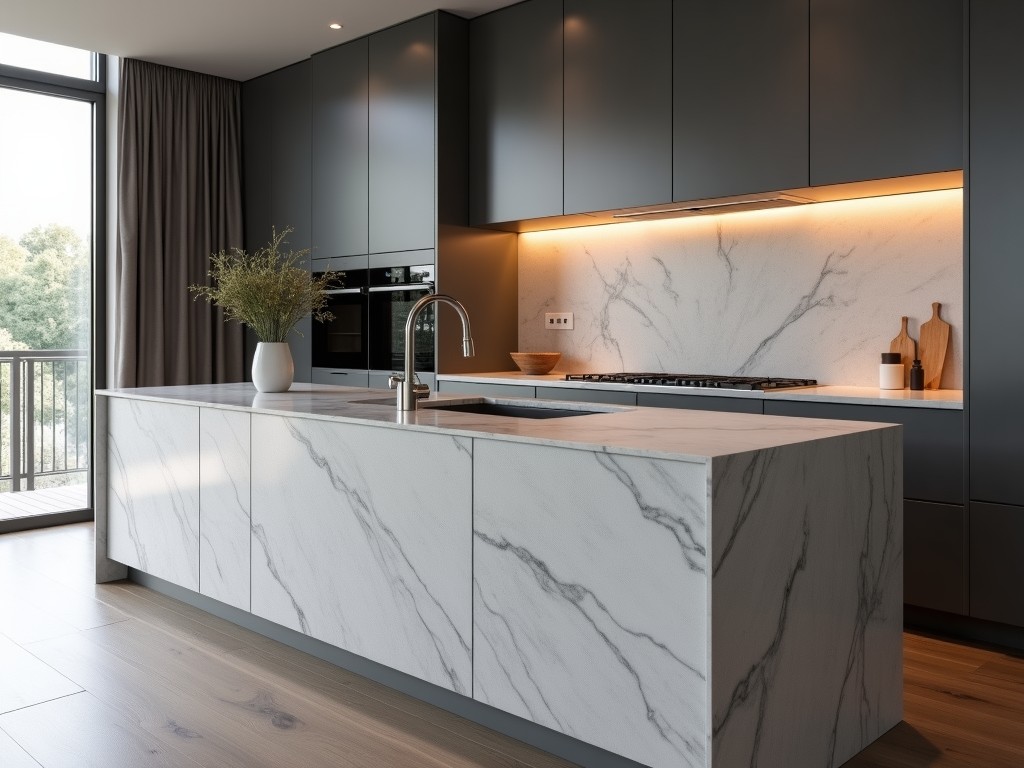
Grey Quartz Kitchen Countertops
Inquire Now
Grey Quartz Kitchen Countertops
Grey quartz countertops are engineered stone surfaces composed of natural quartz aggregates bound with polymer resins and pigments. The typical quartz content ranges from 90% to 94% by weight, providing a hard, non‑porous slab suitable for demanding kitchen environments.
Material Composition and Structure
The slab consists of crushed quartz particles (size 0.1–2 mm) evenly distributed in a resin matrix. Pigments impart the grey hue while achieving consistent color throughout the thickness. The resin system, usually a unsaturated polyester or acrylic blend, fills voids and creates a monolithic structure with low water absorption.
Key Technical Properties
Typical values for grey quartz slabs are shown below. Actual values may vary with specific formulation and thickness; consult the supplier for project‑specific data.
| Property | Typical Value | Unit | Test Standard |
|---|---|---|---|
| Density | 2.4 | g/cm³ | ASTM C97 |
| Compressive Strength | >150 | MPa | ASTM C170 |
| Flexural Strength | >50 | MPa | ASTM C880 |
| Water Absorption | <0.05 | % | ASTM C97 |
| Mohs Hardness | 6–7 | – | EN 101 |
| Thermal Expansion Coefficient | 25×10⁻⁶ | /°C | ASTM E228 |
Performance Characteristics
The non‑porous nature prevents liquid penetration, giving the surface a stain resistance rating of excellent for common kitchen agents such as wine, oil, and acidic foods. Heat resistance permits brief contact with temperatures up to 150 °C without surface degradation; prolonged exposure above this limit may cause resin discoloration. Impact resistance is high due to the interlocking quartz grains, reducing chip formation during normal use.
Typical Applications in Industrial Settings
Beyond residential kitchens, grey quartz is selected for food‑processing preparation areas, laboratory workstations, and pharmaceutical clean rooms where hygiene, chemical resistance, and ease of cleaning are critical. The uniform grey tone minimizes visual contamination detection, and the seamless surface eliminates crevices that could harbor microbes.
Customization Options
- Slab thickness: 12 mm, 20 mm, 30 mm (custom thicknesses available on request)
- Edge profiles: eased, bevel, bullnose, ogee, waterfall
- Surface finish: polished, honed, leathered, brushed
- Standard dimensions: up to 3200 mm × 1600 mm; larger formats achievable via seamless joining
- Color variants: light grey, medium grey, dark grey with subtle veining options
Quality Control and Testing
Each slab undergoes visual inspection for color consistency, surface defects, and dimensional accuracy. Random samples are tested for flexural strength and water absorption to verify compliance with internal tolerances. Thickness variation is kept within ±0.5 mm across the slab, and color deviation is monitored using spectrophotometer readings to maintain ΔE < 2 between batches.
Installation Considerations
Proper substrate preparation is essential; a level, rigid base with deflection limits of L/360 ensures long‑term performance. A compatible thin‑set adhesive or polyester‑based bonding agent is applied, followed by mechanical fastening where required. Seams are filled with color‑matched epoxy resin and polished to achieve a monolithic appearance. While sealing is not required for stain resistance, a penetrating silicone‑based sealant may be applied to the edges for added moisture protection in wet zones.
Frequently Asked Questions
| Question | Answer |
|---|---|
| Can dimensions be customized? | Yes. Slab size, thickness, and edge profiles can be tailored to project specifications; consult technical sales for feasibility. |
| What information is required before quotation? | Project dimensions, desired thickness, edge finish, surface finish, and any special cut‑outs (sink, cooktop) are needed to generate an accurate quote. |
| What materials are available? | Grey quartz slabs are standard; other hues and veining patterns are offered upon request, with minimum order quantities applying. |
| How is quality inspected? | Each slab receives visual checks, dimensional verification, and mechanical testing on a statistical basis; test certificates are available with shipment. |
| What packaging methods are available? | Slabs are packed in upright wooden crates with corner protectors, foam interleaving, and stretch‑film wrapping; custom packaging for export can be arranged. |
| What is the typical production lead time? | Lead time ranges from 2 to 4 weeks depending on slab size, finish, and current capacity; exact timing is confirmed at order. |
Contact for Technical Inquiry
For detailed specifications, sample requests, or project‑specific engineering support, please reach out to our technical team.
Request a Quote or Technical Data SheetRelated Products
Related News

custom closet spatial organization and material performance analysis

Bathroom Taps Technical Analysis
