
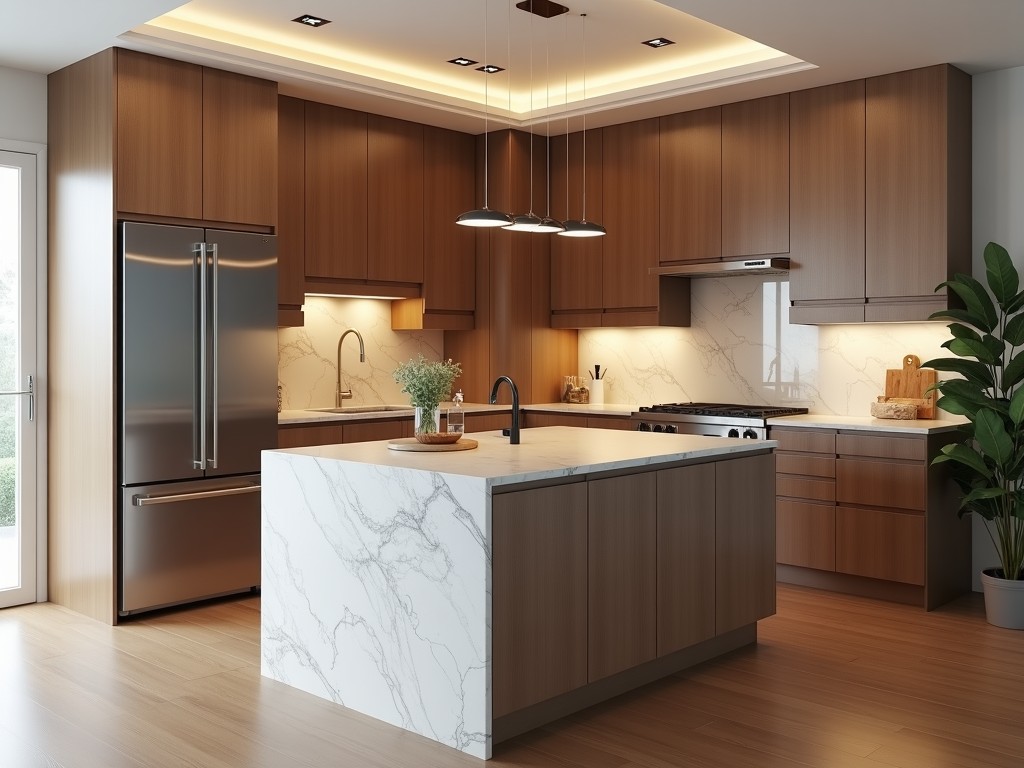
High End Custom Kitchen Cabinets
Inquire Now
High End Custom Kitchen Cabinets
Cabinet systems for premium kitchens are engineered to meet strict dimensional tolerances, load‑bearing requirements, and finish durability. Each unit is fabricated from selected substrate materials and hardware that comply with industry standards for residential and commercial installations.
Design and Engineering Considerations
The design process begins with a detailed load analysis that includes static weight of countertops, appliances, and dynamic forces from door operation. Finite element analysis is used to validate panel thickness and reinforcement locations, ensuring deflection remains under 0.5 mm under a 150 N point load. Edge banding and joint geometry are selected to minimize stress concentrations at high‑use areas such as hinges and pull‑outs.
Material Selection
Substrate options include hardwood veneer over cross‑banded plywood, medium density fiberboard (MDF) with melamine overlay, and particleboard with high‑pressure laminate. Each material is characterized by its modulus of elasticity, swelling coefficient, and surface hardness. For example, plywood typically exhibits a modulus of 8‑10 GPa and a thickness swelling of less than 2 % after 24 h water immersion, while MDF offers a modulus of 3‑4 GPa with swelling around 5‑7 %. Selection is driven by the client’s aesthetic preference, budget constraints, and environmental exposure.
Construction Methods
Panels are cut to ±0.1 mm tolerance using CNC routers, followed by edge‑banding with PUR adhesive that provides a peel strength exceeding 1.5 N/mm. Dovetail or mortise‑and‑tenon joinery is employed for carcass assembly, delivering shear strengths of 2.5‑3.0 kN per joint. Adjustable shelf pins are installed in 5 mm diameter holes with a tolerance of ±0.05 mm to ensure consistent load distribution. All hardware, including soft‑close hinges and full‑extension slides, is rated for 50,000 cycles.
Customization Options
Clients may specify panel thickness ranging from 16 mm to 25 mm, door overlay styles (full, half, inset), and interior accessories such as pull‑out waste bins, spice racks, and integrated lighting. Finish choices include UV‑cured acrylic lacquer, water‑based polyurethane, and veneer stains, each with measured gloss units (GU) and abrasion resistance (Taber cycles). Interior dimensions are adjustable in 1 mm increments to accommodate appliance envelopes and ergonomic reach zones.
Technical Specifications
| Parameter | Typical Value | Notes |
|---|---|---|
| Panel Thickness | 16‑25 mm | Customizable per project |
| Modulus of Elasticity (Substrate) | 3‑10 GPa | Depends on material selection |
| Thickness Swelling (24 h water) | <2 % (plywood) / 5‑7 % (MDF) | Measured per ASTM D1037 |
| Hinge Cycle Life | ≥50,000 cycles | ANSI/BHMA A156.9 |
| Slide Load Capacity | 40 kg per pair | Dynamic load, full extension |
| Finish Gloss (GU) | 20‑90 GU | Based on lacquer or polyurethane |
| Fire Rating (Surface) | Class B (ASTM E84) | Available upon request |
Applications in Commercial and Residential Projects
In residential settings, cabinets are designed to integrate with kitchen work triangles, providing clearances of at least 900 mm between opposing countertops and ensuring ergonomic reach heights between 750 mm and 1200 mm. For commercial installations such as hotel suites or high‑end retail kitchens, the system accommodates heavier loads from professional appliances, requiring reinforced carcasses with additional stretcher bars and increased screw density (up to 8 screws per linear meter). The modular design allows for seamless integration with building management systems for automated lighting and ventilation controls.
Quality Assurance and Testing
Each production batch undergoes incoming material verification, including moisture content measurement (target 6‑8 % for wood‑based panels) and surface roughness assessment (Ra < 2 µm). In‑process checks confirm dimensional accuracy after CNC cutting and joint assembly. Final inspection includes functional testing of doors and drawers (opening/closing force ≤ 5 N), load testing of shelves (uniformly distributed load of 150 kg/m²), and finish adhesion testing (cross‑hatch method per ASTM D3359). Non‑conforming items are segregated and reworked or scrapped according to defined quality thresholds.
Lead Time and Packaging
Standard lead time for fully custom cabinets ranges from 6 to 9 weeks, contingent on design complexity and material availability. Packaging utilizes corner protectors, edge foam, and double‑wall corrugated cartons rated for 30 kg stacking strength. Each unit is labeled with a unique identification number that links to the production record, facilitating traceability for warranty claims. Export shipments comply with ISPM‑15 wood packaging regulations and include desiccant packets to maintain relative humidity below 50 % during transit.
Frequently Asked Questions
Can dimensions be customized?
Yes. Width, height, and depth can be specified in 1 mm increments to match architectural openings and appliance envelopes. Custom cut‑outs for sinks, cooktops, and ventilation ducts are prepared during the CNC programming stage.
What information is required before quotation?
A detailed layout plan, including wall dimensions, ceiling height, and locations of utilities, is needed. Additionally, preferred material, finish, and hardware selections should be provided to enable accurate cost modeling.
What materials are available?
Options include hardwood veneer over plywood, MDF with melamine or laminate overlay, and particleboard with high‑pressure laminate. Each substrate offers distinct mechanical and moisture‑resistance properties suitable for different environments.
How is quality inspected?
Quality control involves incoming material verification, in‑process dimensional checks, and final functional testing of doors, drawers, and shelves. Adhesion and surface hardness of finishes are also assessed per industry standards.
What packaging methods are available?
Standard packaging includes corner protectors, edge foam, and double‑wall cartons. For overseas shipments, additional moisture barrier layers and palletization are provided upon request.
Get Started
To discuss your project requirements and receive a technical quotation, please contact our engineering team. Provide your layout sketches, material preferences, and any specific performance criteria.
Contact Us for a QuoteRelated Products
Related News

custom closet spatial organization and material performance analysis

Bathroom Taps Technical Analysis
