
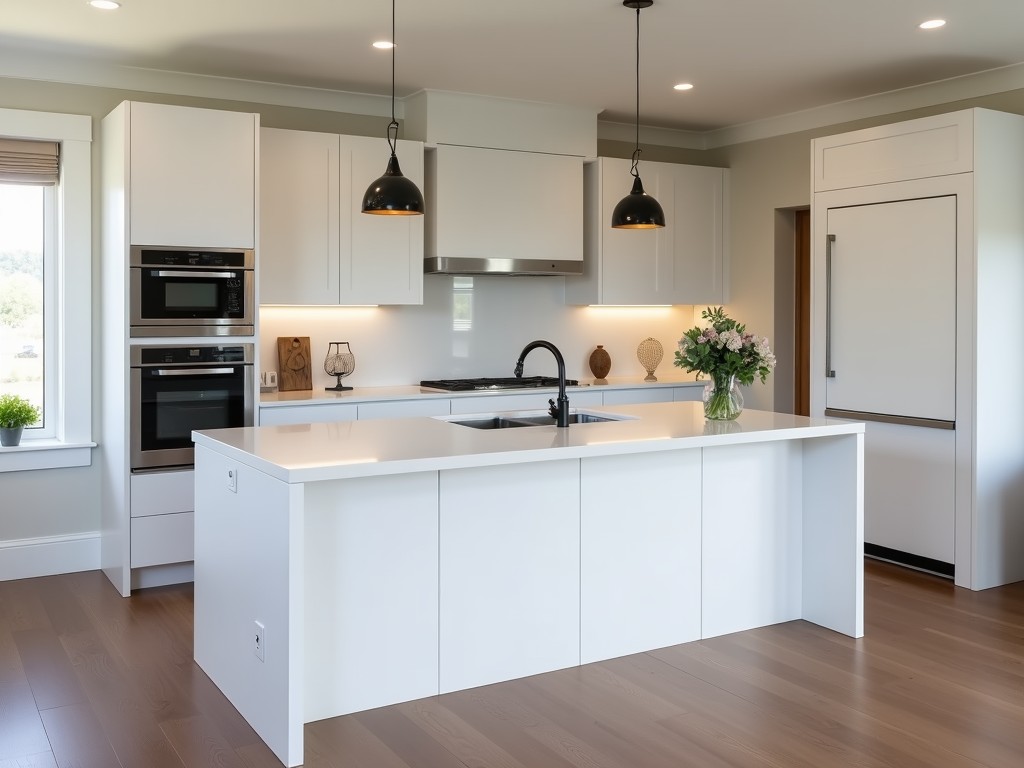
Most Popular White Quartz Countertops
Inquire Now
Most Popular White Quartz Countertops
White quartz countertops are engineered stone panels composed primarily of natural quartz aggregate bound with a polymer resin matrix. Typical formulations contain about 93 % quartz by weight and 7 % resin, yielding a bulk density of approximately 2.3 g/cm³ and a non‑porous surface.
Material Characteristics
The quartz phase gives the slab a Mohs hardness of 7, comparable to granite, while the resin binder contributes to flexural strength. Measured flexural strength typically ranges from 40 to 60 MPa, and compressive strength exceeds 150 MPa.
Water absorption is below 0.05 % by weight, which prevents staining and microbial growth. The coefficient of thermal expansion is around 20 × 10⁻⁶ /°C, allowing stable performance under normal indoor temperature variations.
Manufacturing Process
Production begins with blending quartz granules, pigment, and resin in a vacuum mixer to eliminate air bubbles. The mixture is then poured into molds and subjected to vibration and vacuum pressure to achieve dense compaction.
After forming, the slab is cured in a heated press at approximately 90 °C for 30 minutes, which polymerizes the resin. Standard slab thicknesses are 2 cm and 3 cm, with common dimensions of 300 cm × 140 cm; custom sizes are available upon request.
Performance Data
| Property | Typical Value | Test Method |
|---|---|---|
| Density | 2.3 g/cm³ | ASTM C97 |
| Flexural Strength | 45‑55 MPa | ASTM C880 |
| Compressive Strength | >150 MPa | ASTM C170 |
| Water Absorption | <0.05 % | ASTM C97 |
| Mohs Hardness | 7 | ISO 10545‑12 |
| Thermal Expansion Coefficient | 20 × 10⁻⁶ /°C | ASTM E228 |
Applications
In laboratory environments, the non‑porous surface resists absorption of solvents and acids, simplifying decontamination procedures. The material’s chemical resistance to common reagents such as ethanol, acetone, and dilute hydrochloric acid makes it suitable for workbenches and fume hood liners.
Food processing facilities benefit from the low bacterial retention and ease of cleaning; the surface can withstand repeated wash‑downs with hot water and alkaline detergents without degradation. Similarly, healthcare settings value the seamless appearance and the ability to meet strict hygiene standards.
Retail and hospitality installations often select white quartz for its bright, uniform appearance that enhances lighting and creates a perception of cleanliness, while the high abrasion resistance ensures longevity under heavy foot traffic.
Customization Options
- Edge profiles: eased, beveled, bullnose, ogee, waterfall.
- Thickness options: 2 cm (standard), 3 cm (heavy‑duty), custom laminations up to 5 cm.
- Surface finishes: polished (gloss >80 GU), honed (matte 10‑20 GU), leathered texture.
- Veining and pattern: subtle gray veining, bold marble‑look, solid white with consistent speckle.
- Custom sizes: panels can be cut to project‑specific dimensions with CNC waterjet or bridge saw.
Quality Control
Each slab undergoes dimensional inspection; thickness tolerance is maintained within ±0.1 mm and length/width tolerance within ±2 mm. Surface flatness is measured with a laser profilometer, requiring a deviation of less than 0.5 mm over a 1 m span.
Color consistency is verified using a spectrophotometer; the delta E between production lots is kept below 2.0 to ensure visual uniformity. Resin cure is assessed via barcol hardness, targeting a minimum of 45.
Final inspection includes a visual check for defects such as pits, cracks, or resin spots, with a permissible limit of zero visible defects per square meter.
Frequently Asked Questions
- Can dimensions be customized? Yes, slabs can be cut to specific lengths and widths; edge profiling and thickness adjustments are performed per project specifications.
- What information is required before quotation? Project dimensions, desired thickness, edge profile, finish type, and any special cut‑outs (sink, cooktop) are needed to generate an accurate quote.
- How is quality inspected? Each slab undergoes dimensional, color, and mechanical testing as outlined in the quality control section.
- What packaging methods are available? Slabs are packed in wooden crates with corner protectors, sealed with stretch film, and labeled with handling instructions.
To discuss your specific requirements or obtain a sample panel, please contact our technical sales team.
Request QuoteRelated Products
Related News

custom closet spatial organization and material performance analysis

Bathroom Taps Technical Analysis
