
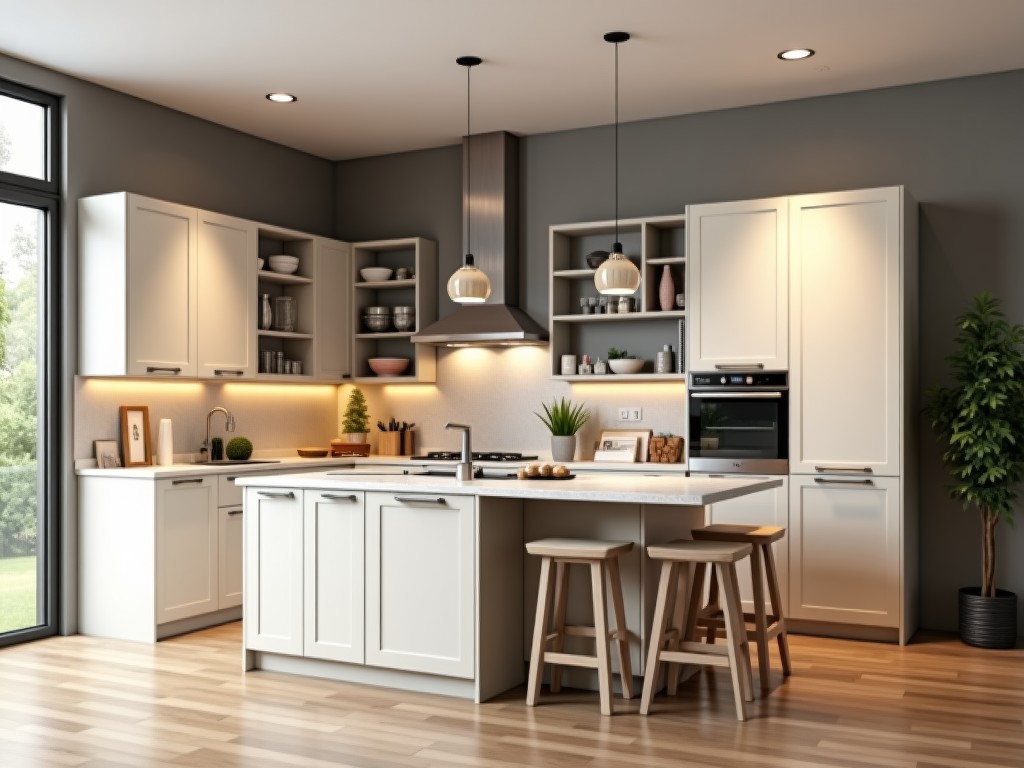
Oem Affordable Custom Kitchen Cabinets
Inquire Now
OEM Affordable Custom Kitchen Cabinets
Overview
Custom kitchen cabinets built for original equipment manufacturers combine modular panel systems with precise dimensional tolerances to support high‑volume assembly lines. Each unit is fabricated from engineered wood substrates selected for consistent thickness and moisture stability, allowing repeatable fit across multiple installations.
The design emphasizes ease of integration: pre‑drilled mounting holes, standardized cam‑lock connectors, and edge‑banding that matches the door finish reduce on‑site labor and minimize alignment errors.
Material Selection
Substrates are offered in three common grades: 18 mm particleboard with a density of 650 kg/m³, 18 mm MDF at 720 kg/m³, and 18 mm hardwood‑core plywood with 5‑ply construction and a density of 550 kg/m³. All panels receive a melamine‑impregnated decorative layer that meets EN 14322 surface‑wear class 2.
Moisture resistance is quantified by a 24‑hour swelling test; particleboard shows ≤5 % thickness increase, MDF ≤3 %, and plywood ≤2 % under standard 65 % RH conditions. These values help OEMs predict long‑term dimensional stability in humid kitchen environments.
Core Construction
Panels are cut on CNC routers with a positional tolerance of ±0.1 mm, ensuring that cabinet carcasses maintain square within 0.2 mm diagonal deviation. Edge banding is applied using hot‑melt EVA adhesive, delivering a bond strength of ≥1.5 MPa and a thickness of 0.5 mm ±0.05 mm.
Assembly relies on cam‑lock fasteners and pre‑installed confirmit bolts, providing a shear load capacity of 800 N per joint. Dowel reinforcement is optional for high‑stress corners, adding approximately 150 N of additional resistance.
Customization Options
- Overall cabinet width, height, and depth adjustable in 1 mm increments from 200 mm to 1200 mm width, 300 mm to 2200 mm height, and 300 mm to 650 mm depth.
- Door styles include slab, shaker, raised panel, and inset, each available with 18 mm or 22 mm thickness.
- Finish choices cover melamine, PVC foil, UV‑cured acrylic, and water‑based lacquer, with gloss levels ranging from 10 % to 90 %.
- Hardware integration options: concealed hinges, soft‑close dampers, pull‑out basket systems, and internal lighting channels.
- Interior accessories such as adjustable shelves, drawer boxes with full‑extension slides, and wine racks can be specified per module.
Manufacturing Process
Raw panels are first inspected for thickness and surface defects using laser‑based gauges with a resolution of 0.01 mm. CNC nesting software optimizes material yield, typically achieving 85‑90 % utilization for standard cabinet kits.
After cutting, edges are banded in a continuous line where temperature is controlled at 180 °C ±5 °C, ensuring consistent adhesive cure. Drilling and dowel insertion are performed on multi‑spindle heads with positional repeatability of ±0.05 mm.
Final assembly occurs on a pneumatic conveyor where torque‑controlled tools apply 1.2 Nm to cam‑locks, guaranteeing uniform joint tightness across batches.
Quality Control
Dimensional checks are performed on the first piece of each production run and then every 50 units, measuring diagonal variance, door gap, and shelf level with digital calipers accurate to 0.01 mm.
Surface quality is evaluated using a gloss meter and a 45° visual inspection lamp; acceptable finish deviation is ≤5 gloss units and no visible particulates >0.1 mm.
Load testing simulates a 150 kg uniform load on shelves for 24 hours; deflection must remain under 2 mm to pass. All test results are logged in a traceable database linked to the cabinet’s serial number.
Typical Applications
OEM kitchen cabinets are engineered for high‑repeatability projects such as multi‑family housing developments, where dozens of units share identical layouts and require fast turnover on the construction schedule.
In the hospitality sector, the cabinets support rapid room‑turnover renovations; the standardized cam‑lock system allows installation crews to complete a full suite in under four hours per unit.
For custom home builders, the modular approach enables mass‑customization: a base cabinet platform can be varied in width and finish to meet individual client preferences while retaining the same structural core.
Specifications
| Parameter | Typical Value | Customizable Range |
|---|---|---|
| Panel Thickness | 18 mm | 16 mm – 22 mm |
| Density (Particleboard) | 650 kg/m³ | 600 – 700 kg/m³ |
| Edge Banding Thickness | 0.5 mm | 0.3 mm – 0.8 mm |
| Cam‑lock Torque | 1.2 Nm | 0.8 – 1.5 Nm |
| Shelf Load Deflection | ≤2 mm @150 kg | Adjustable per design |
| Production Lead Time | 3‑4 weeks | 2‑6 weeks depending on volume |
Frequently Asked Questions
Can dimensions be customized to match existing layouts?
Yes. Width, height, and depth can be adjusted in 1 mm increments within the ranges listed in the specifications table, allowing the cabinets to align with existing wall studs or appliance cut‑outs.
What information is required before a quotation can be issued?
To generate an accurate quote we need the desired cabinet dimensions, substrate type, finish selection, hardware preferences, and the total quantity per SKU. Optional details such as edge‑band color and interior accessories further refine the estimate.
Which material options are available for high‑humidity environments?
For humidity‑prone areas we recommend 18 mm marine‑grade plywood or moisture‑resistant MDF, both of which exhibit ≤2 % thickness swelling after 24 hours at 65 % RH. Particleboard can be used with a sealed melamine surface but offers lower resistance.
How is quality inspected before shipment?
Each batch undergoes dimensional verification, surface gloss measurement, and a load‑deflection test on shelves. Results are recorded against the batch number and a copy of the inspection report is supplied with the shipping documents.
What packaging methods are available for export shipments?
Standard packaging includes flat‑packed cartons with corner protectors, polyethylene stretch wrap, and palletizing on heat‑treated wood pallets. For extra protection, foam edge guards and humidity‑absorbing packets can be added upon request.
What is the typical production lead time?
Lead time averages three to four weeks for orders under 500 units. Larger volumes or highly customized finishes may extend the schedule to five or six weeks, which is confirmed during the quoting stage.
How are samples arranged for evaluation?
Sample doors or full cabinet modules can be shipped via express courier. The customer covers freight charges, and the sample cost is credited toward the first production order if the purchase proceeds.
Get a Quote
To discuss your specific kitchen cabinet requirements, provide the project dimensions, material preferences, and expected quantity. Our engineering team will return a detailed quotation with lead times and tooling considerations.
Contact UsRelated Products
Related News

custom closet spatial organization and material performance analysis

Bathroom Taps Technical Analysis
