
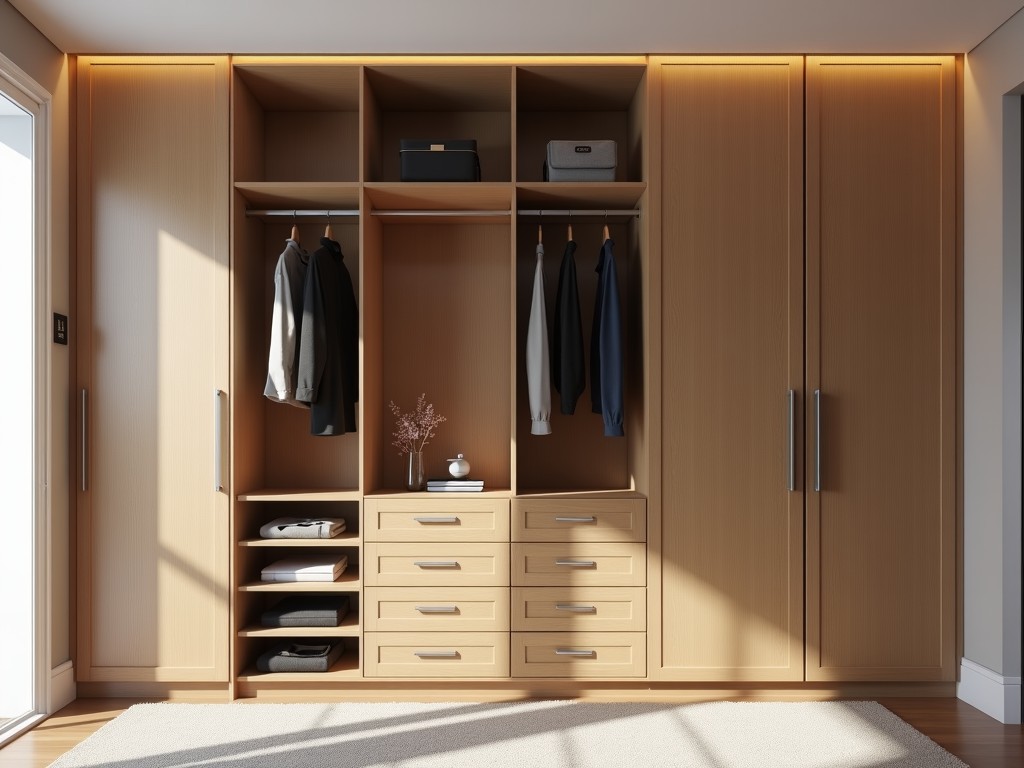
Oem Best Custom Closet Systems
Inquire Now
OEM Best Custom Closet Systems
Product Overview
Closet systems are engineered storage assemblies that integrate shelving, hanging rails, drawers, and accessories into a coordinated wall‑mounted solution. They are designed to maximize usable volume while accommodating specific garment types, accessory loads, and access patterns. The system’s modularity allows reconfiguration without structural modification to the building.
Material Selection and Performance
Primary panels are typically manufactured from melamine‑faced particleboard with a density of 650 kg/m³, providing a balance of stiffness and weight. Edge protection uses 0.5 mm PVC or ABS banding applied via hot‑melt adhesive, delivering a peel strength exceeding 1.2 N/mm. For higher moisture resistance, marine‑grade plywood or formaldehyde‑free MDF can be specified, each with documented swelling ratios under 0.2 % after 24 h immersion.
- Melamine‑faced particleboard – standard interior, 16 mm thickness.
- MDF with low‑VOC finish – 18 mm, suitable for painted surfaces.
- Birch plywood – 15 mm, high screw‑holding capacity.
- Aluminum extrusions – for frameless systems, 6063‑T5 alloy.
Customization Capabilities
Each system is defined by a parametric model that adjusts panel widths, shelf depths, and hanging rod positions in 1 mm increments. Customization extends to accessory integration such as pull‑out baskets, shoe racks, and integrated lighting channels, which are mounted using pre‑drilled clearance holes to maintain panel integrity. Finish options include solid colors, wood‑grain prints, and textured laminates, each with a certified abrasion resistance of at least 150 cycles (Taber).
- Width adjustment: 300 mm to 1200 mm per module.
- Depth options: 400 mm, 500 mm, 600 mm (shelf), 500 mm (hanging).
- Height increments: 50 mm for shelf repositioning.
- Door types: sliding, hinged, bifold, with soft‑close dampers rated to 30 000 cycles.
- Hardware: cam locks, confirmat screws, concealed hinges.
Typical Technical Specifications
| Parameter | Typical Value | Notes / Customization |
|---|---|---|
| Panel Thickness | 16 mm (standard) | 12 mm–25 mm available per material |
| Shelf Load Capacity | 80 kg uniformly distributed | Tested per EN 14749; higher with reinforcement |
| Adjustable Shelf Pitch | 25 mm increments | Custom pitch 10 mm–50 mm on request |
| Edge Band Thickness | 0.5 mm PVC/ABS | 1.0 mm available for impact zones |
| Finish Abrasion Resistance | 150 cycles (Taber) | Higher grades up to 500 cycles |
| Mounting Method | French cleat or concealed brackets | Load rating 200 kg per bracket pair |
Industrial Applications
In multifamily residential projects, the system provides unit‑specific storage that can be factory‑pre‑finished and installed in a single trade visit, reducing on‑site labor. Hospitality suites benefit from integrated lighting and valet rods that enhance guest experience while meeting fire‑rating specifications. Healthcare facilities specify antimicrobial‑treated panels and smooth, crease‑free surfaces to support infection‑control protocols.
- Multifamily residential – standardized unit closets, quick‑turn installation.
- Hospitality – guest‑room wardrobes, minibar integrations, branded finishes.
- Healthcare – patient‑room storage, antimicrobial surfaces, easy‑clean edges.
- Retail – back‑of‑house stockrooms, adjustable shelving for seasonal inventory.
- Office fit‑out – personal lockers, file‑and‑supply closets, modular reconfiguration.
Quality Assurance and Testing
Dimensional verification is performed on a coordinate measuring machine with a tolerance of ±0.2 mm on critical interfaces. Load testing applies cyclic forces up to 125 % of rated capacity for 10 000 cycles to confirm joint integrity. Finish adhesion is assessed via cross‑hatch tape test per ASTM D3359, requiring a minimum rating of 4B. Edge band pull strength is measured with a tensile tester, ensuring values above 1.0 N/mm before release.
- Dimensional inspection – CMM, ±0.2 mm tolerance.
Related Products
Related News

custom closet spatial organization and material performance analysis

Bathroom Taps Technical Analysis
