
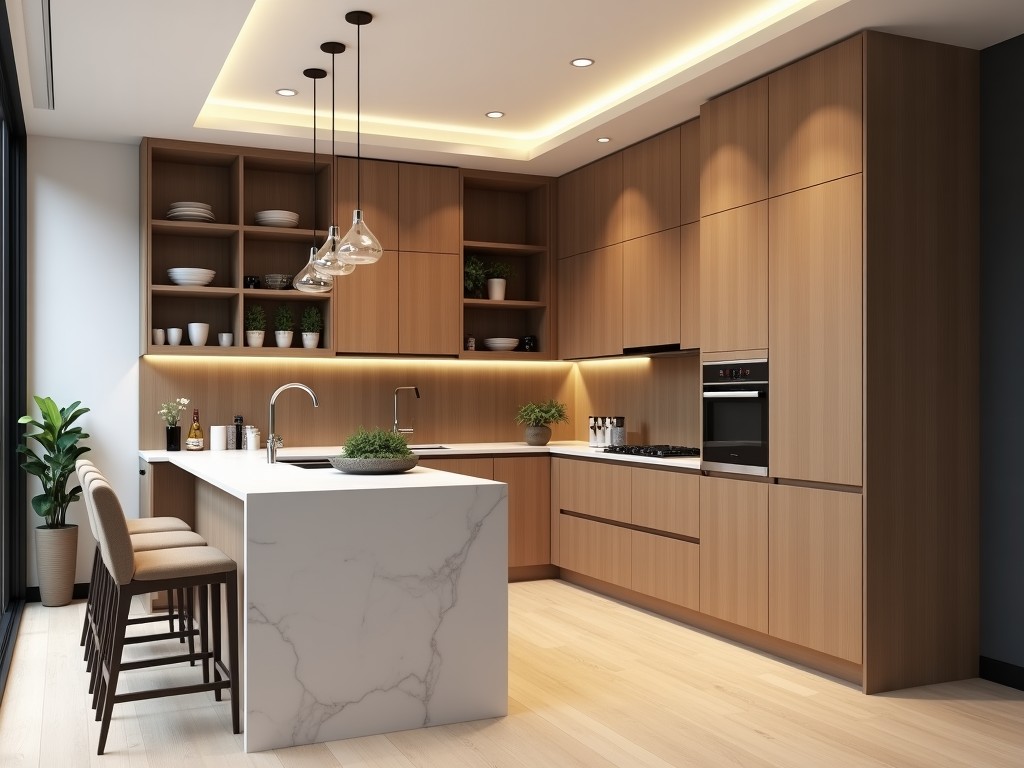
Oem Custom Kitchen Cabinet Designs
Inquire Now
OEM Custom Kitchen Cabinet Designs
OEM kitchen cabinets are developed through close collaboration between the cabinet manufacturer and the equipment or appliance supplier. The process begins with translating functional requirements into detailed CAD models that define panel dimensions, joint details, and hardware locations.
Design Process
Initial steps involve gathering project specifications such as appliance envelopes, ergonomic reach zones, and load expectations. Engineers then create parametric models that allow rapid adjustment of cabinet width, height, and depth while maintaining structural integrity.
- Requirement capture: appliance dimensions, door swing, drawer extension.
- 3D modeling: panel layout, stile‑rail joints, cam‑lock or dowel specifications.
- Structural analysis: deflection limits under typical loads (e.g., 150 N on shelves).
- Prototype review: fit check with actual hardware and finish samples.
- Production tooling: CNC nesting programs, edge‑banding parameters.
Material Selection
Substrate choice influences weight, stiffness, moisture response, and fastening performance. Typical options are defined by thickness, core density, and surface suitability for various finishes.
| Material | Typical Thickness (mm) | Core Density (kg/m³) | Moisture Resistance (%) | Typical Use |
|---|---|---|---|---|
| Particleboard | 16‑25 | 600‑800 | Low (<5) | Shelves, carcasses where cost is primary |
| MDF | 16‑25 | 700‑900 | Moderate (5‑10) | Doors, painted surfaces requiring smooth substrate |
| Plywood (birch or poplar) | 12‑25 | 500‑700 | High (>10) | High‑load cabinets, wet‑area bases |
Thicknesses are selected based on span length and expected load; edge banding is applied to protect cut edges from moisture ingress.
Hardware and Functional Components
Hardware determines operational smoothness, load capacity, and adjustability. Selection is guided by door weight, usage frequency, and aesthetic preferences.
- Concealed hinges: 35 mm cup, soft‑close torque 0.25‑0.45 Nm, opening angle 110°.
- Overlay hinges: adjustable depth ±2 mm, side‑load capacity up to 20 kg per hinge.
- Drawer slides: ball‑bearing or undermount, static load 30‑40 kg, soft‑close damping 0.2‑0.3 s.
- Shelf pins: steel or nylon, 5 mm diameter, load rating 15 kg per pin.
Finishing Options
Surface finishes protect the substrate, provide desired appearance, and influence cleaning resistance. Thickness and adhesion are key performance indicators.
- Melamine foil: 0.1‑0.2 mm thickness, abrasion resistance ≥150 cycles (Taber).
- PVC foil: 0.15‑0.3 mm, good impact resistance, suitable for high‑humidity zones.
- UV lacquer: 0.05‑0.1 mm cured film, hardness 2H‑3H, low VOC.
- Wood veneer: 0.6‑0.8 mm real wood layer, requires seal coat for moisture protection.
- Spray paint: polyurethane base, film thickness 0.08‑0.12 mm, gloss levels 10‑90 %.
Quality Control and Tolerances
Dimensional accuracy and surface integrity are verified at multiple stages to ensure assembly fit and long‑term performance.
- Panel size tolerance: ±0.5 mm length/width, ±0.3 mm thickness.
- Cabinet squareness: diagonal difference ≤2 mm.
- Edge‑band adhesion: peel strength ≥1.5 N/mm (ASTM D903).
- Surface defect limit: no visible specks >0.5 mm in Class A areas.
- Hardware alignment: hinge cup center deviation ≤0.2 mm from design.
Applications and Value
Custom cabinets enable OEMs to integrate appliances seamlessly, optimize kitchen ergonomics, and reduce total lifecycle cost through precise material usage and standardized mounting interfaces.
- Space utilization: filler panels and adjustable shelves accommodate non‑standard appliance envelopes.
- Ergonomic alignment: countertop height and reach zones tailored to user anthropometry.
- Service life: substrate selection and finish specification target 15‑year cycle under typical kitchen conditions.
- Installation efficiency: pre‑drilled mounting holes and cam‑lock systems reduce on‑site labor.
Request a Quote
To begin a quotation, provide CAD assembly files, material preferences, hardware specifications, and any required performance standards. Our engineering team will review tolerances, confirm finish compatibility, and return a detailed cost breakdown.
Contact UsRelated Products
Related News

custom closet spatial organization and material performance analysis

Bathroom Taps Technical Analysis
